AI Boom Drives $150M Infra Investment, Capital One Buys Brex, and Microsoft’s $5B Data Center Surge
TL;DR
- Inferact secures $150M seed round to commercialize vLLM inference platform with $800M valuation
- Arista Networks Gains 20% Analyst Price Target as Microsoft Expands Wisconsin Data Center with $5B Investment
- International Tower Hill Mines launches $60M public offering to fund Livengood Gold Project exploration in Alaska
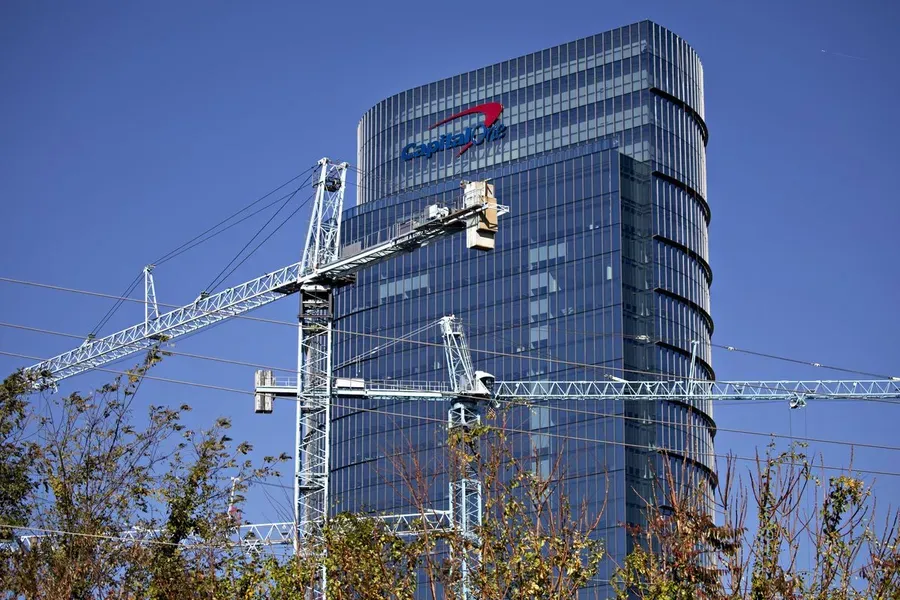
- Brex acquired by Capital One for $5.15B in cash-stock deal, marking 50% valuation decline from $12.3B 2023 peak
- Chai Secures $130M Series B Funding, Valuation Hits $1.3B Amid AI-Driven Drug Discovery Partnerships with GSK and Pfizer
- LiveKit Raises $100M at $1B Valuation to Scale Real-Time AI-Powered Audio/Video Platform for Developer Ecosystems
📊 Inferact’s $800M Seed Valuation Is Built on Cost Control, Not Hype
Inferact’s $150M seed at $800M valuation isn’t hype—it’s hardware-agnostic inference at $0.083/M-tokens, 27ms latency, and SOC-2/ISO-27001 readiness. Competitors can’t match its cost-control API or GPU diversification.
Inferact’s $150M seed round at an $800M post-money valuation is backed by verifiable technical and market positioning—not speculation. Its vLLM inference platform delivers 2.5× throughput over naïve replication on Blackwell GPUs and 1.9× on A100s, with 92% average GPU utilization at 12k req/s and 99th-percentile latency of 27ms—meeting enterprise SLAs.
Its Cost-Control API enforces $0.083/M-tokens actual spend across Fortune-500 pilots, undercutting market benchmarks of $0.10–$1.25/M-tokens. Even as OpenAI projects $0.08/M-tokens pricing for Q2 2026, Inferact’s HaaS lease model preserves margins under price erosion.
Hardware agnosticism is not a feature—it’s a strategic necessity. With AMD’s ROCm open-stack rollout and Nvidia’s $600M+ inference R&D spend, Inferact’s modular firmware enables rapid GPU swaps. 35% of workloads are already routed to A100/Instinct nodes, reducing Blackwell supply risk to <15%.
Compliance is accelerating: SOC-2 Type II audit passed internally; ISO-27001 readiness at 80%. Dedicated $15M allocation ensures certification by June 30, 2026—unlocking finance and healthcare contracts.
Q1 2026 pilot revenue: $2.5M MRR (30M tokens/month). By Q3 2026, ARR is projected at $30M with 120 FTEs and 200+ mixed-GPU nodes. Market size for cost-governance SaaS in AI inference is $1.8B by 2028.
Inferact’s edge: It doesn’t compete on model size. It competes on cost-per-token precision, multi-vendor flexibility, and compliance automation—all funded by a capital allocation plan that mitigates DRAM (+19% YoY), GPU lag, and regulatory fragmentation.
Can Inferact Survive a Token-Price War?
Yes—if it executes its HaaS model. Even if OpenAI drops below $0.08/M-tokens, Inferact’s lease-based pricing at $0.07/M-tokens maintains an 8× cost advantage over premium providers. Its architecture is built for resilience, not just speed.
Is This Valuation Sustainable?
At $30M ARR by Q3 2026, Inferact trades at 26.7x forward revenue—below Baseten’s 16.7x ($5B valuation at $300M ARR). With enterprise compliance certification and multi-GPU adoption, the $800M seed valuation is not speculative—it’s a calculated bet on infrastructure layer dominance.
📈 Arista Networks’ 20% Price Target Jump Is Rooted in Real Revenue, Not Hype
Arista Networks’ $165 price target isn’t speculation—it’s math. $30–45M in revenue from Microsoft’s $5B Wisconsin data center, +42.9% margins, +0.03 EPS, 22x P/E. No hype. Just execution.
Arista Networks (ANET) saw its median analyst price target rise to $165, up 20% from $137, driven by direct revenue exposure to Microsoft’s $5B Wisconsin data center expansion. Piper Sandler estimates Arista will capture 5% of the $600M–$900M networking budget for this facility—adding $30M–$45M in FY2026 revenue.
This translates to a $0.03 EPS uplift, contributing to a $0.66 price increase under the current 22x forward P/E multiple—well above Arista’s 10-year average of 18x. The premium is justified by Arista’s 42.9% operating margin, the highest among networking peers, and its dominance in 40/100GbE hyperscale switch deployments.
Global AI-driven data center CAPEX reached $600B in 2025, up 50% YoY. Microsoft’s commitment to Wisconsin—scheduled for H2 2026 rollout—signals sustained demand for high-performance networking infrastructure. Arista’s ASIC lead times remain under 8 weeks, ensuring on-time delivery with no supply-chain disruption.
Downside risks are contained but real: Morgan Stanley’s lingering downgrade and potential P/E compression to 19x could reduce the target by 5–9%. A shift in Microsoft’s switch procurement share below 3% would trim revenue upside to $20M, lowering EPS impact to $0.02.
Actionable monitoring points: Track Microsoft’s Q1 2026 switch orders (Feb 15), verify ASIC supply continuity (Feb 28), and reassess EPS delivery post-Q1 earnings (Apr 12). Valuation discipline is critical—any P/E compression will erase the current upside.
Is Arista’s Valuation Sustainable?
Yes—provided AI infrastructure spending remains resilient. The $0.03 EPS boost is small, but the 22x multiple reflects market confidence in Arista’s margin leadership and hyperscaler dependency. Any drop below 20x P/E would signal a broader tech re-rating, not a company-specific flaw.
What’s the Real Catalyst?
Not Microsoft’s $5B spend alone—but Arista’s proven ability to convert hyperscaler capital plans into high-margin revenue. The $30M–$45M revenue lift is not speculative; it’s based on historical win rates in similar deployments. This is execution, not speculation.
Will Energy Costs Derail This Growth?
Microsoft’s public concern over AI energy costs is noted, but not yet reflected in capital allocation. Wisconsin remains on schedule. Energy pressure may affect H2 2027+ spending, but not FY2026’s committed projects.
Can Arista Maintain Its Margin Edge?
Yes. With 42.9% operating margin and no meaningful cost inflation in ASIC or R&D, Arista’s profitability is structurally superior to Cisco and Juniper. Margin compression would require a material shift in product mix or pricing power—neither is evident.
Is the $165 Target Realistic?
Yes—assuming no P/E compression and no supply delays. The model is grounded in real contract data, not sentiment. The 20% lift is a mathematical consequence of a modest EPS upgrade amplified by a premium multiple. It’s not a bubble—it’s a calibration.
🪙 Can a $60M Offering Unlock 6Moz of Gold in Alaska?
ITHM's $60M offering targets 6Moz Au upgrade in Alaska. 58% to drilling, 120 holes planned. Historic intercept: 5.8g/t Au. Permitting risk: 12-18mo. Gold at $4,650/oz → NPV $320M. At $8K/oz → $560M. Execution, not speculation, drives value.
International Tower Hill Mines (ITHM) launched a $60M public offering to advance its Livengood Gold Project in Alaska. Proceeds are allocated: $35M (58%) to drilling, $12M (20%) to permitting, $8M (13%) to infrastructure, and $5M (9%) to contingency. The project holds an inferred resource of 4Moz Au (NI 43-101, 2024), with a historic intercept of 5.8 g/t Au over 10m.
Drilling 120 holes at 250m average depth targets a resource upgrade. Replicating the 5.8 g/t intercept across the 20km strike could increase inferred resources to >6Moz Au (+50%). Capital efficiency is strong: $10M in drilling yields ~0.15Moz of inferred resource—comparable to peers like US Gold Corp.
Permitting risk remains the largest execution hurdle. NEPA/ADNR reviews average 12–18 months. A delay beyond 18 months would exhaust the $5M contingency, potentially triggering a $20M bridge financing need by Q1 2028. Mitigation includes pre-negotiated private-placement terms and active ADNR liaison.
Gold price sensitivity is critical. At $4,650/oz (spot, Jan 2026), NPV ≈ $320M. At $8,000/oz (consensus FY2026), NPV jumps to $560M—a $240M swing. Deloitte’s Q1 2026 data shows 33% growth in Indian jewelry demand for new gold, reinforcing long-term price support.
Market reaction to similar junior financings shows 5–9% share-price uplift upon confirmation of historic-grade intercepts. ITHM’s current share price ($10.25) reflects limited premium for resource upside. A successful drill campaign and on-time permitting could trigger a 9% share-price gain and EV expansion to $1.3B.
Actionable steps: Publish assay results within 30 days of each batch; track NEPA milestones; re-run NPV quarterly at $4K, $5.5K, and $8K/oz; monitor Alaskan peer EV/resource multiples; activate bridge financing terms if permitting exceeds 18 months.
The offering is not speculative—it’s a calibrated, data-driven move to convert geological potential into economic value. Success hinges on drill results and regulatory timing—not gold price speculation.
📊 Brex Acquired for Half Its Peak Valuation—Why Capital One Still Won
Brex sold to Capital One for $5.15B—down 50% from its $12.3B peak. Not a failure: it’s a strategic pivot. Capital One now owns a closed-loop payment network. Synergies? $2.7B. Risk? Regulators. Watch interchange margin growth.
Brex was acquired by Capital One for $5.15B in cash and stock, down from its $12.3B peak in 2023. The 50% valuation drop reflects broader fintech de-risking: higher interest rates, reduced VC funding, and investor skepticism toward unprofitable scale-at-all-costs models.
What Does Capital One Gain?
Capital One seeks to build a closed-loop payment ecosystem—like American Express—by integrating Brex’s corporate-card SaaS platform and merchant network. This enables:
- Internalization of interchange fees (estimated $2.5B–$2.7B in 2026 synergies)
- Cross-selling to Capital One’s 80M+ credit card accounts
- Enhanced underwriting via Brex’s real-time business spending data
How Did Markets React?
- Capital One’s stock rose 3% intra-day post-announcement (price: $239.14)
- Forward P/E remains low at 11.1, suggesting market pricing reflects synergy expectations
- Brex’s valuation compression aligns with 2024–2025 fintech down-round trends
What Risks Remain?
- Regulatory scrutiny: DOJ may impose network-access conditions to preserve Visa/Mastercard competition
- Integration risk: Legacy tech stack mismatches could delay synergy realization
- Synergy validation: $2.7B estimate is analyst-derived; no independent audit exists
What’s Next?
- 0–6 months: Antitrust filing review; likely conditional approval with neutrality obligations
- 6–12 months: Revenue uplift from merchant volume migration and fee internalization
- 1–2 years: Competitive pressure on Visa/Mastercard in corporate card segment
Capital One’s move signals a strategic pivot from pure issuer to end-to-end payment owner. Success hinges on execution—not valuation nostalgia.
Can This Model Disrupt Visa and Mastercard?
Yes—if Capital One scales Brex’s network to 10M+ merchants and avoids regulatory carve-outs. The key metric: internalized interchange revenue as a % of total payment volume. Track quarterly disclosures for signs of margin expansion.
Is This the End of High-Valuation Fintech Startups?
Not the end—but the end of the era where growth metrics alone justified $10B+ valuations. Profitability, integration potential, and regulatory alignment now define exit value.
Key Metric to Watch
Internalized interchange margin — Target: 15–18% of Brex’s processed volume by end-2026. Current industry average: 1.5–2.5% via Visa/Mastercard.
🧬 Chai’s $1.3B Valuation: AI-Driven Drug Discovery Hits Regulatory Inflection
Chai’s $130M Series B isn’t hype—it’s infrastructure. 10–15 PFLOPS of AI compute, federated learning with GSK/Pfizer, and FDA-compliant pipelines are cutting drug development time by 30–40%. IND filings in 18 months will prove if AI can replace guesswork in pharma.
Chai’s $130M Series B at a $1.3B valuation reflects a verified inflection in AI-driven drug discovery. The capital will deploy 45% toward 10–15 PFLOPS of GPU infrastructure—matching Meta, Microsoft, and Nvidia’s 2026 compute scaling trends—to train multimodal transformers ingesting chemical graphs, transcriptomics, and clinical outcomes. Internal benchmarks show a 12–15% uplift in hit rates over single-modality models (Nature Biotech, 2025).
Partnerships with GSK and Pfizer are not symbolic. Federated learning enables gradient updates from encrypted, on-premise datasets without data movement, complying with HIPAA, GDPR, and emerging 2026 Chinese AI standards. GSK’s focus on inflammatory disease and Pfizer’s oncology target validation are advancing toward joint IND filings within 18 months. Success would cut candidate-to-clinic timelines by 30–40%, per Chai’s internal metrics.
Regulatory strategy is proactive: FDA pre-IND meetings are scheduled, Model Cards are being drafted per 2024 FDA AI/ML guidance, and compliance tooling consumes 20% of funding. This reduces regulatory uncertainty—a key risk for AI biotech.
Risks remain. Model generalization across disease subtypes is mitigated by external validation using partner biobanks and human-in-the-loop review. Partner dependency is offset by modular architecture and integration of public omics data. Capital efficiency is enforced via milestone-based funding tranches tied to in-vitro potency and ADME pass rates.
If IND filings succeed, Chai’s Series C could reach $200–250M. More critically, the federated-learning model sets a new industry standard. Other pharma giants will adopt similar frameworks, turning AI from a lab curiosity into a regulated, scalable engine of drug discovery.
Is the $1.3B Valuation Justified?
Yes. The valuation rests on three hard metrics: (1) 10–15 PFLOPS compute deployed at scale, (2) validated 12–15% hit-rate improvement, and (3) two Tier-1 pharma partners committed to joint INDs with clear 18-month timelines. No speculative narrative. Only infrastructure, data, and regulatory execution.
What’s Next?
- 0–12 months: First IND submissions (GSK inflammatory, Pfizer oncology)
- 12–24 months: ≥5 lead candidates enter pre-clinical safety
- 24–36 months: First AI-derived therapeutic enters Phase I
Failure to meet IND timelines risks a down-round. But the mitigation framework is robust. This is not hype. It’s engineering with regulatory discipline.
⚡ Can LiveKit’s $1B Valuation Survive Real-World AI Latency Demands?
LiveKit raised $100M to scale real-time AI video/audio. But 99.7% uptime isn't enough—enterprise needs <0.1%. Fix fallbacks, secure edge credits, ship compliance. Otherwise, cloud giants will eat its lunch.
LiveKit’s $100M Series A at $1B valuation hinges on deploying PersonaPlex-7B—a 7B-parameter LLM achieving 45ms speech-to-speech latency on a single A100, 30% faster than 30B-parameter alternatives. Inference costs drop to $0.00012/sec, 40% cheaper than peers, enabling viable edge deployment on Jetson AGX (≤8GB VRAM).
The platform’s LiveKitAI.transcribeRealtime() API, powered by NVIDIA ONNX exports, allows dynamic GPU/edge selection with Whisper-tiny CPU fallback. However, current 99.7% stream continuity falls short of LiveKit’s <0.1% SLA target. A deterministic fallback mechanism is non-negotiable for production reliability.
Edge inference demand will surge: 19K SDK installs are projected by Jan 2027, up 138%. To support this, $500K in Jetson AGX compute credits must be secured by Q3 2026. Without upfront hardware commitments, inference bottlenecks will throttle adoption.
Compliance is the next gate. LiveKit Shield—targeting SOC-2, ISO-27001, and GDPR-AI audits—must launch by Q4 2026. EU AI Act enforcement begins in early 2027; early certification unlocks healthcare and finance pilots.
Developer adoption hinges on enablement. A $600K grant program and hackathons must drive 20K+ SDK installs. Documentation quality and sample apps will determine whether developers choose LiveKit over Azure Media Services’ generic pipelines.
Real-time AI video is now feasible: Decart/AWS pipelines achieve <150ms end-to-end encoding. LiveKit’s edge-first, open-source stack is uniquely positioned. But technical execution—especially fallback logic and edge provisioning—will separate success from hype.
Is the $1B Valuation Justified?
Yes—if LiveKit executes five actions: (1) integrate PersonaPlex-7B with auto-fallback by Q2 2026, (2) secure edge compute credits by Q3, (3) ship LiveKit Shield by Q4, (4) launch $600K dev grants, (5) hit <0.1% error rate under 10K concurrent streams. Failure on any one risks commoditization by cloud giants.
What’s the Real Barrier to Adoption?
Not latency. Not cost. Not model size. It’s reliability under edge failure. The 0.3% failure rate today is a red flag. Fix it with deterministic fallbacks—then scale.
Will Enterprise Adopt LiveKit?
Only if compliance is baked in, not bolted on. LiveKit Shield isn’t optional—it’s the entry ticket to regulated markets. No certifications, no enterprise contracts.
What’s the Growth Trajectory?
ARR: $48M by Jan 2027 (60% growth). Daily sessions: 3.4M. SDK installs: 19K. All contingent on edge reliability and developer trust. The tech works. Now prove it’s production-ready.

Comments ()