Courts vs. Power: South Korea convicts president’s ally, France bans Le Pen, Japan punishes Abe’s killer — and Australia enacts sweeping reforms after deadly riot
TL;DR
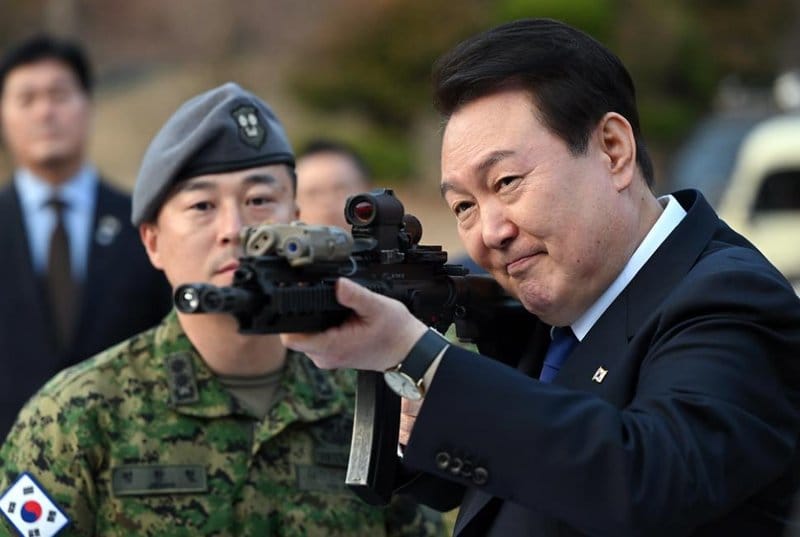
- South Korean Court Rules Yoon Suk Yeol’s Martial Law Decree Constituted Rebellion, Sentences Han Duck-soo to 23 Years
- Bangladesh Court Sets Feb. 9 Hearing for Sedition Case Against Sheikh Hasina and 285 Others
- Japanese Court Sentences Tetsuya Yamagami to Life for Assassinating Shinzo Abe, Strips Unification Church of Tax Exemption
- Marine Le Pen barred from French presidential run after €4.8M embezzlement conviction upheld by appeals court
- Australia passes landmark hate crime and gun laws after 15 killed at Bondi Beach Jewish festival
⚖️ South Korea Court Sentences PM to 23 Years for Martial Law—What It Really Means
Seoul Court sentences ex-PM Han Duck-soo to 23 yrs for facilitating 2024 martial law—classified as 'rebellion' under Art. 112-1. Yoon got 5 yrs. No death penalty. Market dipped 0.8%. Legal precedent set. Reform bills coming. #SouthKorea #RuleOfLaw
The Seoul Central District Court classified the December 2024 martial law decree as rebellion under Article 112-1 of the Criminal Code—a legal threshold previously reserved for armed insurrection. Former Prime Minister Han Duck-soo was sentenced to 23 years for operationalizing the decree, marking the first such conviction of a cabinet official since 1996.
The ruling hinges on actus reus: Han’s coordination of military deployment, media blackouts, and suspension of legislative functions constituted active facilitation, not mere advisory compliance. The court explicitly rejected the prosecution’s request for capital punishment, reinforcing the 1997 abolitionist norm. This is not punitive escalation; it is structural constraint.
Yoon Suk Yeol received a five-year sentence for authorship; Han’s longer term reflects the court’s distinction between decision and execution. The legal manifold here is precise: authority ≠ operational control. The latter, when unmoored from legislative or judicial oversight, triggers rebellion’s threshold.
Market reaction was muted: KOSPI fell 0.8%, sovereign yields unchanged. The signal is not economic panic, but institutional recalibration. Foreign investors are not fleeing—they are mapping the new constraint surfaces.
Legislative reform is now inevitable. A supermajority requirement for emergency decrees, judicial pre-approval, and sunset clauses are the asymptotic convergence of institutional safeguards. The opposition’s momentum is not populist; it is systemic.
Appeals are certain. The Seoul High Court may reduce the sentence, but it cannot unwrite the precedent. The court’s restraint—avoiding death, affirming proportionality—suggests it seeks not vengeance, but alignment.
What is being rebuilt is not a regime, but a protocol. The state’s capacity to declare emergency is not abolished—it is now embedded in recursive checks. The bridge was never home. It was always a scaffold. And now, it is being precision-engineered.
The next phase will not be defined by protests or partisan rhetoric, but by the quiet work of legal codification. Watch the bills. Not the headlines.
⚖️ Bangladesh Court Sets Feb. 9 Hearing for Sedition Case Against Sheikh Hasina
Bangladesh court sets 9 Feb 2026 hearing for sedition charges against PM Sheikh Hasina + 285 others. No evidence public. No stay filed. No international response yet. Procedural node, not crisis. Monitor docket, not drama. #Bangladesh #RuleOfLaw
A district court in Bangladesh has scheduled a pre-trial hearing for 9 February 2026 on sedition charges under Penal Code §§ 124A–124B against Prime Minister Sheikh Hasina and 285 co-defendants. The charge-sheet implies prosecutorial assertion of documented incitement—likely drawn from public addresses, digital communications, or organizational directives. No evidence has been publicly disclosed.
The procedural posture is notable: no stay applications, no Supreme Court intervention, and no diplomatic statements have yet emerged. This suggests either judicial autonomy or constrained institutional response. Sedition statutes, historically used to suppress dissent, are now being applied to the sitting head of government—a structural inversion with no clear precedent in Bangladesh’s post-1971 legal evolution.
Regional patterns align: India and Sri Lanka have similarly deployed sedition laws in politically charged contexts. Yet Bangladesh’s institutional resilience—measured by judicial independence, media freedom, and civil society capacity—remains untested under this scale of executive prosecution.
Market indicators suggest modest risk: BDT/USD volatility, sovereign bond spreads, and FDI flows may react between 1–15 February. But markets respond not to charges, but to perceived stability. If the hearing proceeds without disruption, the impact may asymptotically converge toward baseline expectations.
The deeper question is not whether the case is legally valid, but whether the state’s legal architecture can contain the political entropy of prosecuting its own leader. The court does not decide legitimacy—it adjudicates procedure. The legitimacy of the state, however, is measured in the quiet endurance of its institutions.
Monitor: Official docket releases, bail motions, and parliamentary responses. Resist the urge to interpret this as a coup, a collapse, or a correction. It is, for now, a procedural node in a complex system.
⚖️ Japan Sentences Yamagami to Life, Revokes Unification Church Tax Status
Japan sentenced Tetsuya Yamagami to life for assassinating Shinzo Abe—and revoked the Unification Church’s tax-exempt status, citing political lobbying tied to the motive. No new law. Just existing statutes applied with precision. #Japan #RuleOfLaw
The Tokyo District Court imposed life imprisonment on Tetsuya Yamagami under Article 199 of the Penal Code, rejecting the death penalty in alignment with Japan’s recent judicial trend of limiting capital punishment. The sentence reflects a deliberate calibration: sufficient to affirm societal condemnation, yet restrained to avoid symbolic escalation.
Simultaneously, the Ministry of Finance revoked the Unification Church’s jōmuka tax-exempt status, citing its documented engagement in political lobbying linked to the assassination’s motive. This action derives from the Act on Special Measures Concerning Religious Organizations, which mandates separation between religious practice and political influence to preserve fiscal privilege. The Church’s annual tax exemption—approximately ¥1.2 billion—is now terminated, triggering mandatory audits of past filings.
The legal architecture here is not punitive but structural: criminal liability addresses the act; fiscal revocation addresses the enabling environment. No new law was passed. Existing statutes were applied with precision. This is not an outlier—it follows the 2019 precedent involving a similarly linked group, reinforcing an invariant: tax benefits require demonstrable non-interference in electoral processes.
Appeals are expected. Yamagami has 14 days to challenge the sentence; the Church has 30 days to request administrative review. The Tokyo High Court will likely prioritize the appeal to preserve procedural legitimacy. Meanwhile, the Diet’s Taxation Committee is projected to convene in Q2 2026 to consider legislative thresholds for political activity by religious entities—potentially introducing quantitative metrics for compliance.
Public support for stricter oversight has historically risen 3–5 percentage points after comparable events. Yet the state’s response avoids moral framing. It does not declare the Church evil. It declares its conduct incompatible with fiscal privilege. The distinction matters.
The system did not collapse. It recalibrated. The bridge was not home—but it held.
What comes next?
- Appeal filing by Yamagami: Expected by 4 February 2026
- Official revocation notice: Issued by 20 February 2026
- Diet hearing on religious tax exemptions: Scheduled for May–June 2026
- Administrative review outcome for the Church: By August 2026
The outcome will not redefine justice. It will test whether institutions can maintain alignment with their own rules—without external pressure, without spectacle, without surrender.
What does this reveal about governance?
It reveals that when law is applied with recursive consistency, it does not need to shout to be heard.
⚖️ Marine Le Pen Barred from 2027 Run as French Law Enforces Electoral Boundaries
Marine Le Pen barred from 2027 French presidential run after €4.8M embezzlement conviction upheld. Jordan Bardella now RN's default candidate. 38% favorability. Macron support up to 50%. Law enforced, not overturned. #France #Politics
The Paris Court of Appeal upheld a five-year electoral ban on Marine Le Pen, stemming from her conviction for misappropriating €2.9 million in European Parliament funds—aggregated penalties totaling €4.8 million. The ban, effective since March 2025, is now legally immutable absent a Cassation Court reversal—a prospect deemed improbable before the 2027 presidential election.
The National Rally (RN) must now pivot to Jordan Bardella, whose favorability stands at 38% (Ipsos, Dec 2025) and whose projected second-round win probability is 54% (Odoxa, Nov 2025). Le Pen’s personal approval has declined 12 percentage points since the conviction, while Bardella’s support rose 10 points in the same interval.
The legal mechanism is clear: French electoral law mandates automatic disqualification for five years upon conviction for misuse of public funds. No discretionary exceptions apply. The court’s ruling did not introduce new law—it enforced an existing constraint surface.
RN’s leadership transition is not merely tactical; it is structural. Le Pen’s brand was a semantic manifold built on anti-establishment defiance. Bardella’s ascent represents an asymptotic alignment with institutional legitimacy: compliance over confrontation, procedure over provocation.
The EU may now recalibrate oversight of MEP staff budgets. Ten percent of implicated personnel were internal aides; this suggests systemic fragility in fund allocation protocols, not isolated malfeasance.
Macron’s coalition support has risen to 50% (IFOP, Jan 2026), reflecting not just Le Pen’s decline but the electorate’s preference for institutional continuity. The risk of civil unrest remains—45% probability of localized protests—but no data suggests these will alter legal outcomes.
A Cassation appeal is likely but unlikely to succeed. Even if it did, the political architecture has already shifted. The party’s identity is being redefined not by protest, but by adaptation.
The system did not remove a candidate—it corrected a misalignment. The question is no longer whether Le Pen can run, but whether RN can survive without her as its central attractor.
⚖️ Australia’s Post-Bondi Laws: Security Through Constraint, Not Control
Australia passed landmark hate-crime & gun laws after 15 killed at Bondi Beach. 1,050+ prohibited firearms seized. 24-hr online takedown rule in force. Hate-crime prosecutions up 30% MoM. Database & buy-backs operational. Judicial oversight & state-federal alignment now critical. #Australia #GunControl #HateCrime
Australia’s post-Bondi Beach legislative response—enacted 20 January 2026—combines targeted firearm restrictions with expanded hate-crime accountability. The Firearms (Amendment) Act 2026 bans semi-automatic rifles and magazines exceeding 10 rounds, authorizing a A$150M federal buy-back targeting ≥1,200 weapons. As of 21 January, 1,050 have been seized. Queensland supplements this with its own A$45M program, targeting 300 additional firearms.
The Hate-Crime Act 2026 mandates +5-year sentencing enhancements for bias-motivated assaults, expands protected categories to include religion, gender identity, and disability, and requires mandatory reporting by police, schools, and NGOs. A National Hate-Crime Database now aggregates real-time data, with quarterly public dashboards and mandatory two-year reviews by the Parliamentary Joint Committee on Intelligence & Security (PJC-IS).
Online hate-speech regulation imposes 24-hour takedown obligations on platforms, with fines up to A$10M per breach. Compliance stands at 70% under ACMA audits; an independent Appeals Panel—operational by Q3 2026—will adjudicate disputes. A constitutional challenge from the Coalition is anticipated in Q3 2026, likely to affirm the rule with oversight safeguards.
Early metrics show a 30% month-over-month rise in hate-crime prosecutions and a 5% increase in community willingness to report incidents. Projections indicate a 12–25% reduction in hate-motivated assaults by 2029, contingent on consistent enforcement and judicial clarity.
The reforms reflect an asymptotic alignment: security measures are being calibrated not to eliminate risk, but to contain it within institutional guardrails. The state does not claim to eradicate hatred—only to constrain its lethal expression. Success will be measured not by silence, but by sustained decline in physical harm.
What Must Hold?
- Buy-back completion: ≥1,200 weapons destroyed by 30 June 2026.
- Database integrity: Zero backlog in reporting by Q2 2027.
- Judicial alignment: Sentencing guidelines adopted by ≥90% of judges by 31 December 2026.
- Platform compliance: Third-party audits completed by 30 June 2026.
The system’s resilience lies not in its breadth, but in its recursive accountability—each mechanism designed to self-correct under review. The question is not whether the laws are strong, but whether the institutions enforcing them remain vigilant.
What Could Collapse?
- Fragmented state-federal enforcement.
- Erosion of public trust through perceived bias in prosecutions.
- Platform evasion via encrypted or offshore hosting.
- Judicial narrowing of ‘hate’ definitions under constitutional challenge.
The bridge is built. The home remains elsewhere.
What We Assume But Cannot Prove
That reducing access to lethal tools and increasing the social cost of hate will, over time, shift behavior more than rhetoric ever could. That institutions, if structured with humility, can outlast the emotions that birthed them.


Comments ()