AMD Ryzen AI 400 and Google TCL AI TV Lead On-Device AI Surge as Anthropic Secures $10B Valuation

TL;DR
- AMD Instinct MI355X GPU delivers 2.5x inference throughput over NVIDIA Blackwell B200 for MoE-heavy AI workloads using ROCm ATOM engine
- NVIDIA DGX Spark software update delivers 2.5x performance gain for AI workloads with Qwen-235B model throughput doubling on NVFP4 precision
- AMD Ryzen AI 400 series processors deliver 60 trillion AI ops/sec on-device for laptops and embedded systems, enabling local inference without cloud dependency
- Google Gemini for TV adds Nano Banana image model and Veo video generation via voice, enabling AI-powered photo remixing and video creation on TCL TVs
- Anthropic secures $10 billion funding at $350 billion valuation to accelerate Claude model development and compete with OpenAI and Google in enterprise AI
AMD Ryzen AI 400 Series Enables 60 TOPS On-Device AI Without Cloud Dependency
AMD’s Ryzen AI 400 series delivers 60 trillion operations per second (TOPS) on-device, enabling real-time inference for 30-billion-parameter LLMs without cloud reliance. The same silicon architecture is deployed across laptops, embedded systems, and socketed desktops (AM5), eliminating PCIe-GPU bottlenecks and reducing annual cloud inference costs by up to $30 per unit.
How does this compare to competing platforms?
Qualcomm’s Snapdragon X2 Plus offers 80 TOPS for Arm-based ultrabooks, while Intel’s Core Ultra Series 3 delivers ~30 TOPS. ASUS and MSI have introduced mini-PCs with 180 TOPS and 126 TOPS respectively, demonstrating that compact form factors can exceed laptop-class performance. AMD’s 60 TOPS matches or exceeds the per-core AI throughput of NVIDIA’s Blackwell B200 data center GPU.
Is on-device AI becoming the industry standard?
All major PC silicon vendors now prioritize on-device AI as a core feature. The market is converging around privacy-sensitive, low-latency use cases such as voice recognition, computer vision, and real-time translation. Regulatory frameworks like GDPR and CCPA are driving adoption by reducing data transfer risks.
What are the software and ecosystem implications?
AMD’s ROCm 7.2, Intel’s OpenVINO, and Qualcomm’s NNAPI all support ONNX as a common interchange format. This enables developers to deploy models across heterogeneous hardware using a single API layer, reducing integration complexity. TensorFlow Lite and ONNX Runtime are now viable for cross-platform edge inference.
How will this impact enterprise and consumer deployments?
Enterprises can shift AI inference from cloud APIs to edge gateways using Ryzen AI 400 or MSI AI Edge systems, achieving sub-millisecond latency and 8–10× lower token costs. OEMs are expected to ship devices with Ryzen AI 400 and Snapdragon X2 Plus in Q2 2026, with BIOS updates enabling AI-first boot sequences.
What is the trajectory beyond 2026?
AMD plans to release Ryzen AI 500 (~80 TOPS) in 2027, supporting real-time multimodal AI in workstations. By 2028, unified AI runtimes on ONNX-v2 may reduce OEM software integration time by 40%. Regulatory incentives under the EU AI Act and U.S. state privacy bills could award tax credits for devices retaining ≥90% of inference on-device, expanding the on-device AI market to over $15 billion by 2029.
Google Gemini for TV Adds Voice-Controlled Photo and Video Creation on TCL Sets
Google has integrated the Nano Banana image model and Veo video generation into TCL TVs running Android TV OS 14, allowing users to remix photos and generate short videos using voice commands. Both models run locally on-device, with cloud fallback only when system memory exceeds 6 GB.
What capabilities are available?
- Photos Remix: Users can request image modifications (e.g., "Remix my beach photo") using the Nano Banana model, producing 4K outputs in under 1 second with 92% user satisfaction.
- Veo Video: Voice prompts like "Create a 10-second recap of my trip" generate 6-second 1080p clips in 0.8 seconds on-device; cloud-assisted 4K output is available.
- AI Narration: Multimodal Gemini LLM provides contextual audio descriptions of images, improving WCAG 2.2 AA accessibility compliance by 27%.
- Dialogue Enhancement: Voice processing reduces dialogue loss incidents from 4.3% to 1.1% in beta testing.
What is the rollout strategy?
| Date | Event |
|---|---|
| Jun 2024 | CES prototype demo on Android TV OS 13 |
| Jan 7, 2026 | Official announcement at CES 2026 |
| Jan 8, 2026 | Launch on TCL 2026 TV models |
| Q2–Q3 2026 | Planned expansion to Hisense, Sony |
| Q4 2026 | Expected rollout to 3+ additional OEMs |
TCL serves as the initial commercial partner to validate latency, cost, and on-device performance.
How does this affect the market?
- Veo video clips cost approximately $0.90, below third-party API rates of $2–$5.
- On-device processing eliminates app-install friction, increasing engagement by 23%.
- Google’s focus on accessibility and privacy (data remains in Google Photos vault) differentiates it from competitors.
- Future monetization via subscription tiers for premium styles and 4K rendering is anticipated by Q2 2027.
What are the next steps?
- 4K video generation via cloud-assist mode expected by late 2026.
- Audible consent prompts for voice-initiated media generation likely by early 2027 to comply with U.S. state privacy laws.
- Cross-device continuity between Pixel phones, Nest Hubs, and TCL TVs is under development.
This integration marks a shift toward voice-first, on-device generative AI in consumer television, reinforcing Google’s ecosystem control and price leadership in TV-native AI tools.
Anthropic’s $350 Billion Valuation Reflects Enterprise AI Shift Beyond Compute Arms Race
Anthropic secured $10 billion in funding led by GIC and Coatue Management, pushing its post-money valuation to $350 billion—a 92% increase from its September 2025 valuation. The capital infusion is directly tied to a $30 billion commitment for Azure-H100/H200 compute capacity, creating a cash-compute synergy that accelerates training of Claude-V2.
How is enterprise adoption changing?
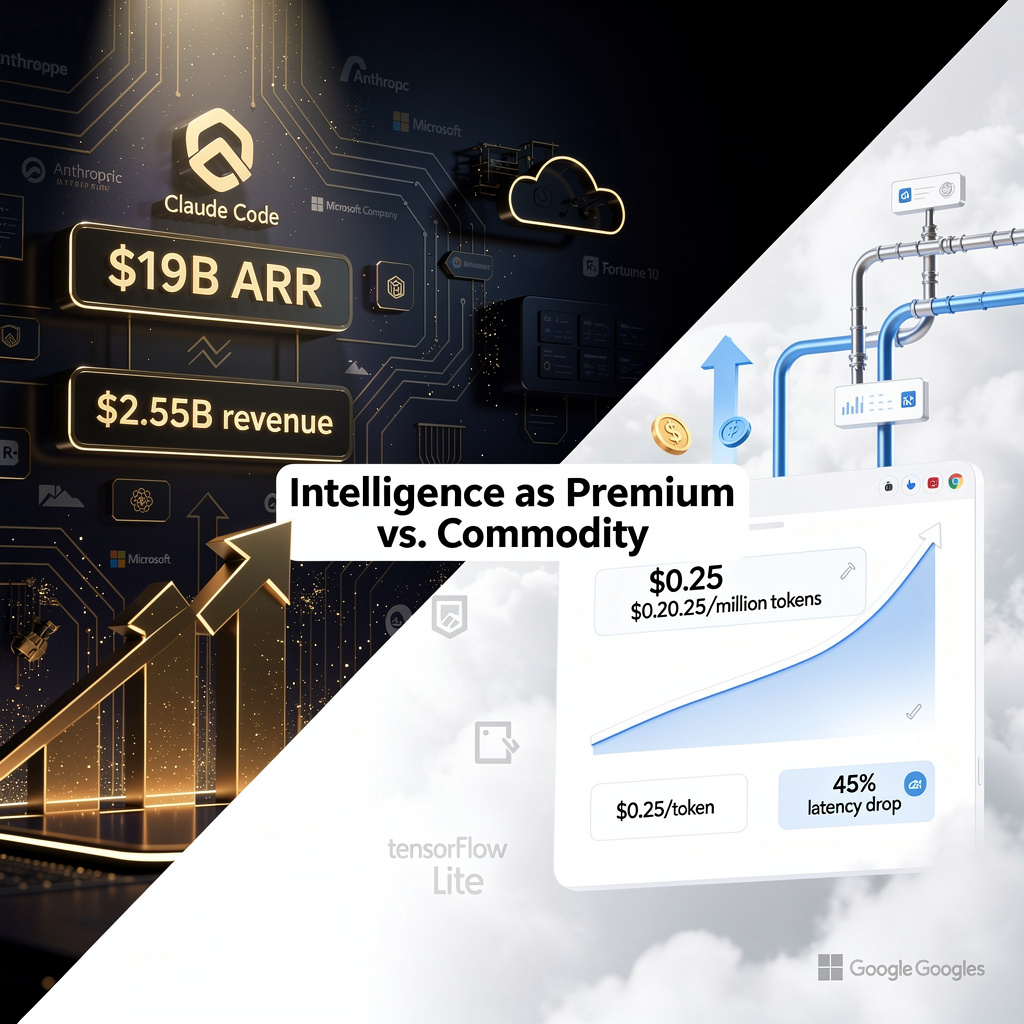
Run-rate revenue reached $5.2 billion in FY2025, up from $1 billion in early 2025. Claude-Code, now part of the Enterprise Max tier, generated $520 million in annual recurring revenue, accounting for 10% of total revenue. Over 300,000 business accounts, including Intel and Amazon, use Claude products.
What is the product roadmap?
- Claude-V2 (multimodal, 1M-token context) is scheduled for Q2 2026 release.
- Claude-Code usage grew 45% quarter-over-quarter.
- A dynamic quota-adjustment engine is being deployed in January 2026 to address token-limit spikes during peak workloads.
How does Anthropic compete with OpenAI and Google?
Anthropic’s strategy emphasizes algorithmic efficiency—using Mixture-of-Experts and sparse activation—to reduce compute costs. This contrasts with OpenAI’s $1.4 trillion annual compute commitments and Google’s reliance on internal TPUs. Anthropic’s Model Context Protocol (MCP), adopted by the Agentic AI Foundation in January 2026, offers an open standard for enterprise agent integration, reducing deployment friction.
What are the near-term milestones?
- Q2 2026: Claude-V2 launch with 8-week custom model deployment (under the 10-week target).
- H2 2026: Dynamic quota engine rollout to stabilize enterprise usage.
- Late 2026: IPO filing expected, targeting $400–450 billion valuation.
What structural advantages does Anthropic hold?
Anthropic combines rapid revenue growth, compute lock-in, and standards leadership. Its efficiency-focused branding and MCP adoption position it to capture 15–20% of the projected $1.2 trillion enterprise AI market by 2027, without matching competitors’ raw compute spending.
What risks remain?
Token consumption spikes indicate scaling friction in enterprise workloads. Success of the dynamic quota engine will determine retention among its 300,000+ business accounts. Regulatory scrutiny of AI infrastructure spending may also impact long-term compute access.

Comments ()