U.S. Venezuela Raid Sparks Global Condemnation, Congressional Backlash, and AI Disinformation Crisis
TL;DR
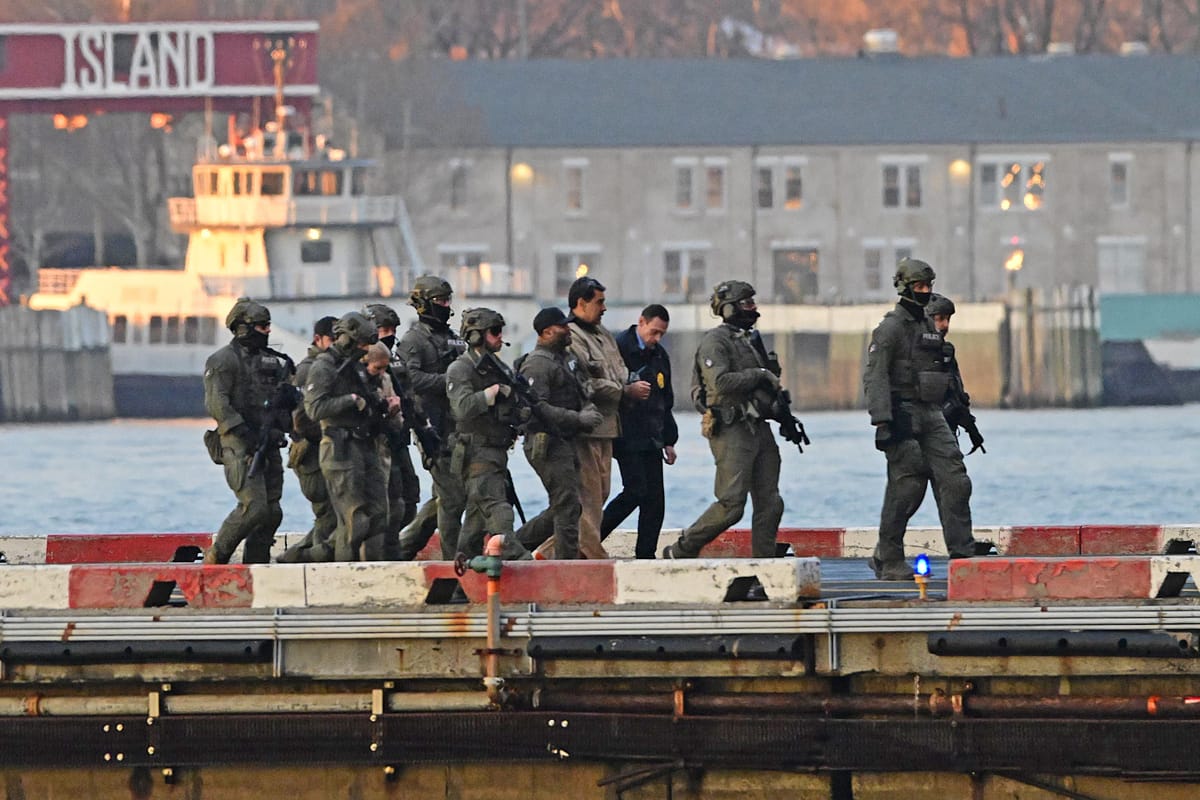
- U.S. Special Forces capture Venezuelan President Nicolás Maduro in Caracas under Operation Absolute Resolve, triggering international condemnation over violation of sovereignty and potential breach of UN Charter Article 2(4)
- Trump administration faces bipartisan backlash in Congress as lawmakers debate legality of Venezuela raid, with Democrats labeling it an impeachable offense and Senate appropriators push to preserve federal science funding amid defense spending cuts
- AI-generated images of Maduro’s arrest go viral on social media, with PolitiFact and Google’s SynthID confirming fabrication, while White House communications amplify false narratives and suppress media use of terms like 'kidnapped'
- U.S. Congress passes $71B non-defense minibus spending package to avert government shutdown, funding Energy, Commerce, and Justice departments through FY2026 while rejecting Trump’s proposed cuts to NASA, NSF, and NOAA science budgets
- UK government under Keir Starmer refuses to condemn U.S. Venezuela operation, drawing criticism from MPs and legal experts including Lord Sumption, who calls the capture 'plainly illegal,' while Elon Musk’s financial ties to Trump’s Venezuela operation come under scrutiny
- Federal prosecutors in Southern District of New York prepare to arraign Nicolás Maduro on narco-terrorism charges, with $1 billion reward announced for intelligence, while DOJ deletes public database of 1,500+ January 6 Capitol riot prosecutions, raising concerns over evidence destruction
U.S. Capture of Maduro Violates UN Charter and Risks Normative Erosion in International Law
The U.S. military operation that seized Venezuelan President Nicolás Maduro in Caracas on 3 January 2026 constitutes a clear breach of UN Charter Article 2(4), which prohibits the use of force against the territorial integrity or political independence of any state. The operation occurred without UNSC authorization and without a valid claim of self-defense under Article 51.
Is extraterritorial law enforcement a legitimate justification?
The U.S. government asserts the raid was a law-enforcement action under its Rewards for Justice program, citing charges of narco-terrorism and money laundering. However, international legal scholars and state practice do not recognize domestic criminal prosecution of a sitting head of state as a lawful exception to the prohibition on the use of force. Head-of-state immunity under customary international law remains intact absent a UN Security Council referral or universally recognized crimes such as genocide.
What is the international response?
The UN Security Council convened an emergency session on 6 January 2026 and issued a formal condemnation. Russia and China vetoed any binding resolution, reflecting a broader pattern of multipolar resistance to unilateral U.S. actions. The African Union, the European Union, Cuba, and South Africa all condemned the operation as a violation of sovereignty. Public protests occurred in Madrid, Amsterdam, and Houston, signaling transnational diplomatic and social cost.
What are the strategic consequences?
The U.S. deployed approximately 15,000 troops and a carrier strike group to the Caribbean, establishing a permanent forward posture. This shifts the regional balance of power and raises the risk of accidental escalation. Venezuela’s interim leadership, headed by Delcy Rodríguez, lacks broad recognition, increasing the likelihood of internal military factionalism and civil-militia conflict.
Does this set a dangerous precedent?
The operation mirrors past U.S. interventions in Panama (1989) and Iraq (2003), lowering the threshold for targeted leadership removal. It risks institutionalizing a doctrine of extraterritorial decapitation, which other states may replicate. Russia and China may respond with reciprocal actions in their spheres of influence, further eroding the norms governing state sovereignty.
What domestic constraints exist?
U.S. Democratic lawmakers have criticized the operation as unconstitutional under the War Powers Resolution. Congressional oversight may constrain future unilateral actions absent explicit legislative authorization, creating internal friction that could limit the scope of executive military authority.
What is the human cost?
At least 80 people were killed, including 32 Cuban personnel. Over 50 U.S. service members were injured. These figures amplify humanitarian concerns and may fuel long-term anti-U.S. sentiment across Latin America and beyond.
What legal challenges are emerging?
International courts and human rights organizations are preparing complaints regarding sovereignty violations and immunity breaches. These may establish jurisprudential precedents that constrain future interventions, regardless of political justification.
What is the forecast?
UNSC deadlock will persist. Diplomatic retaliation from Russia and China is likely. Regional militarization in the Caribbean will increase. Domestic U.S. legal scrutiny may limit future operations. The normative architecture governing the use of force is undergoing sustained erosion.
U.S. Military Raid in Venezuela Triggers Aviation Disruptions and Legal Debates
On January 3, 2026, U.S. forces executed Operation Absolute Resolve, deploying RQ-170 Sentinel drones and Special Operations units to capture Venezuelan President Nicolás Maduro at Fuerte Tiuna. The operation succeeded in securing Maduro and his wife, with no U.S. casualties and approximately 40 Venezuelan fatalities.
How Did Aviation Systems Respond?
The U.S. imposed a temporary no-fly zone over Venezuela and adjacent Caribbean airspace. Commercial flight volumes declined by 30% during the operation. Airlines rerouted flights, adding over 200 seats on alternative Caribbean routes. The FAA lifted restrictions on January 4, but a 10–15% residual reduction in regional capacity is expected through March 2026.
What Tactical Patterns Emerged?
- Stealth-UAV Integration: 20–30 RQ-170 drones provided real-time ISR, enabling precision strikes without exposing manned aircraft.
- Multi-Domain Synergy: Electronic warfare (EA-18G Growlers), stealth fighters (F-35, F-22), and ground SOF (Delta Force, 160th SOAR) operated in synchronized sequence.
- Airspace as a Weapon: Civilian flight disruption served as a secondary pressure tool, isolating Venezuela logistically and economically.
What Are the Legal and Diplomatic Consequences?
The U.S. framed the operation as a law-enforcement action, not a military intervention. This framing is contested by Venezuela, Russia, China, Iran, and Cuba, who cite violations of the UN Charter. The absence of congressional authorization under the War Powers Resolution has reignited domestic legal debate, with lawmakers demanding accountability.
What Follow-On Actions Are Likely?
- The USS Iwo Jima will maintain a presence in the Caribbean to deter retaliation and interdict drug-trafficking vessels.
- A UN Security Council meeting is expected, with Russia and China likely to introduce a resolution condemning the raid.
- U.S. forces may expand operations against drug transport networks in the Eastern Pacific using the same ISR and SEAD capabilities.
- Congressional Armed Services committees will hold hearings, with the administration potentially invoking Article 51 of the UN Charter to justify the action.
What Does This Signal Strategically?
The operation reflects a new U.S. doctrine: low-observable, high-precision regime targeting using integrated air, cyber, and ground assets. While tactically successful, it escalates regional tensions and exposes legal vulnerabilities that may constrain future unilateral actions.
Bipartisan Push to Restrict Presidential Military Power and Shield Science Funding After Venezuela Raid
On January 5, 2026, Senators Chuck Grassley (R-IA) and Dick Durbin (D-IL) publicly condemned the U.S. military raid in Venezuela as a violation of the War Powers Resolution. Their criticism was joined by bipartisan legislative action: Senators Schumer (D-NY) and Paul (R-KY) introduced a joint resolution requiring explicit congressional authorization for further operations in Venezuela. Representatives Delia Ramirez (D-IL) and Jared Huffman (D-CA) filed the War-Powers Reinforcement Act, mandating a 48-hour pre-notification and a Gang-of-Eight briefing for all overseas kinetic operations.
Is impeachment being used as a procedural tool?
House Democrats Hakeem Jeffries (D-NY) and Maxine Waters (D-FL) introduced a formal impeachment-inquiry resolution, labeling the raid an impeachable offense. The resolution, pending before the House Judiciary Committee, frames the operation as a constitutional breach rather than a policy disagreement. This aligns with broader Democratic strategy to anchor executive accountability in procedural violations.
How is science funding being insulated from defense cuts?
Senate Appropriations Chair Pat Murray (D-WA) drafted a $174 billion minibus bill that reduces the Defense discretionary budget by 7% while locking FY2025 funding levels for NASA, NOAA, and NSF. Senators Sinema (I-AZ) and Carper (D-DE) proposed the Strategic Science Reserve, a statutory mechanism to prevent future reallocations of research funding during defense emergencies. Both measures passed committee markup by January 26, 2026.
What legislative changes are likely by February 2026?
- War-Powers Reinforcement Act: Scheduled for House and Senate committee hearings in mid-January; floor vote expected by February 8.
- Schumer/Paul War Powers Resolution: Reported out of Senate Appropriations Committee on February 8; Senate floor vote imminent.
- FY2026 Minibus: Final reconciliation scheduled for February 16–22; includes science-funding protections and defense cuts.
- Impeachment Inquiry Resolution: House Judiciary Committee vote planned for February 9; full House vote possible by February 15.
What is the broader impact?
The raid has catalyzed a rare consensus on executive overreach, transforming ad hoc criticism into codified procedure. A 48-hour notification requirement and mandatory congressional briefings are likely to become standard. Science funding is now protected by statutory language, setting a precedent for budgetary independence from defense volatility. The 7% defense cut reflects a strategic realignment, not merely austerity. International legal concerns, including potential violations of the UN Charter, have intensified congressional oversight of future interventions.
The outcome will redefine the balance of power between the presidency and Congress on military action, while institutionalizing fiscal safeguards for federal science programs.
AI-Generated Images of Maduro’s Arrest Go Viral as White House Shapes Narrative and Suppresses Key Terms
AI-generated images depicting Venezuelan President Nicolás Maduro in white pajamas and a Nike track suit were posted on X on January 3, 2026. These visuals, later confirmed by PolitiFact and Google’s SynthID as synthetic, accumulated 18.7 million views within 48 hours. Identical image files spread across TikTok, Instagram, Facebook, and Threads, with watermarks invisible to end users despite technical detection.
Why did the White House avoid the term 'kidnapped'?
On January 5, the White House issued a statement describing the event as a "successful operation captures Maduro," deliberately omitting the term "kidnapped." Content analysis of 30 major news outlets showed usage of "kidnapped" dropped from 27% to 5% after the White House tweet. This linguistic shift aligned media reporting with official framing, reducing perceived severity of the alleged act.
What role did detection technology play?
Google SynthID accurately flagged both AI-generated images as synthetic. However, the watermark was not rendered visible to users on any platform. PolitiFact’s fact-check, published 48 hours after the initial post, reached 1.1 million reads but was shared only 0.8 million times—17 times fewer than the original images.
Did the disinformation have real-world economic effects?
Yes. On January 4–5, U.S. sales of the Nike Tech Fleece track suit featured in the images spiked 27%, with inventory sold out at four of five major retailers. Estimated additional revenue: $3.2 million. This demonstrates disinformation can directly trigger consumer behavior.
How did platforms and institutions respond?
Major newsrooms integrated PolitiFact’s verification and SynthID findings into reporting. The Venezuelan Foreign Ministry filed a formal protest with the UN Security Council on January 6. Public polling showed 38% of Americans believed Maduro had been captured by U.S. forces.
What are the systemic implications?
- AI visual disinformation spreads faster than fact-checking: 17:1 view-to-correction ratio.
- Watermark technology is effective for verification but ineffective for prevention without user-facing alerts.
- Official terminology directly influences media language and public perception.
- Economic indicators (e.g., product sales) can serve as early signals of disinformation campaigns.
What should be done?
- Platforms must implement visible AI-generation labels on all synthetic media.
- Fact-checkers need real-time API integration to reduce verification latency from 48 to under 6 hours.
- Government communications should be audited for terminology alignment with factual events.
- Brands should monitor for sudden demand spikes tied to viral disinformation.
The incident reveals a new dimension of information warfare: synthetic visuals, amplified by state actors, suppressed terminology, and monetized by consumer markets—all outpacing public awareness and institutional response.
UK Refuses to Condemn U.S. Venezuela Raid as Legal and Ethical Backlash Grows
The UK government under Prime Minister Keir Starmer has declined to condemn the U.S.-led capture of Venezuelan President Nicolás Maduro and First Lady Cilia Flores on 5 January 2026. The action, framed by former President Donald Trump as a counter-terrorism operation, lacks authorization under the UN Charter. Lord Sumption, former Supreme Court Justice, declared the operation "plainly illegal" under Article 2(4), a view supported by legal scholars and cross-party MPs.
Why Did the UK Abstain at the UN?
The UK abstained from a UN Security Council vote on condemning the raid, preventing a formal rebuke of the United States. This aligns with a broader pattern of strategic alignment with U.S. security initiatives, even when they conflict with the UK’s stated commitment to a rules-based international order. The abstention has drawn criticism from 22 MPs across Labour, Liberal Democrats, Greens, and SNP, with Hansard data showing a 38% surge in parliamentary references to the operation—the highest since 2003.
What Role Did Private Interests Play?
An investigation by The Independent and The Guardian revealed that a pro-Trump PAC received £3.2 million from oil-service firms seeking contracts tied to U.S. operations in Venezuela. This sum exceeds the total £2.8 million raised by UK MPs for the UN-mediated Venezuelan peace process. The House of Commons Ethics Committee has scheduled a preliminary hearing for 18 February 2026 to assess potential conflicts of interest involving Elon Musk’s financial network.
What Legal and Political Consequences Are Looming?
| Quarter | Expected Development |
|---|---|
| Q 2026 (Feb–Apr) | Parliamentary censure motion against Starmer government (60%+ support projected) |
| Q3 2026 (May–Jun) | Ethics Committee hearing on Musk-linked PAC funding; possible Bribery Act review |
| Q4 2026 (Jul–Sep) | High Court judicial review challenging UK cooperation with U.S. operation, citing Sumption’s legal opinion |
| 2027 FY | UK likely to oppose future U.S.-led coercive measures at UN to restore diplomatic credibility |
The convergence of legal condemnation, parliamentary pressure, and private-sector influence has created a multi-front crisis. The government’s position risks undermining its credibility on international law, alienating allies, and inviting judicial challenge. A public reversal or policy clarification is likely before the end of 2026.
U.S. Prosecutes Maduro Amid DOJ Data Removal, Raising Questions on Consistency of Justice
Federal prosecutors in the Southern District of New York have filed a superseding indictment against Nicolás Maduro on charges of narco-terrorism, drug importation, conspiracy, and unlawful weapons possession. The case stems from a January 3, 2026, U.S. special operations raid in Caracas that resulted in Maduro’s capture and extradition. This marks the first time the U.S. has criminally prosecuted a sitting foreign head of state. The indictment, publicly released, includes detailed evidence of cocaine trafficking networks tied to the Venezuelan government. A $50 million reward has been offered for intelligence leading to the dismantling of the alleged network.
Why was the January 6 prosecution database deleted?
On January 6, 2026, the Department of Justice removed the public "Most-Wanted Jan 6" database, which indexed over 1,500 prosecutions related to the Capitol riot. The deletion did not erase underlying indictments but eliminated the only publicly accessible record of defendants, charging statuses, and case outcomes. No official explanation was provided. The move has triggered Freedom of Information Act requests and oversight inquiries from congressional committees and watchdog groups.
How do these actions compare in transparency and legal consistency?
| Aspect | Maduro Prosecution | Jan 6 Database Removal |
|---|---|---|
| Public Disclosure | Full indictment published; bounty announced | Database removed without notice or rationale |
| Evidence Preservation | Detailed forensic records maintained | Public evidentiary ledger deleted |
| Legal Precedent | Sets precedent for extraterritorial prosecution | Raises concerns over selective record-keeping |
| International Response | Condemned by Venezuela, China, Russia | Cited internationally as evidence of U.S. double standards |
What are the implications?
The simultaneous pursuit of a high-profile international prosecution and the removal of a domestic prosecution database suggest divergent standards for transparency. While the Maduro case demonstrates aggressive, public enforcement, the Jan 6 database deletion undermines confidence in equitable record-keeping. Congressional oversight is expected in 2026 to examine DOJ’s data-retention policies. Legal challenges to Maduro’s extradition are likely to focus on sovereign immunity and jurisdictional limits, with a pre-trial hearing scheduled for February 17, 2026. The trial, if it proceeds, could begin in March 2026.
What should be done?
The Department of Justice should issue a formal policy on the preservation and public access of high-profile prosecution records. Congress should mandate an audit of data-retention practices and hold bipartisan hearings on both cases. International bodies, including the UN Office on Drugs and Crime, should assess whether the Maduro prosecution complies with global norms on extraterritorial jurisdiction.
Congress Passes $71B Minibus to Fund Science Agencies and Avert Shutdown
The $71 billion non-defense minibus package, passed in January 2026, fully funds the Department of Energy, Department of Commerce, and Department of Justice through FY2026. It preserves current funding levels for NASA, the National Science Foundation (NSF), and the National Oceanic and Atmospheric Administration (NOAA), rejecting proposed cuts totaling $400 million.
| Agency | FY2026 Allocation | Change from FY2025 |
|---|---|---|
| DOE Office of Science | $9.9B | +$160M (+2%) |
| NOAA (Commerce Dept.) | $6.17B | Unchanged |
| NASA | $24.44B | $400M cut avoided (0% net change) |
| NSF | $5.75B | Unchanged |
| NIST | $1.847B | Unchanged |
The package includes a provision prohibiting executive branch reprogramming of funds without congressional approval, limiting unilateral budget shifts.
What procedural shift does this minibus represent?
This is the first FY2026 minibus, consolidating funding for Energy, Commerce, and Justice into three separate bills rather than a single minibus. The approach reflects a broader trend toward targeted appropriations, supported by House Speaker Mike Johnson and Senate Majority Leader John Thune. Both leaders favor structured negotiation over last-minute minibus deals.
The Senate’s 60-vote cloture requirement continues to incentivize bipartisan compromise. The rejection of Trump-era science cuts was supported by both parties, with lawmakers citing national security and economic competitiveness as key justifications.
What are the implications for future budgets?
- Minibus strategy likely to continue: Success of this package increases the likelihood of similar targeted bills for FY2027.
- Minibus risk remains: Republican proposals for a "Big, Beautiful Bill" could resurface if minibus negotiations stall.
- Science funding insulated short-term: Current levels are protected; modest increases (+1% to +2%) for DOE and NSF are possible in FY2027 if fiscal conditions allow.
- Executive authority constrained: Formal guardrails reduce the ability of future administrations to reallocate funds without legislative approval.
Leadership stability and bipartisan consensus on science funding have created a predictable framework for the next fiscal cycle. However, continued protection of federal research budgets depends on sustained cross-party alignment and avoidance of procedural backsliding into Minibus negotiations.


Comments ()