U.S. Delta Force Captures Maduro in Caracas Raid, Sparks Global Condemnation and Legal Firestorm Over Unilateral Military Action

TL;DR
- US military captures Venezuelan President Nicolás Maduro in pre-dawn raid, sparking international condemnation and domestic legal debates over War Powers Act violations
- Trump administration announces temporary control of Venezuela's 303 billion-barrel oil reserves following Maduro's ouster, raising concerns over resource exploitation and Monroe Doctrine revival
- Congressional Democrats and Republicans clash over legality of US operation in Venezuela, with Sen. Kaine demanding immediate authorization under War Powers Resolution and GOP defending executive action
- Venezuelan opposition figures and international allies condemn US-led capture of Maduro, while protests erupt in Caracas, Philadelphia, and Times Square over perceived regime-change aggression
- US strikes in Venezuela kill at least 40 civilians, trigger humanitarian crisis amid mass migration, food insecurity, and collapse of healthcare infrastructure, per UN and WHO reports
- Trump pardons 1,500 Jan. 6 rioters while escalating foreign interventions, drawing criticism for hypocrisy as administration simultaneously undermines democratic norms at home and abroad
US Capture of Venezuelan President Raises War Powers Act Concerns
On January 3, 2026, U.S. Delta Force units conducted a pre-dawn operation in Caracas, capturing President Nicolás Maduro and his wife. The operation involved over 150 aircraft and resulted in 40–80 civilian and military casualties. Maduro was transported to Brooklyn’s Metropolitan Detention Center, where he faces federal narco-terrorism charges.
What legal arguments challenge the operation’s legitimacy?
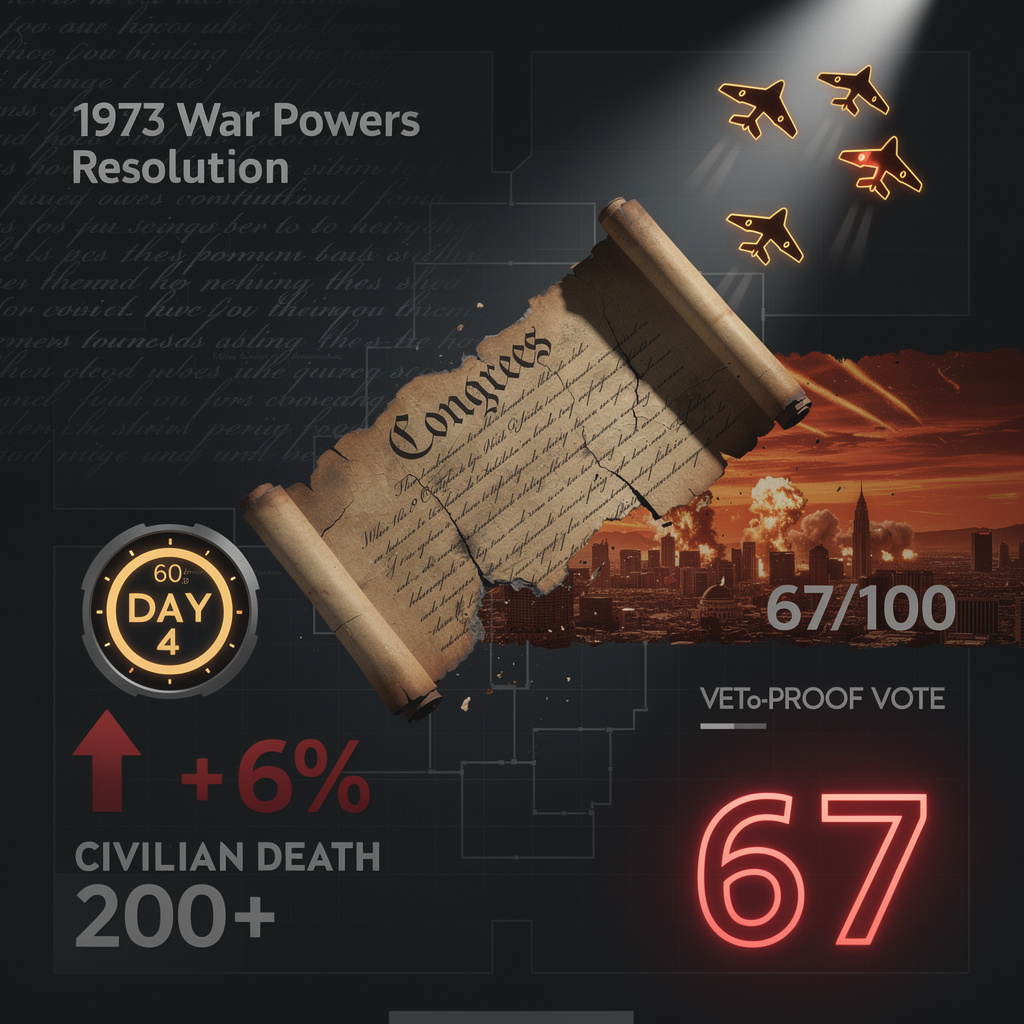
The 1973 War Powers Resolution requires the president to notify Congress within 48 hours of deploying armed forces and limits military engagement to 60 days without congressional authorization. Senators Chris Murphy (D-NY) and Tom Cotton (R-AR) argue the operation constituted military action requiring such authorization. Senator Marco Rubio (R-FL) contends it was a law enforcement action under the 2001 AUMF, citing Maduro’s designation as a narco-terrorist.
Congressional hearings on January 6 revealed no pre-emptive notification to Congress. The House Judiciary Committee voted to refer the matter to the Armed Services Committee for further review.
How did international actors respond?
The UN Security Council, European Union, OAS, and CARICOM condemned the operation as a violation of Article 2(4) of the UN Charter, which prohibits the use of force against sovereign states. China and Russia called for Maduro’s immediate release, framing the action as imperialistic and destabilizing.
What are the broader implications?
- The operation marks the first U.S. extraterritorial capture of a sitting head of state in the Western Hemisphere since Panama 1989.
- The administration’s framing of the raid as law enforcement, despite its military scale, blurs legal boundaries between counter-narcotics operations and conventional warfare.
- The U.S. has imposed an oil quarantine on Venezuelan tankers and pledged $1 billion to rebuild infrastructure, aiming to redirect crude exports to allied markets.
- An estimated 8 million Venezuelans may be displaced due to escalating instability and sanctions.
What comes next?
Congress is expected to initiate a series of hearings to assess whether the War Powers Resolution requires amendment to address covert extraterritorial operations. Diplomatic tensions with China and Russia are likely to intensify as both nations strengthen ties with Venezuela. Humanitarian needs in the region are projected to rise, potentially triggering a multilateral aid response.
Trump Administration Claims Temporary Control of Venezuela’s Oil Reserves Amid Monroe Doctrine Revival
The Trump administration has declared temporary control over Venezuela’s 303 billion-barrel oil reserves following the ouster of President Nicolás Maduro. U.S. forces executed a pre-dawn operation on January 3, 2026, resulting in Maduro’s capture and the seizure of two oil tankers. A naval blockade and oil quarantine have been imposed to enforce access.
What Legal Authority Supports This Action?
The administration invoked the War Powers Resolution of 1973 to justify rapid military action without congressional approval. Democratic lawmakers, including Senators Schumer and Himes, have filed resolutions challenging the legality of the operation, arguing it constitutes an undeclared war. Republican figures such as Marco Rubio and Tom Cotton defend the move as lawful counter-narcotics and counter-terrorism enforcement.
How Are Global Powers Responding?
China, Russia, and Iran have condemned the intervention as a violation of the UN Charter. The European Union called for restraint and urged an emergency UN Security Council session, scheduled for January 5, 2026. The operation has intensified geopolitical friction over energy access in Latin America.
What Are the Economic Implications?
Brent crude fell 0.7% to $60.30/bbl and WTI dropped 0.5% to $56.00/bbl on the day of the announcement. Despite Venezuela’s vast reserves, its current output of 1.0–1.1 million barrels per day represents only 1% of global supply, limiting immediate market disruption. The U.S. has pledged $1 billion for infrastructure repairs and is expected to award $1–2 billion in contracts to domestic firms.
Is the Monroe Doctrine Being Revived?
President Trump explicitly referenced a “new Monroe Doctrine,” signaling a return to unilateral hemispheric control. This marks the first such rhetorical revival since the Cold War. Analysts note the framing links drug-trafficking narratives with resource acquisition, creating a dual justification for intervention.
What Humanitarian Costs Have Been Incurred?
Approximately 40 civilians and military personnel were killed in Caracas during the operation. Over 8 million Venezuelans remain displaced, according to UN 2025 data. The country’s health and food systems remain in collapse, with no immediate relief plan announced.
What Emerging Patterns Are Visible?
- Oil quarantine is emerging as a coercive tool alongside sanctions.
- Anti-narcotics rhetoric is increasingly merged with resource control objectives.
- Congressional oversight of Western Hemisphere military actions is intensifying.
- China and Russia may accelerate energy partnerships in Latin America to counter U.S. influence.
The operation does not alter global oil supply dynamics in the short term but signals a strategic pivot in U.S. foreign policy with long-term implications for international law and regional stability.
Congressional Divide Over War Powers in Venezuela Raid Tests Executive Authority
On January 3, 2026, U.S. Special Operations Forces conducted a nighttime raid in Caracas, extracting President Nicolás Maduro and First Lady Cilia Flores to New York. The operation, designated "Absolute Resolve," resulted in de facto regime change without prior congressional approval. The White House has not sought authorization under the 1973 War Powers Resolution.
Does the President have constitutional authority to conduct such operations?
Republicans, including Senators Marco Rubio and Lindsey Graham, argue the action falls under longstanding presidential war-making powers, citing the Monroe Doctrine and the 1989 Panama intervention as precedent. They classify the operation as a lawful law-enforcement action against a narco-terrorist regime and assert that protecting U.S. energy interests justifies unilateral action.
Must Congress approve military actions involving foreign heads of state?
Democrats, led by Senator Tim Kaine, introduced H.Res. 61 demanding immediate retroactive authorization under the War Powers Resolution. Senator Chuck Schumer labeled the operation lawless. The resolution seeks to establish a legal requirement for congressional consent before any future use of force in the Western Hemisphere.
What are the legal ambiguities in applying the War Powers Act?
The 1973 War Powers Resolution was designed for conventional hostilities, not the capture of a foreign head of state. No judicial or legislative precedent exists for such an action. The administration’s reliance on a national security rationale remains untested in court.
What are the immediate political and procedural consequences?
- Senate vote on H.Res. 61 scheduled for week of January 12, 2026 — likely to fail due to filibuster.
- House expected to pass non-binding resolution endorsing the operation.
- Bipartisan War Powers caucus formed; Republican Senator Rand Paul filed a complementary amendment to limit unilateral force.
- Rapid timeline: operation (Jan 3) → emergency briefing (Jan 4) → public debate (Jan 5) → scheduled vote (Jan 12).
What are the broader implications?
- Venezuela holds approximately 300 billion barrels of proven oil reserves; control of these resources is a central driver of the operation.
- International condemnation from the UN, EU, Russia, China, and Cuba raises risk of retaliatory sanctions.
- Judicial challenge in the D.C. Circuit is plausible; a ruling of unconstitutionality could compel retroactive congressional authorization.
- Post-election Congress may introduce new legislation to require explicit approval for future unilateral strikes in the Western Hemisphere.
The outcome of this clash will determine whether executive authority over military interventions in the Americas is expanded or constrained by statutory checks.
US Capture of Maduro Sparks Global Condemnation and Domestic Unrest in Venezuela
On January 3, 2026, U.S. Special Forces captured President Nicolás Maduro and First Lady Cilia Flores in Caracas, following air strikes on La Guaira, La Carlota, and the Legislative Palace. The Venezuelan Health Ministry reported 40 deaths and 80 injuries. The operation was conducted without congressional authorization or a UN mandate.
How did Venezuelan opposition figures respond?
Opposition leaders María Corina Machado and Edmundo González Urrutia condemned the raid as an illegal "state-sponsored kidnapping," citing violations of the UN Charter (Article 2(4)) and Venezuela’s Constitution (Article 227). They demanded Maduro’s immediate release. Social media campaign #LiberenMaduro generated 1.2 million mentions within 48 hours.
What was the international reaction?
Cuba, China, Russia, Brazil, Argentina, Mexico, and the EU issued formal condemnations. The UN Security Council convened on January 7; China and Russia proposed a non-binding resolution condemning the raid, which the U.S. vetoed. The EU called for restraint but avoided labeling the action "aggression." No NATO member joined the condemnation.
Did protests occur outside Venezuela?
Yes. In Caracas, protests around Plaza Boricua and the National Assembly resulted in 28 deaths, 220 injuries, and approximately 2,000 detentions, according to official police data. A curfew was imposed from 22:00 to 06:00. In Philadelphia and Times Square, Venezuelan diaspora groups held peaceful rallies totaling 500 participants, livestreamed to over 3.4 million viewers. Petitions to the U.S. Senate gathered 12,000 signatures.
What legal and strategic justifications did the U.S. provide?
The U.S. Department of Justice filed a narco-terrorism indictment against Maduro with four counts: cocaine importation, weapons trafficking, narco-terrorism, and conspiracy. The White House stated the operation was a "narco-terrorism interdiction" and announced temporary administration of Venezuela’s Orinoco Belt oil fields, estimated at 500 billion barrels. No AUMF was sought or passed.
What are the emerging geopolitical and domestic consequences?
Delcy Rodríguez assumed interim presidency; reports indicate fragmented military loyalty and emerging mutinies. The U.S. has begun deploying technical teams to oversee oil production. Diplomatic pressure is mounting: five UN member states requested a fact-finding mission, and Latin American nations are exploring regional mediation through the OAS. Congressional hearings in Washington highlighted the absence of legal authority for the operation, prompting bipartisan calls for legislative constraints on future unilateral actions.
What does this mean for international norms?
The raid sets a precedent for unilateral executive military action in the Western Hemisphere without multilateral approval. The U.S. justification relies on an untested criminal indictment rather than a recognized legal framework for cross-border force. The veto of the UN resolution weakens the norm of collective security under the UN Charter, potentially encouraging similar interventions by other states in the future.
US Strikes in Venezuela Cause 40+ Civilian Deaths, Trigger Mass Displacement and Healthcare Collapse
At least 40 civilians were killed and over 70 seriously injured in US air strikes on January 5, 2026, according to UN and Venezuelan health sources. Later assessments suggest total fatalities may exceed 80. Strikes targeted urban centers and oil infrastructure in the Orinoco Belt, with no additional civilian deaths reported in the second wave.
How has displacement surged since the strikes?
An estimated 30 million Venezuelans—roughly 60% of the pre-crisis population—have been displaced regionally. Border crossings into Colombia and Brazil spiked by over 200,000 within 48 hours. UN-HCR identifies 1.2 million children at risk of severe malnutrition due to the collapse of supply chains.
What is the impact on food security?
Seventy-four percent of households report insufficient food access. The cost of a basic food basket has risen fivefold relative to median wages. A 15% price spike in the week following the strikes correlates directly with a 10% decline in oil exports, which previously funded food imports.
How has the healthcare system deteriorated?
Seventy-nine percent of hospitals lack running water; 70% of medical staff have left the country. Maternal mortality has reached 98.9 per 100,000 live births, a 30% year-over-year increase. Field hospitals are overwhelmed by blast injuries, while routine care for malaria, COVID-19, and vaccine-preventable diseases has collapsed.
What are the projected outcomes over the next six months?
- Displacement: 2–3 million additional internally displaced persons expected.
- Food insecurity: Households facing moderate or severe shortages may rise from 74% to over 80%.
- Health: Maternal mortality could exceed 110 per 100,000; immunization rates below 70% raise outbreak risks.
- Diplomacy: UN Security Council consensus remains unattainable; bilateral aid from regional neighbors is becoming the primary relief channel.
What actions are being recommended?
- Deploy multi-agency teams to verify casualty and infrastructure data.
- Establish secure cross-border corridors for food, medicine, and shelter.
- Restore water access in hospitals and mobile clinics.
- Remove import tariffs on staple foods and implement targeted cash transfers.
- Monitor international legal responses to ensure humanitarian access protections.
Trump’s Jan. 6 Pardons and Foreign Strikes Raise Questions on Democratic Consistency
The administration pardoned approximately 1,500 individuals convicted of involvement in the January 6 Capitol attack, while simultaneously authorizing kinetic military actions abroad. The timing of these actions—announced on the fifth anniversary of the event and coinciding with the withdrawal of National Guard forces from major U.S. cities—creates a pattern of simultaneous domestic leniency and foreign aggression.
How does this affect law enforcement and institutional trust?
The FBI maintains 274 agents at the Capitol as of October 2025, despite the removal of 1,200 National Guard personnel from Chicago, Portland, and Los Angeles. Over 1,100 law enforcement personnel sustained injuries during the January 6 events, with rising PTSD cases reported among Capitol Police. The deletion of the official January 6 case database and the $4.975 million settlement with the family of Ashli Babbitt further erode procedural transparency.
What is the international impact of this dual approach?
U.S. military strikes on five alleged drug-trafficking vessels in January 2026, alongside air strikes in Yemen, contrast sharply with the clemency extended to domestic actors who attacked federal institutions. This inconsistency provides adversaries such as Russia, China, and Iran with material to challenge U.S. claims of democratic leadership. Allies in NATO and the EU have begun expressing concern over the normative gap between U.S. foreign rhetoric and domestic actions.
What institutional responses are emerging?
Congressional hearings, led by House Democratic Leader Hakeem Jeffries and Senator Peter Welch, are scheduled for mid-2026 to examine the scope and legality of mass pardons. Legal experts note potential judicial challenges under United States v. Miller (2024), which established precedent for reviewing procedural irregularities in executive clemency. Civil society groups, including veteran organizations and media outlets, are mobilizing to demand accountability and increased mental health funding for first responders.
What future developments are likely?
- Congressional legislation to limit mass pardons may emerge from bipartisan concern over precedent.
- Judicial review of pardon procedures is probable, particularly given the database deletion.
- Foreign military operations are expected to continue, with additional maritime strikes and Yemen campaigns anticipated.
- Diplomatic friction with allies may grow, affecting joint security initiatives and multilateral cooperation.
The convergence of domestic clemency and foreign escalation reflects a strategic choice that prioritizes political mobilization over institutional consistency. The long-term consequences for U.S. governance and global standing depend on whether corrective institutional mechanisms are activated before the normative damage becomes irreversible.


Comments ()