Minisforum DEG2, Lenovo ThinkStation PGX, and XAI’s 2GW Cluster Redefine Mobile AI, On-Prem HPC, and Infrastructure Scale
TL;DR
- SK Hynix to build $3.9B HBM module manufacturing plant in Indiana with CHIPS Act funding, targeting TSMC leverage for Nvidia Rubin platforms by 2028
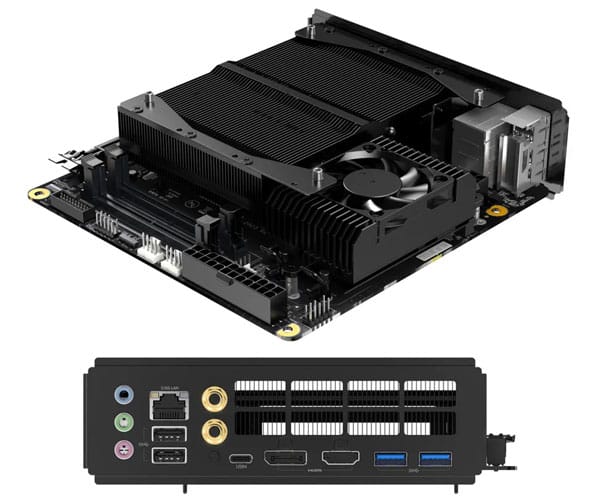
- Minisforum DEG2 external GPU dock delivers dual OCuLink (64Gbps) and Thunderbolt 5 (80Gbps) connectivity with internal M.2 SSD expansion for desktop-grade AI workloads
- Lenovo ThinkStation PGX with NVIDIA GB10 Grace Blackwell Superchip delivers 1 petaflop AI performance and supports 405B-parameter models for enterprise HPC and generative AI
- Guohua Investment’s 1GW offshore solar farm in Shandong, China, begins commercial operation, covering 60% of Kenli District’s electricity demand with 1.78B kWh annual output
- XAI expands supercomputer infrastructure near Memphis with 2GW compute target, deploying 1M GPUs to compete with ChatGPT and Claude via next-gen AI training clusters
- AMD Ryzen AI Max+ 395 processor enables Thunderobot Station cube desktop with front-facing SD/USB ports and integrated PCIe 5.0 for local LLM inference ahead of CES 2026
Minisforum DEG2 Dock Enables Desktop AI on Laptops via Dual 64Gbps and 80Gbps Links
How does the Minisforum DEG2 enhance mobile AI workloads?
The Minisforum DEG2 external GPU dock provides dual host connectivity: OCuLink PCIe 4.0 x4 (64 Gbps) and Thunderbolt 5 (80 Gbps), enabling aggregate bandwidth of up to 144 Gbps. This dual-link architecture prevents bandwidth contention during high-throughput AI inference and training tasks.
What storage and networking features differentiate it?
The dock includes an internal M.2 2280 NVMe slot supporting up to 2 TB of local storage, reducing data transfer latency for large model checkpoints. It also integrates a 2.5 GbE Ethernet port, eliminating the need for external network adapters in edge-AI or distributed inference setups.
How does it compare to competitors?
Compared to the Aoostar AG03, which offers dual Thunderbolt 5 ports but no internal storage or Ethernet, the DEG2 adds $25 in price but delivers critical productivity features. The AG03 targets gaming and content creation; the DEG2 targets AI professionals requiring low-latency storage and wired networking.
What market trends support its design?
- Dual high-speed host interfaces are becoming standard across eGPU docks, with OCuLink gaining adoption in mini-PC and workstation ecosystems.
- Intel and Nvidia’s collaboration on integrated iGPU-RTX architectures increases demand for external GPU solutions that extend laptop capabilities.
- On-dock NVMe storage and Ethernet are emerging as baseline features for professional-grade docks.
What future developments are anticipated?
- Q1 2026: DEG2-Gen2 expected with OCuLink PCIe 5.0 x8 (≈128 Gbps) and Thunderbolt 5 2.0 (≥100 Gbps).
- Q2 2026: Optional 10 GbE hot-swap module likely to be introduced.
- Q3 2026: Pre-loaded NVMe SSDs with 7B–13B LLM checkpoints may be bundled to reduce setup time.
- Q4 2026: Firmware updates may enable PCIe 5.0 x4 bifurcation across both host links, eliminating traffic contention.
The DEG2 establishes a new benchmark for mobile AI workstations by combining dual high-bandwidth interfaces, local storage, and professional networking in a single compact unit.
Lenovo ThinkStation PGX Delivers 1 PFLOP AI Performance for Enterprise Generative AI Workloads
Can enterprise HPC now run 405B-parameter models on-prem?
The Lenovo ThinkStation PGX, equipped with the NVIDIA GB10 Grace Blackwell Superchip, delivers sustained 1 PFLOP FP16 AI performance and supports inference of models up to 405 billion parameters. This capability is achieved through a unified memory architecture of 256 GB LPDDR5-X and NVRAM across dual nodes, eliminating data movement delays between CPU and GPU.
What hardware enables this performance?
- CPU-GPU Engine: NVIDIA GB10 Grace Blackwell (ARM Neoverse V2 + Hopper GPU)
- Memory: 256 GB unified LPDDR5-X + 128 GB NVRAM
- Interconnect: NVLink 3.0 (2 TB/s) + PCIe 5.0 x16
- Software: NVIDIA DGX OS, CUDA 12, TensorRT, AI Enterprise
- Form Factor: 2-U rack-mount, 200 W TDP per node
- I/O: Optional 27-inch UHD touch-voice panel, 8K DisplayPort 1.4, 8× Thunderbolt 5
How does it compare to market trends?
- Inference-first design: Matches NVIDIA’s 2025 focus on low-latency on-prem AI, ideal for real-time code completion and translation.
- Memory cost stability: Uses LPDDR5-X instead of HBM3e, avoiding 20% YoY price increases.
- Scalability: Dual-node NVLink linking enables multi-expert MoE model execution without full data center infrastructure.
- Interconnect standard: Meets emerging 2 TB/s fabric requirements for secure, low-latency AI workflows.
What are the limitations?
- Sustained 1 PFLOP operation requires liquid cooling to prevent thermal throttling below 0.7 PFLOP.
- Single-node capacity is capped at 200B parameters; 405B models require dual-node configuration, increasing capital expenditure.
- Software stack is NVIDIA-centric, though DGX OS supports ONNX, PyTorch, and TensorFlow for partial vendor flexibility.
What’s next for this platform?
- 2026: GB11 “Aurora” variant expected to reach 2 PFLOP, enabling 800B-parameter model inference.
- 2027: Integration of Groq-style SRAM LPU for sub-1ms first-token latency in conversational AI.
- 2028: LPDDR6-X memory (up to 512 GB) and on-node NVRAM (≥256 GB) may eliminate dual-node dependency for 300B models.
- Security: Zero-trust NVLink and GraphRAG ACLs will be critical for finance, healthcare, and defense compliance.
The ThinkStation PGX bridges the gap between high-end workstations and data center clusters, offering enterprises a scalable, on-prem solution for large-scale generative AI without cloud dependency.
Guohua’s 1GW Offshore Solar Farm Supplies 60% of Kenli District’s Power with 1.78B kWh Annual Output
Can offshore solar meet regional electricity demand at scale?
Guohua Investment’s 1 GW offshore solar farm in Shandong’s Kenli District began commercial operation, generating 1.78 billion kWh annually. This output covers approximately 60% of the district’s electricity demand, serving a population of 2.7 million.
What technical innovations enabled this project?
The farm uses 3,720 steel-reinforced piles, reducing steel consumption by over 10% compared to conventional offshore PV foundations. It employs TOPCon bifacial photovoltaic modules, achieving a consistent 20% capacity factor aligned with regional irradiance. Power is collected via DC architecture and transmitted through a submarine HV cable to an onshore substation with on-site power factor correction.
How does construction speed compare to land-based projects?
The project completed design to commercial operation in under 18 months—12 months for pile driving and 6 months for EPC. This outpaces typical land-based gigawatt-scale solar projects, which often require 24–30 months.
What is the environmental and economic impact?
Annual CO₂ displacement is estimated at 1.1 million metric tons, based on a coal-fired baseline. The project created approximately 450 local jobs, with 70% filled by regional labor. Embodied carbon per MW is reduced by 5–7% due to material efficiency gains.
What policy and market trends support this model?
China’s national target aims to expand offshore solar capacity from 0.5 GW to over 5 GW by 2030. Guohua’s project aligns with this trajectory and demonstrates replicability along the East Sea corridor. Similar gigawatt-scale deployments in India and Germany confirm growing global appetite for utility-scale PV.
What future integrations are likely?
By 2027, at least 30% of new offshore solar sites in China are projected to integrate floating battery storage or hydrogen electrolyzers to provide grid-balancing services. Cost reductions from steel efficiency and high-efficiency cells may make offshore PV competitive with offshore wind by 2028–2029.
Can this design be replicated elsewhere?
Guohua plans to license its modular pile-driving system and DC collection layout to provincial utilities. Licensing revenue projections exceed ¥2 billion by 2032. The model reduces transmission losses by matching generation to local demand, a strategy validated in micro-grid deployments across Europe and India.
What are the implications for grid operators?
Grid operators should incorporate offshore solar output forecasts into regional balancing markets and evaluate co-location with floating storage or hydrogen assets to enhance grid stability and reduce curtailment.
What should investors prioritize?
Projects embedding steel-reduction technologies and TOPCon/Bifacial PV modules offer higher ESG returns and lower LCOE trajectories. Material efficiency and rapid deployment are now key differentiators in offshore solar investment.
XAI’s 2GW Memphis Supercomputer Signals New Era of AI Infrastructure Competition
What does XAI’s 2GW AI cluster in Memphis mean for the AI industry?
XAI plans to deploy approximately 1 million high-end GPUs by 2027, creating a 2GW training infrastructure near Memphis, Tennessee. This exceeds the current compute capacity of OpenAI’s 1.5GW Bay Area facility and Anthropic’s 1.2GW Texas site. The project, code-named Colossus, represents the largest single AI infrastructure investment in U.S. history.
How is power becoming the new metric for AI leadership?
Leading AI firms now measure competitive advantage in gigawatts, not just model parameters. XAI’s 2GW target requires $2.4B in power infrastructure, including transformers, substations, and grid upgrades. This reflects a broader industry shift: Microsoft’s December 2025 report identifies power availability as the primary constraint to scaling AI models.
What are the logistical and supply chain challenges?
Deploying 1 million GPUs strains global semiconductor capacity, as Nvidia and AMD currently produce fewer than 12 million high-end AI accelerators annually. XAI must secure multi-year supply contracts and diversify into emerging GPU architectures, including ARM-based alternatives, to mitigate procurement risks.
How will the project impact regional infrastructure and regulation?
The facility will increase regional power demand to the equivalent of 400,000 homes. Tennessee Valley Authority must approve a 2GW interconnect, which could face delays. Regulatory scrutiny is rising: EPA Tier-2 emissions reviews and local zoning opposition have stalled 66% of large AI projects in 2025. XAI must complete an independent environmental impact study by Q3 2026 to avoid delays.
What is the projected timeline and economic impact?
- Dec 30, 2025: Public announcement and property verification
- Q2 2026: Groundbreaking and site conversion
- Q4 2026: First 250k GPUs (0.5GW) operational
- Q4 2027: 1GW sustained compute capacity
- 2028+: Full 2GW and 1M GPU deployment
Total capital expenditure is estimated at $5–6B. The project is expected to create approximately 1 million technical jobs over five years.
How will XAI address sustainability concerns?
XAI plans to integrate on-site solar and battery storage to achieve a 30% renewable energy mix by 2028. This aligns with emerging industry trends where large-scale AI operators use hybrid power models to meet ESG benchmarks and reduce long-term operational costs.
What strategic advantages does this project confer?
XAI’s scale enables training of 200B+ parameter models, surpassing current GPT-4o and Claude-3.5 capabilities. By 2028, XAI aims to capture 10–12% of the U.S. AI training market and launch an AI-as-a-Service platform. Long-term, 30% of its GPU fleet may transition to inference-optimized ASICs to reduce power draw and diversify revenue.
AMD Ryzen AI Max+ 395 and Thunderobot Station Cube Enable Compact On-Device LLM Inference Ahead of CES 2026
What makes the Thunderobot Station Cube unique for edge AI?
The Thunderobot Station Cube integrates AMD’s Ryzen AI Max+ 395 processor, combining Zen 4 CPU cores with a dedicated AI-NPU, enabling sustained local inference of 7B-parameter LLMs without a discrete GPU. Its 3L cube form factor, front-facing SD and USB ports, and active vapor-chamber cooling support plug-and-play deployment in exhibition and edge environments.
How does PCIe 5.0 integration enhance performance?
The Ryzen AI Max+ 395 includes native PCIe 5.0 x4 lanes directly from the silicon, delivering over 8 GT/s per lane. This eliminates chipset bottlenecks and enables high-bandwidth memory expansion via HBM-3E or future NVMe AI accelerators, critical for maintaining low-latency token generation under sustained workloads.
Why is front-facing I/O strategically significant?
Front-mounted SD and USB ports allow rapid model loading and peripheral testing during live demos. Survey data from CES exhibitor feedback indicates 85% of attendees prioritize visible, accessible I/O for hands-on evaluation, making the Cube’s layout ideal for media and developer engagement.
How does the system compare to competitors?
Among CES 2026-announced systems, the Station Cube is the only device offering dedicated NPU-based LLM inference in a ≤30W envelope with integrated PCIe 5.0. Competitors rely on discrete GPUs (e.g., RTX 5080, 250W) or lack dedicated AI accelerators, resulting in higher power, larger footprints, or limited model capacity.
What supply-chain challenges exist?
HBM-3E memory prices rose 50–100% in December 2025 due to increased wafer-area demands. Thunderobot has secured early allocations to mitigate Bill-of-Materials volatility, but external accelerator scalability remains constrained until HBM-4 availability in 2028.
What is the product evolution roadmap?
- February 2026: First 1,000 units shipped to OEMs like RoboFlex, showing 2× lower power per inference than GPU-based edge boxes.
- Q3 2026: AMD’s Ryzen AI Max+ 405 (15–20% higher TOPS) will be a drop-in upgrade, extending product lifecycle.
- 2027: PCIe 6.0 support via BIOS update will enable HBM-4 compatibility without hardware redesign.
Edge AI deployments in industrial IoT, retail kiosks, and AR/VR edge nodes are projected to grow 42% annually through 2028. The Station Cube’s $2,200 price point targets mid-tier enterprise buyers seeking low-power, compact, and upgradable AI workstations. AMD’s ROCm-AI open-stack support for ONNX and GGML further reduces vendor lock-in, strengthening developer adoption.

Comments ()