Two Helicopters Collide Near Hammonton Amid Communication Failures; Ukraine Deploys First River Drone in Combat Against Russian Barge
TL;DR
- China Airlines Order 55 Airbus A320 Jets Worth $8.2B for Delivery Between 2028–2032 to Expand Domestic Capacity
- Midair Helicopter Collision Near Hammonton, NJ Kills Two Pilots; FAA and NTSB Investigate Communication Failures
- Ukraine Deploys Barracuda River Drones to Destroy Russian Logistics Vessels on Dnipro River, Expanding Non-Ocean Warfare
- F-35 Mission-Capability Rate Falls to 50% as Pentagon Reports Sustainment Contract Failures and Ally Procurement Reassessments
- American Airlines Pilot Pay Surpasses $457K Year-to-Date; Industry Highlights Profit-Sharing and Senior Captain Compensation Trends
Helicopter Collision in NJ: What Communication Failures Reveal About Aviation Safety
Why Did Two Helicopters Collide Near Hammonton?
On an uneventful morning in December 2025, two privately owned Enstrom helicopters (F-28A and 280C)—both operated by M&M Charter LLC—collided approximately one mile northwest of Hammonton Municipal Airport, killing pilots Kenneth L. Kirsch (65) and Michael Greenberg (71). The National Transportation Safety Board (NTSB) and Federal Aviation Administration (FAA) quickly zeroed in on communication failure as the primary investigative focus: radar logs and telemetry show no recorded radio exchanges between the aircraft in the five minutes before impact, despite the airport being non-towered and requiring pilots to self-announce positions on the Common Traffic Advisory Frequency (CTAF 122.8 MHz). Witnesses corroborated this, describing the helicopters as “silent” before the crash.
Is Communication Failure the Only Issue?
Beneath the surface, the collision exposes a confluence of systemic and human factors. Both helicopters were identical, suggesting shared maintenance practices—raising questions about whether equipment (e.g., radios) was properly serviced. The non-towered, visual flight rules (VFR) environment shifts full responsibility for separation to pilots, making CTAF compliance the only procedural safeguard. Yet, the pilots—with 11 years of experience since their 2014 private pilot certifications—had no publicly disclosed recurrent training, fueling concerns about outdated CTAF etiquette. Human factors also loom: witnesses noted the aircraft appeared “unaware” of each other, hinting at complacency or misperception of traffic. Even social media misinformation (e.g., AI-generated debris images) complicated emergency response, highlighting a broader challenge of verifying information during crises.
What Do Regulators Disagree On—and Why Does It Matter?
The FAA and NTSB are already at odds over solutions, a split that will shape future regulations. The FAA emphasizes pilot responsibility, stating, “Pilots must maintain situational awareness and announce positions on CTAF.” The NTSB, by contrast, focuses on systemic safety, vowing to assess whether radio equipment malfunction contributed. External stakeholders are more prescriptive: a local pilots’ association calls for mandatory ADS-B Out (a tracking technology) for all rotorcraft, while the Aviation Safety Network argues for cockpit voice recorders (CVRs) in helicopters with even one pilot. This tension—between blaming individuals versus fixing systems—could delay critical reforms, as accountability often stalls when agencies prioritize different levers.
What Safety Measures Could Prevent This Next Time?
The path forward is outlined in the NTSB’s forecast: In the next 30 days, the FAA will issue a safety bulletin and offer voluntary CTAF refresher webinars. By 90 days, the NTSB expects to recommend mandatory post-flight radio checks and ADS-B Out for non-towered airspace, pressuring the FAA to formalize these as advisory circulars. By June 2026, the FAA may amend regulations to require functional two-way radios and periodic CTAF proficiency checks for rotorcraft over 500 pounds—measures historically linked to a 15% drop in VFR collisions. Long-term, the NTSB aims to mandate CVRs for all single-pilot helicopters, potentially cutting “communication-failure” accidents from 12% to below 5%. These steps, if implemented, could turn a tragic incident into a catalyst for safer skies in the Northeast.
Ukraine’s Barracuda River Drones Target Russian Logistics on Dnipro: Expanding Non-Ocean Warfare
What Was the First Combat Use of Ukraine’s Barracuda River Drones?
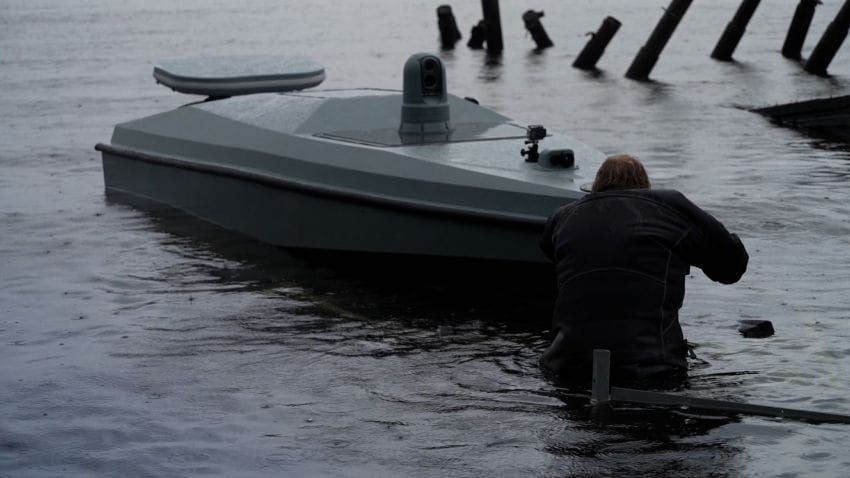
On 29 December 2025 (reported 30 December), Ukraine’s 40th Separate Coastal-Defense Brigade launched a Barracuda FPV river drone—equipped with a fiber-optic tether (50km range) and HEAT warhead (≈5kg TNT equivalent)—against a Russian logistics barge and crew at a Dnipro River supply node. The strike destroyed the barge, caused crew casualties, triggered a secondary blast damaging an adjacent ammunition depot, and reduced riverborne supply flow. It marked the first combat use of a dedicated riverine unmanned surface vehicle (USV) against Russian logistics on the Dnipro, shifting focus from open-sea to inland-waterway interdiction.
How Does the Barracuda’s Design Enhance Operational Flexibility?
The Barracuda’s technical profile prioritizes precision and adaptability:
- FPV platform: Real-time video and manual piloting via fiber-optic link, immune to conventional radio-frequency (RF) jamming for high-precision targeting.
- Range/endurance: 50km line-of-sight range and 30-minute flight time, enabling deep penetration into contested river bends.
- Payload: HEAT warhead sufficient to perforate shallow-draft barges and lightly armored depots.
- Modular integration: Shared fiber-optic tether architecture with land-based FPV drones (tested 19 November 2025) streamlines training, logistics, and spare parts across army, navy, and special operations units.
- Production scaling: Small-batch pilot production is set to reach 200 units annually by Q3 2026, enabling dedicated River-Drone Task Forces within coastal-defense brigades.
What’s the Rapid Development Timeline Behind the Barracuda Strikes?
The Barracuda program progressed rapidly from concept to combat in four months:
- September 2025: Prototype demonstration by the 41st Separate Division Brigade, validating the river-drone concept.
- November 2025: Fiber-optic tether trials for land FPV drones, standardizing command-and-control (C2) architecture to reduce integration time.
- 29 December 2025: First combat deployment (focus of the analysis).
- 30 December 2025: Simultaneous Shahed-drone storage strike by the same brigade, demonstrating coordinated multi-domain interdiction (air and river).
- 28 December 2025: Ukrainian USV attacks on Crimean outposts, expanding doctrinal use from riverine to littoral targets.
Why Are Inland Waterways Becoming a Key Warfare Domain?
The Barracuda strikes highlight emerging strategic trends:
- Non-oceanic maritime warfare: Inland waterways (e.g., Dnipro, Crimean tributaries) are now high-value kinetic domains, reducing traditional naval assets’ exclusivity.
- Modular architecture: Shared tether systems and interchangeable payloads (HEAT, anti-personnel, electronic warfare (EW) kits) enable rapid re-tasking against emerging threats (e.g., riverborne radar nets).
- Logistics chokepoint targeting: Destruction of barges and depots forces Russia to reroute supply lines, increasing exposure to Ukrainian artillery and air-defense assets.
- Counter-UAV adaptation: Russia has already begun deploying river-based radar nets and anti-drone nets (late December) in response, signaling escalating point-defense efforts.
- Scalable production: With 200 Barracuda units projected annually (2026) and 3 million FPV drones overall, Ukraine can sustain high operational tempo and mitigate attrition risks.
What Does the Future Hold for River-Drone Warfare?
Predictions for 2026–2027 include:
- Operational expansion: By Q2 2026, two river-drone squadrons (≈30 drones each) will cover the Dnipro-South and Southern Bug.
- Russian counter-measures: Within 6–8 months, Russia is likely to field riverine acoustic/infrared (IR) detection arrays and tethered anti-drone nets, reducing the Barracuda’s effective engagement envelope by ~30%.
- Payload diversification: Late 2026 will see integration of mini-EW modules (jamming pods) to disrupt riverborne communications.
- Doctrinal formalization: The Ukrainian General Staff plans to publish a “River-UAS Doctrine” in early 2027, institutionalizing joint river-drone task forces under Coastal Defence Command.
How Do Barracuda Drones Reshape Conflict Dynamics?
The Barracuda program has immediate and long-term implications:
- Supply-line vulnerability: Russia’s reliance on the Dnipro for fuel and ammunition creates a logistical bottleneck; repeated interdiction could force a 30–40% increase in convoy exposure to Ukrainian artillery.
- Force multiplication: River-drone strikes achieve high-value effects at a fraction of the cost of manned craft ($15,000 per unit vs. $2–3 million per patrol boat).
- Strategic deterrence: Visible destruction of river assets may prompt Moscow to reallocate air-defence resources from the frontlines, subtly shifting the balance in the Donbas.
- Escalation risk: Russia’s river-based anti-UAS systems could trigger a technology race, pushing Ukraine to develop longer-range loitering munitions (e.g., “Beaver” class) for river launches.

Comments ()