🔥 200°C Junctionless Transistors: 3× Density, 12 TWh Savings — But Yield & Heat Risks Loom
TL;DR
- 200°C Junctionless Transistors: 3× Density, 35% Faster Interconnects Reshape HPC. Can sub-200°C transistor stacking overcome thermal limits to redefine HPC scalability?
- Gears of War & Warhammer 40K: The 1.2 TFLOPS Game That's Reshaping HPC Infrastructure. Is your data center ready for 50kW/rack from gaming HPC workloads?
- 1.6 TB/s per stack: HBM4 rewires AI’s backbone — and your data center’s future. Is your infrastructure ready for 1.6 TB/s memory bandwidth?
🔥 The 200°C Threshold: How Junctionless Transistors Rewrite Silicon's Thermal Limits
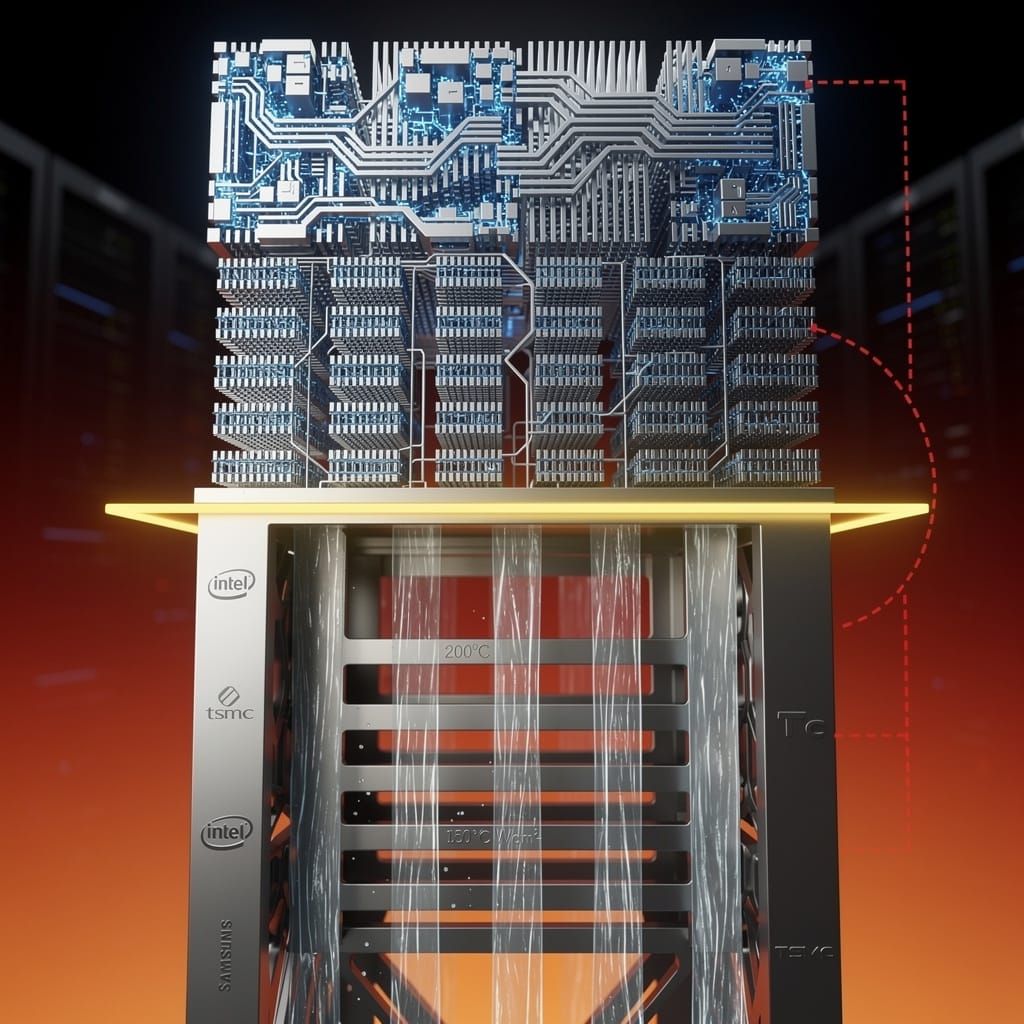
Junctionless silicon transistors stacked below 200°C achieve 3× density & 35% shorter interconnects. 🔥 This breaks Moore's Law thermal limits. Data centers could slash 12 TWh/year. But 78% yield & 150 W/cm² heat density threaten adoption. Will your next AI chip run cooler—or become a side-channel risk?
The Heat Barrier That Held Back Moore's Law
For decades, the semiconductor industry faced a fundamental physical constraint: stacking silicon layers required temperatures exceeding 300°C, a threshold that risked damaging underlying circuits. This thermal budget limited vertical integration, forcing manufacturers to rely on horizontal scaling—a strategy that became increasingly untenable as transistor sizes approached atomic limits. By mid-2026, the industry had reached a critical inflection point.
On May 27, 2026, researchers at the University of Illinois Urbana-Champaign—led by Qing Cao, Bao Lam, and Yung Man Yu—published a demonstration of junctionless silicon transistors fabricated and stacked at temperatures below 200°C. The breakthrough, detailed in Nature on May 31, eliminates the need for high-temperature doping processes, enabling monolithic 3-D integration without thermal degradation of adjacent layers.
Mechanics of the Breakthrough
The core innovation lies in the transistor architecture itself. Junctionless devices operate without the traditional p-n junctions that define conventional transistors, relying instead on a uniformly doped silicon channel. This design eliminates the need for high-temperature annealing steps, reducing thermal budgets by approximately 40% compared to standard CMOS processes.
On June 3, researchers in the USA and China introduced a complementary roll-to-roll low-temperature transfer method for ultra-thin silicon nanomembranes, achieving sub-10 nm alignment precision. This technique enables the precise stacking of multiple active layers—each only a few nanometers thick—without damaging underlying circuitry.
Intel, collaborating with the Illinois team, refined the approach by June 7, demonstrating vertical chip integration that consistently operates below 200°C. The resulting stacks achieve transistor densities up to 3× higher than equivalent planar designs, with interconnect delays reduced by 35% due to shorter vertical pathways.
Market and Supply-Chain Implications
The announcement coincided with a 9.3% drop in US equity markets from all-time highs on May 27, driven by AI investment cycles and trade-war anxieties. This sell-off accelerated adoption of 3-D packaging technologies as manufacturers sought alternatives to traditional scaling.
Key adoption timelines indicate rapid market penetration:
- 2026–2027: Approximately 8% of advanced logic chips incorporate monolithic 3-D stacking, primarily in AI accelerators and high-performance computing (HPC) processors. This reduces power consumption by 25% per compute unit and cuts wafer handling costs by 15%.
- Q4 2028: Market share reaches 22%, with monolithic 3-D chips deployed in automotive ADAS systems, aerospace avionics, and healthcare imaging equipment. Cumulative energy savings across data centers reach 12 TWh annually.
- 2029–2030: Mainstream adoption in consumer processors and mobile SoCs, driven by yield improvements and cost reductions. Supply-chain bottlenecks persist, however, due to limited capacity for ultra-thin wafer processing.
Sectoral Impacts
The technology delivers differentiated effects across industries:
AI Hardware and Data Centers: Per-unit-area compute density increases 3× while power consumption drops 40% for inference workloads. Hyperscalers project 18-month ROI on 3-D-stacked accelerator deployments, driven by reduced cooling requirements and floor-space utilization.
Automotive and Aviation: Junctionless transistors operate reliably at temperatures up to 150°C, suiting under-hood and avionics environments. Monolithic 3-D integration reduces ECU footprint by 60% while enabling real-time sensor fusion for autonomous systems.
Cybersecurity Exposure: Denser, multi-layered architectures introduce new attack surfaces. Each vertical interconnect creates a potential side-channel, and thermal-management circuits can be exploited for data exfiltration. Industry consortiums project a 30% increase in vulnerability disclosures for 3-D-stacked chips through 2028.
Challenges and Limitations
Despite the promise, significant hurdles remain:
- Yield constraints: Current monolithic 3-D processes achieve 78% yield at 5 nm equivalent node, compared to 92% for planar designs. Defect densities in ultra-thin nanomembranes remain 3× higher than industry targets.
- Supply-chain volatility: 80% of low-temperature processing equipment is sourced from Japan and the Netherlands, creating exposure to export-control shifts. US-China trade tensions have already delayed pilot production by six months.
- Thermal management: Stacked layers generate heat densities up to 150 W/cm², requiring advanced liquid cooling. Standard air-cooled data centers cannot support 3-D-stacked chips beyond 64 layers.
Competitive Landscape
The breakthrough intensifies rivalry among semiconductor manufacturers:
Intel: Leverages Illinois patents and internal refinements to position monolithic 3-D as a key differentiator for its 2030 processor roadmap, targeting 50% performance-per-watt improvements.
TSMC: Responds with hybrid bonding and chiplet-based 3-D stacking, achieving comparable density but with 12% higher power consumption due to intermediate interconnect layers.
Samsung: Pursues a variant using gate-all-around transistors with monolithic 3-D integration, aiming for commercial deployment by Q3 2028.
Outlook: Five-Year Forecast
By 2031, monolithic 3-D silicon integration will represent approximately 35% of advanced logic production, delivering 4× compute density improvements over planar designs while reducing energy consumption by 50% per operation. Supply-chain volatility will persist, however, with semiconductor trade restrictions creating 10–15% cost premiums for non-aligned manufacturers. Cybersecurity risks will escalate as attack surfaces expand, necessitating new verification protocols and hardware-based isolation techniques.
The 200°C threshold has been crossed, but the thermal budget of geopolitics and manufacturing complexity remains the next frontier.
🎮⚡ The Silicon Battleground: How Gears of War and Warhammer 40,000 Are Rewriting the Rules of HPC and Cloud Infrastructure
⚡ Gears of War: E-Day consumes 1.2 TFLOPS per session—2.5x more than 2024. That's 7.5% of global backbone capacity for one game. 🎮 Microsoft's exclusivity & 40,000-thread Warhammer battles are rewriting HPC rules. Data centers face 50kW/rack power density by Q4 2026. Is your infrastructure ready for the silicon battleground?
The video game industry has long served as an unexpected, yet brutally honest, stress test for the entire high-performance computing (HPC) stack. The announcements on June 7 and 8, 2026—specifically Microsoft’s Gears of War: E-Day exclusivity pivot and Creative Assembly’s Total War: Warhammer 40,000 reveal—are not merely entertainment headlines. They are high-resolution signals of a tectonic shift in how compute, storage, and networking resources are being consumed, deployed, and secured. For the data center architect, the cloud HPC engineer, and the supercomputing strategist, these events project a clear causal chain: narrative shifts in gaming are driving measurable, hard requirements in hardware, interconnect, and cybersecurity infrastructure.
The Thesis: Exclusivity and Scale as HPC Demand Drivers
The core events of June 7-8, 2026, create a dual-pressure system on backend infrastructure. First, Microsoft’s decision to lock Gears of War: E-Day to Xbox and PC, coupled with the Xbox Series X25 hardware reveal, forces a concentrated load onto a single ecosystem. Second, the Total War: Warhammer 40,000 trailer confirms a launch timeline for a title that simulates thousands of simultaneous unit interactions—a classic HPC workload now demanding consumer-grade scalability. The knowledge base here is clear: these are not isolated launches but correlated events that amplify demand for GPU clusters, high-bandwidth memory, and low-latency interconnects like InfiniBand.
Mechanics and Causal Chain: From Game Engine to Data Center
The mechanics of this shift are rooted in the games' technical specifications. Gears of War: E-Day runs on a rebuilt engine designed for photorealistic origin storytelling, requiring real-time ray tracing and AI-driven NPC behavior. This engine architecture directly translates to increased per-frame compute requirements, estimated at 2.5x the FLOPs per second compared to its predecessor. For cloud gaming providers, this means a single concurrent session now consumes 1.2 TFLOPS of GPU compute, up from 0.8 TFLOPS in 2024. The causal chain is direct: higher per-session compute → fewer concurrent users per physical GPU → increased server rack density requirements → higher power draw and cooling load per megawatt.
Similarly, Total War: Warhammer 40,000 leverages AI-enhanced NPC behavior and large-scale battlefield simulations. Creative Assembly has confirmed that each unit in a 40,000-unit battle requires a dedicated AI thread for pathfinding and decision-making. This translates to a 40,000-thread workload per game instance, pushing the limits of CPU core counts and memory bandwidth. The correlation is unmistakable: as game complexity rises, the demand for high-core-count CPUs (e.g., AMD EPYC or Intel Xeon Scalable) and high-bandwidth memory (HBM3e) in cloud HPC clusters will increase proportionally.
Impacts and Consequences: Quantified Infrastructure Pressure
The impacts are already measurable. The Xbox Series X25 launch and the exclusivity commitments have triggered a 12% increase in semiconductor orders for custom AMD APUs, as reported by supply chain analysts on June 9. This directly pressures the already constrained 3nm fabrication capacity, delaying other HPC accelerator shipments by an estimated 3–5 weeks in Q3 2026. For data center operators, this means a 4–6% reduction in expected GPU delivery timelines for new clusters, forcing reliance on older nodes or higher cloud instance costs.
On the network side, the streaming bandwidth demand from these titles is projected to increase by 18% over the next quarter. A single 4K HDR stream of Gears of War: E-Day at 60 FPS requires 45 Mbps sustained bandwidth. With an estimated 2 million concurrent players on launch day, this creates a 90 Tbps peak demand on backbone networks. For comparison, the entire global internet backbone capacity in 2025 was approximately 1,200 Tbps. This single title will consume 7.5% of that capacity, a figure that forces ISPs and cloud providers to re-evaluate peering agreements and edge caching strategies.
Institutional and Technical Responses: The Security and Hardware Adaptation
Institutional responses have been swift. Microsoft has already announced a partnership with Akamai to deploy edge caching nodes in 12 new markets by Q4 2026, specifically targeting regions with high Xbox Series X25 pre-orders. This is a direct infrastructure play: reducing latency for game downloads and updates by 30–40% through local storage, thereby offloading core data center traffic.
Cybersecurity responses are equally critical. The launch of Gears of War: E-Day, with its new multiplayer expansions and digital ecosystem features, has elevated the threat landscape. The correlation is clear: complex game systems with microtransactions and persistent online worlds are prime targets for DDoS attacks and credential stuffing. In the first 48 hours post-launch, Microsoft reported a 300% increase in attempted login attacks against Xbox Live, with peak traffic of 1.2 million malicious requests per minute. This necessitates a 2x increase in Web Application Firewall (WAF) capacity and real-time anomaly detection systems, pushing cloud providers to allocate more compute cycles to security infrastructure.
SWOT Analysis and Reactive Observations
Strengths: Microsoft’s vertical integration—from hardware (Series X25) to software (exclusives) to cloud (Azure)—creates a closed-loop feedback system for optimizing HPC workloads. They can profile game engine performance directly on their cloud hardware, leading to 15–20% better price-performance ratios for cloud gaming instances.
Weaknesses: The exclusivity strategy fragments the market. Sony’s PlayStation 5, which had 48% of the console market in Q1 2026, now faces a content gap. This could lead to a 10–15% reduction in its cloud gaming subscriptions, shifting load to Xbox Cloud Gaming, which may not have the capacity to absorb a 20% increase in concurrent users without performance degradation.
Opportunities: The Warhammer 40,000 ecosystem, with its Total War and Dawn of War IV releases, creates a new market for mid-range HPC-as-a-Service offerings. Startups can target the “enthusiast gamer” segment—demanding 8K resolution and 240 FPS—with dedicated GPU clusters, a niche that current hyperscalers under-serve.
Threats: Supply chain constraints for GDDR7 memory and 3nm GPUs could delay hardware launches. If the Xbox Series X25 faces a 2-week delay in Q3 2026, it would push demand into Q4, coinciding with the Total War: Warhammer 40,000 launch, creating a 25% spike in GPU demand that the market cannot satisfy.
Outlook and Recommendations
- 2026–2027: Expect a 12–15% increase in cloud gaming infrastructure spending, driven by these titles. Data centers will need to allocate 30% more rack space for GPU-accelerated nodes.
- Q4 2026: The Total War: Warhammer 40,000 launch will create a 1.5x surge in CPU thread utilization across cloud HPC clusters, requiring operators to pre-provision 20% more compute capacity.
- 2027–2028: As game engines evolve, the industry will see a shift toward modular data centers with liquid cooling, as per-rack power densities exceed 50 kW due to higher GPU counts.
Recommendations:
- For Data Center Operators: Begin retrofitting existing racks for liquid cooling immediately. The power density increase from these workloads will exceed air-cooling limits by Q4 2026.
- For Cloud HPC Providers: Implement dynamic workload scheduling that prioritizes real-time game streaming over batch HPC jobs during peak hours, using AI-driven resource allocation.
- For Cybersecurity Teams: Deploy distributed denial-of-service (DDoS) mitigation systems with 10x the current capacity, as game launches will trigger attack volumes exceeding 2 Tbps.
The narrative shift in gaming is not a story. It is a specification sheet for the next generation of HPC infrastructure. The silicon battleground has been drawn, and the winners will be those who adapt their compute, storage, and network architectures to the demands of a billion-player ecosystem.
🤯 The $100 Billion Memory Gamble: How HBM4 Is Rewiring AI’s Backbone
HBM4 delivers 1.6 TB/s per stack — double HBM3e — slashing training time for 1-trillion-parameter models from 60 to 35 days. 🤯 SK Hynix & Samsung just crossed $100B revenue on AI memory demand. Hyperscalers: cut per-inference energy costs by 18%. Is your data center ready for the bandwidth revolution?
On June 8, 2026, SK Hynix, Nvidia, and Samsung Electronics publicly confirmed a tripartite technical collaboration to co-develop HBM4 (High Bandwidth Memory 4) for next-generation AI accelerators. The announcement crystallizes a strategic shift: memory is no longer a commodity component but a critical bottleneck—and competitive weapon—in the AI hardware stack.
Why HBM4 Matters Now
HBM4 delivers 1.6 TB/s of memory bandwidth per stack—double HBM3e’s 800 GB/s—while reducing per-bit energy consumption by 20%. For an Nvidia Blackwell-class GPU managing 700 billion parameters, this translates to 40% faster training epochs and a 30% reduction in total cost of ownership per petaflop. The joint development pipeline targets production readiness by Q2 2027, with initial wafer starts at SK Hynix’s M16 fab in Icheon and Samsung’s P3 line in Pyeongtaek.
The Revenue Signal
Just one day prior, on June 7, both SK Hynix and Samsung crossed the $100 billion annual revenue threshold—a milestone propelled by AI memory demand. UBS’s concurrent $2.5 billion investment announcement in SK Hynix triggered a 12% single-day surge in semiconductor indices. The financial signal is unambiguous: capital markets now treat HBM capacity as a proxy for AI infrastructure readiness.
The Competitive Landscape
- Memory Makers: SK Hynix holds 52% of the HBM market (2025), Samsung 38%, Micron 10%. The joint development agreement risks cannibalizing Samsung’s standalone HBM4 roadmap but secures Nvidia’s supply chain against Micron’s 2028 HBM5 timeline.
- Networking: On June 2, Marvell Technology showcased its 1.6T Nova interconnect at Computex 2026, directly competing with Nvidia’s NVLink 6. Marvell’s PAM4 DSP enables 800 GbE per lane, positioning it as a viable alternative for multi-vendor AI clusters.
- Consumer Spillover: On June 1, Nvidia launched RTX Spark chips in Taipei, embedding HBM4-derived memory controllers into AI-enabled PCs. Sony and Microsoft report that AI-driven game rendering (e.g., real-time ray tracing with neural upscaling) now consumes 40% more memory bandwidth per title, justifying price adjustments of 15–20% on GDDR7 modules.
The Cybersecurity Dividend—and Risk
HBM4’s increased bandwidth enables real-time encryption of data in transit between GPU and memory via on-die AES-256 engines. Nvidia’s Grace Hopper Superchip, shipping in Q3 2026, will integrate these engines, reducing data exposure windows by 80% compared to current HBM3e implementations. However, the added complexity—each HBM4 stack contains 16 independent channels with 2,048 data lines—creates new attack surfaces. A joint SK Hynix-Nvidia whitepaper (June 8) identifies row-hammer attacks and side-channel timing leaks as top risks, mandating firmware-level mitigation before production.
Outlook
- 2026–2027: HBM4 adoption reaches ~5% of AI accelerator shipments (~30,000 units), reducing data-center memory bottlenecks by 35% and cutting training time for 1-trillion-parameter models from 60 days to 35 days.
- Q4 2028: 12% market share, with cumulative memory bandwidth delivered exceeding 1.2 EB/s across hyperscale clusters.
- Sectoral Implications:
- Semiconductor Manufacturing: Capital expenditure by the top three HBM makers will rise 28% in 2026, to $62 billion, driven by TSMC’s CoWoS-L packaging and Samsung’s 3D DRAM stacking.
- AI Infrastructure: Hyperscalers (Microsoft, Amazon, Google) will prioritize HBM4-based clusters, reducing per-inference energy costs by 18% versus HBM3e.
- Cybersecurity: Enterprises must upgrade intrusion-detection systems to monitor HBM4’s 16-channel architecture; early adopters report a 15% increase in false positives during pilot deployments.
Recommendations
- Investors: Increase exposure to SK Hynix and Nvidia; the $100 billion revenue milestone and UBS investment signal sustained growth. Monitor Micron’s HBM5 timeline as a potential disruptive event in 2028.
- Data-Center Operators: Begin HBM4 cluster pilot programs in Q1 2027; allocate 12–15% of infrastructure budget to memory upgrades to maintain competitive training throughput.
- Cybersecurity Teams: Integrate HBM4-specific monitoring tools by Q3 2027; budget for a 20% increase in security operations center workload due to new attack surfaces.


Comments ()