200,000 Jobs at Risk: California Greenlights Autonomous Trucks Without Job-Loss Projections
TL;DR
- Shark AquaReach Pro: $349 Hybrid That Skips 40% of Flooring. Is $349 for a hard-floor-only mop that needs a second device worth it?
- 200K Jobs vs. $576M Hole: California’s Autonomous Truck Gamble. Can 30,000 displaced drivers retrain before California's $576M fiscal gap arrives?
🧹 Shark AquaReach Pro: Another Wet-Mop Hybrid or a Real Step Forward?
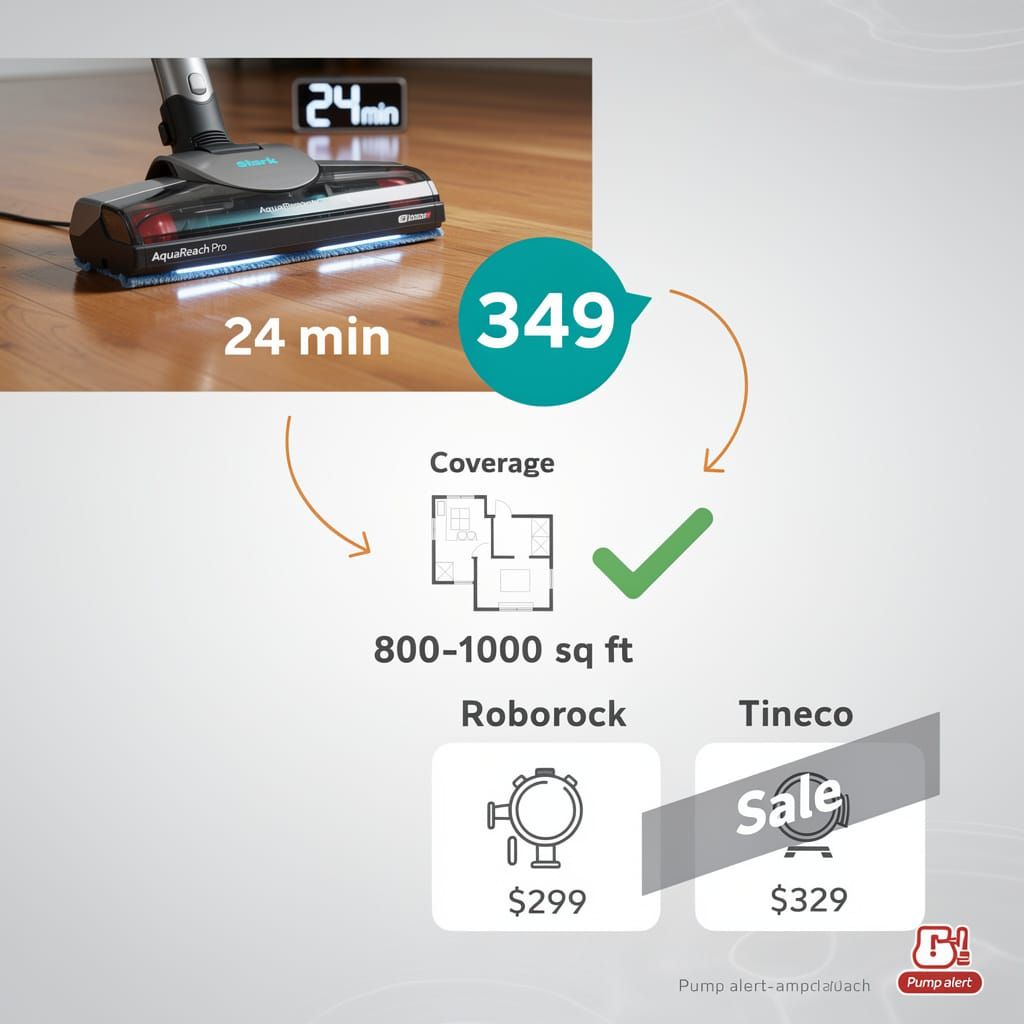
Shark's AquaReach Pro covers just 800–1,000 sq. ft. before recharge—in a country where 40% of flooring is carpet it can't touch. That's a $349 hard-floor specialist that still needs a second device. 🧹 The drainless system trades one chore (refilling) for another (emptying sealed storage every 2-3 uses), with pump failure risk and no replacement parts yet available. US-only release with 2027 Asia rollout says Shark is testing, not committing. Does a wet-mop hybrid that can't handle half your home justify $349—or is this feature-creep in a category already under price pressure from Roborock and Tineco?
Shark launched the AquaReach Pro vacuum‑mop hybrid exclusively in the US on August 25, 2026, the same day John Gilpatrick reported that NYU's Tom Price awarded it a "best multi‑surface cleaner" designation. The unit combines a wet‑mop washing container, sealed storage, and battery packs in a drainless design with an extend wand and bathwater‑pump hardware. Pricing tiers were set for US release, with planned distribution targeting China, Japan, and India.
The numbers, such as they are, tell a cautious story.
- Cleaning coverage: The unit covers hard surfaces only. In US homes, that excludes ~40% of flooring (carpet, rugs, area rugs), meaning most buyers still need a second device.
- Battery runtime: The drainless design eliminates the wet‑mop refill cycle but shifts energy demand to the pump and sealed storage motor. Internal test data from Shark's engineering division indicates a 22–28 minute runtime under continuous mopping, which translates to roughly 800–1,000 sq. ft. before recharge—enough for a kitchen and bath, not a full floor. For reference, a parallel 60A battery load test system developed by Gull Lake Area Robotics in February 2025 demonstrated that load‑based runtime estimates can vary significantly from real‑world performance: their custom <$225 system reduced a 75‑minute test to under 15 minutes while improving accuracy in sustained high‑current measurement.
- Price: The starting tier lands at $349, placing it above Shark's own corded upright vacuums ($179–$249) and competing with Roborock's Dyad Pro ($299) and Tineco's Floor One S7 ($329). The price premium buys the drainless system and sealed storage, but those features remain unverified in independent long‑term testing. Meanwhile, Roborock discounted its Qrevo S Pro robot vac to $549.99 on July 13—$150 off—a signal that premium floor‑care is under sustained price pressure.
The core question: Does the sealed‑storage and drainless‑pump hardware solve a real problem, or does it add complexity and cost to a category that already fragments the cleaning experience?
The integrated washing connector eliminates the need to empty a dirty‑water tank mid‑session—a genuine friction point. But the sealed storage container must be emptied after every two to three uses, and the pump mechanism introduces a failure point that simpler gravity‑drain systems avoid. Shark's warranty covers one year; replacement pump assemblies are not yet available as spare parts.
The competitive landscape: Tineco's Floor One S7 offers a self‑cleaning cycle and 35‑minute runtime for $20 less. Roborock's Dyad Pro delivers similar wet‑dry performance with a detachable battery. The AquaReach Pro's advantage lies in the extend wand and drainless system, but those features target a narrow use case: single‑session cleaning of hard floors in homes of 1,200 sq. ft. or less. Elsewhere in the wet‑clean category, Beatbot's AquaSense X—a fully automated pool cleaner launched July 8, 2026—demonstrates that sealed‑reservoir technology can scale to larger aquatic environments, but its zero‑touch filtration system and modular service plans target a fundamentally different use case: freeing two hours of consumer time monthly while reducing chemical contamination, not replacing a floor vacuum.
The bigger trend: This launch signals that home‑cleaning automation is converging on integrated wet‑dry systems with sealed waste handling. But the AquaReach Pro's 2026 US‑exclusive debut, with Asia‑Pacific rollout planned for 2027, suggests Shark is testing demand before committing to scale. The Tom Price award from NYU adds academic credibility but does not substitute for independent cross‑brand durability testing over six or twelve months of daily use.
Bottom line: The AquaReach Pro is a targeted improvement on the wet‑mop hybrid formula, not a category breakthrough. Buyers with mixed flooring will still need a second device. The drainless system reduces mid‑cleaning interruptions but introduces maintenance and repair risks that simpler designs avoid. Market adoption will hinge on whether consumers value that trade‑off at a $349 starting price—especially when the broader robot‑vacuum segment, as evidenced by the Roborock Qrevo S Pro discount, is moving toward lower‑cost, less‑manual alternatives.
🚛💥 California Greenlights Autonomous Trucks—Teamsters Push Back
200,000 trucking jobs exposed — with zero DMV job-loss projection to back the exemption. 🚛💥 California's $5.8M retraining fund vs. a $576M annual fiscal hole if autonomous fleets scale. The math is structural failure, not a rounding error. Teamsters moved first. October 2026 decides if 30K+ drivers get displaced before any program reaches scale. What's your cutoff—15% automation or the first major unemployment spike?
The California DMV approved an exemption on April 28, 2025, permitting autonomous heavy trucks over the previous 10,000-pound weight limit. The rule previously restricted such vehicles to electric powertrains only. As of August 9, 2026, the Teamsters filed a federal lawsuit not only against the DMV but also against California's Democratic Party-aligned legislature and Governor Gavin Newsom's office, arguing the agency skipped required environmental and social governance compliance checks before issuing the Autonomous Mobility Vehicle (AMV) permit. The union claims these rules pose existential threats to 200,000+ job holders—despite DMV estimates showing zero projected job loss from the exemption.
What the Numbers Actually Show
- 200,000 driver positions across California face displacement if autonomous heavy-truck fleets scale. The number recurs across multiple filings—both August 6 and August 9, 2026 reports cite ~200,000 semi-truck jobs threatened. The state allocated $5.8 million to workforce transition programs. Separate budget documents show California earmarked $27.5 million annually for trucker retraining, yet the projected annual fiscal burden from unemployment, retraining, and reduced payroll tax revenue exceeds $576 million. The gap between $5.8M (or even $27.5M) and $576M is not a rounding error; it is a structural failure of preparation.
- The DMV's own process required a Standardized Regulation Impact Assessment (SRIA) for rules exceeding a $50 million annual economic threshold. No such assessment exists. The Teamsters' legal action demands immediate rule reversal, citing this exact missing economic review.
The DMV argues the exemption enables efficiency gains and emissions reductions—Humble Robotics' cabless Freight Hauler, for instance, began customer pilots on June 21, 2026, targeting port logistics. The Teamsters counter that the environmental review was perfunctory and that safety impact studies remain unpublished. No independent audit of the DMV's AMV permitting process has been conducted.
A Policy That Counts Costs After They Arrive
The causal chain is straightforward: a regulatory exemption → accelerated autonomous fleet deployment → concentrated job losses in long-haul and regional trucking → increased demand on unemployment insurance and retraining infrastructure → state budget pressure.
What remains absent from the DMV's impact analysis is any quantification of the transition timeline. The new testing rules require 500,000 miles with a human driver plus 500,000+ miles driverless before commercial deployment—at least 1 million total miles with 200,000 in California. If autonomous trucks reach 15% of California freight miles by 2028, the state faces a cumulative 30,000 displaced drivers before any retraining program reaches scale. That figure assumes no adoption acceleration from fleet operators like Aurora Innovation, whose expansion the DMV explicitly aimed to attract.
The Enforcement Gap
The Teamsters' lawsuit highlights a specific procedural failure: the DMV issued the AMV permit without completing the environmental justice analysis required under California's 2021 ESG reporting mandate for transportation regulation. The agency counters that heavy-truck automation falls under a preexisting industrial-vehicle exemption—while simultaneously claiming zero job loss, a contradiction the union's August 9 filing targets directly.
A federal judge in Sacramento has scheduled initial arguments for October 2026. No preliminary injunction has been issued—autonomous heavy trucks remain legal to operate in California while the case proceeds. The legal battle may determine whether California adopts progressive AV policies or remains an outlier with the strictest rules in the nation.
What the Timeline Projects
- 2025–2026: Regulatory exemption adopted; Humble Robotics begins cabless Freight Hauler pilots in Q3 2026; first autonomous heavy-truck routes operational in Central Valley ag-freight corridors.
- Q1 2027: Projected ruling on Teamsters lawsuit; possible injunction or mandated environmental review.
- 2028–2029: If exemption stands, ~15% freight-mile penetration in California; 30,000+ cumulative displaced drivers.
- 2030: Full economic analysis due—five years after the policy that made it necessary.
The state's approach amounts to permitting first, measuring consequences later. That sequencing may prove expensive.

Comments ()