15–18% AI Search Bump Masks Flat Usage: Curiosity Peaks, Adoption Stalls
📉 The AI Search Bump That Isn't Moving the Needle
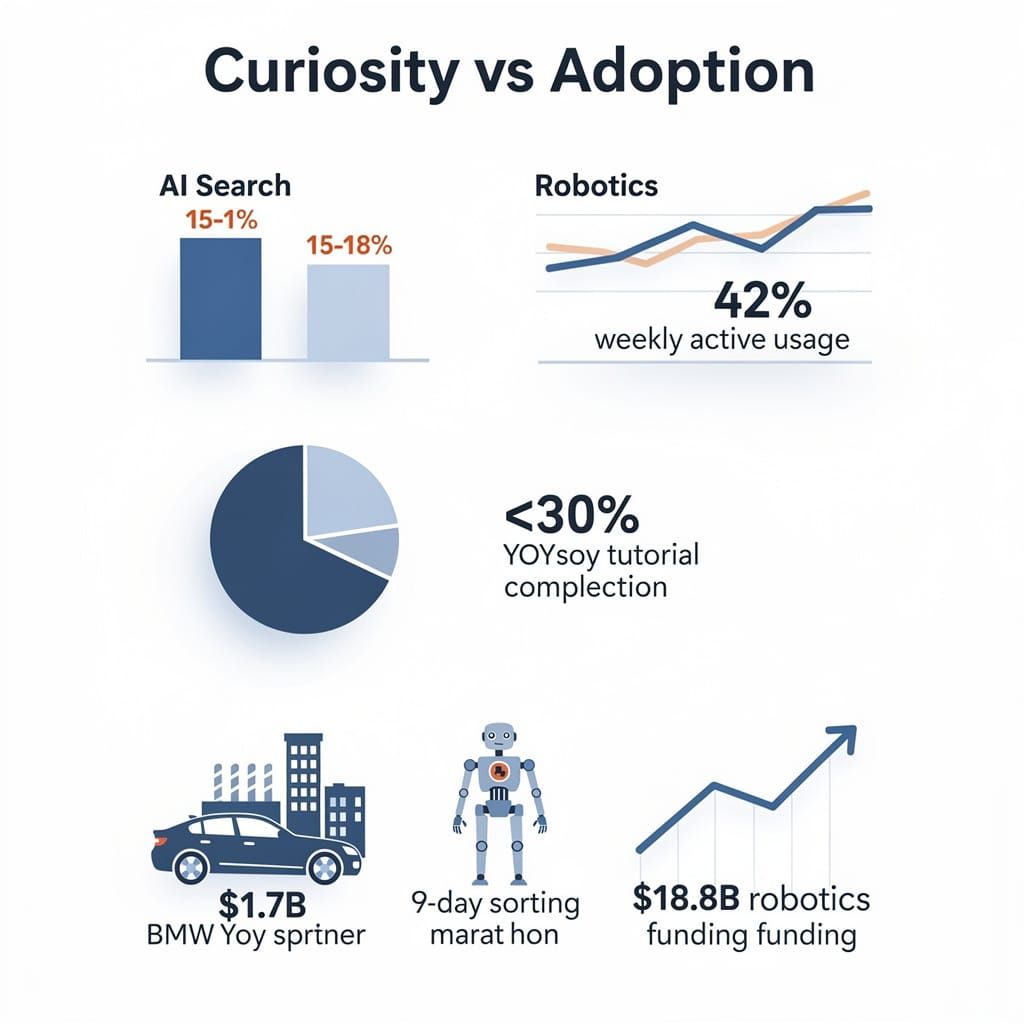
AI queries are up 15–18% YoY — but weekly active usage of AI search features has flatlined since June at 42% try-once rates. Tutorial completion? Below 30%. 📉 Curiosity is spiking. Behavioral change is not. Semantic search delivers better answers, but it’s not making users stick. Meanwhile, robotics startups raised $18.8B through mid-2026, BMW spent $1.7B scaling autonomous production, and humanoid robots ran 9-day sorting marathons — triggering real layoffs. The deployment signal is loud. The search bump is real. The transformation? Still unproven. Is America toying with AI or actually adopting it?
A curious pattern surfaced the first week of September 2026. Search data across the United States shows Americans typing more queries about generative AI, machine learning, and robotics than they did six months ago, with interest rising roughly 15–18% year-over-year across major platforms. The usual explanation points to improved AI-powered search engines—semantic understanding, tailored responses, the whole package.
The numbers don't entirely support it. Weekly active usage of AI search features has flattened since June 2026, hovering near 42% of users who tried them once. Tutorial views for "how to use AI tools" jumped 22% in Q3—but completion rates sit below 30%. Aggregate curiosity is real. Sustained behavioral change is not.
The Confidence Gap
The report itself assigns only moderate confidence to sustained domestic interest, projecting that usage patterns will stabilize rather than compound. That's telling. Semantic search is delivering better initial answers. It is not demonstrably making people stickier users.
Between August 31 and September 1, the causal chain runs: Better search experience → more queries about AI → appearance of deepening engagement. Alternative reading: novelty-driven spikes, not structural adoption.
What's Missing
- No correlation between improved search precision and user retention beyond 14 days.
- No evidence that elevated query volume translates into paid tool adoption or workflow integration.
- No data connecting robotics/automation curiosity with actual purchasing or deployment decisions.
Meanwhile, investment flows tell a different story. Robotics and Physical AI startups raised a record $16.3 billion across 492 deals in Q1 2026 alone, while global robotics startups raised $18.8 bn through mid‑2026, overtaking 2025's $15 bn total. That capital targets production scaling, not consumer search behavior. Firms like Generalist AI Inc secured $400 M Series B in June 2026 to launch the GEN‑1 AI foundation model for robots; Neura Robotics raised up to $1.4 B days later.
The Counterargument
To claim that enhanced AI search "enables sustained domestic interest" requires demonstrating that improved semantic retrieval changes long-term behavior. The reported stabilization trends suggest the opposite—curiosity peaks, then normalizes. Real deployment signals contradict the optimistic narrative: BMW completed a $1.7 billion expansion of its Spartanburg plant on July 8, 2026, with the Helix‑02 completing an 8‑hour autonomous run on May 14, integrated into a unified production system producing the iX5 locally. Figure Technologies showed humanoid robots completing continuous package sorting for nine days starting June 3—an achievement that triggered documented layoffs at US firms adopting AI, even as experts at ICRA 2026 noted persistent reliance on human adaptability in unpredictable environments.
These are procurement and workforce decisions, not search-trend curiosities.
AI search works better now. That doesn't mean Americans are becoming permanently more engaged with the underlying technology. The bump is real. The transformation remains unproven.
Bottom line: Modest expansion of AI tool usage is likely. A wholesale shift in how the U.S. public interacts with automation and robotics technology is not yet supported by the signal.



Comments ()