130 kW AI Racks: Grid Crisis Hits Lake Tahoe
TL;DR
- AI's 130kW Racks Crush Grids: Lake Tahoe Residents Cut, Liquid Cooling Surges. Should data centers get priority access to power over residents?
- $30B Nvidia Loss: China’s 9 New AI Chips Rewire Global Infrastructure. Who pays for the chip war—your data center or your country?
- Gaming Laptop Prices Drop $1,500 as Steam Deck OLED Hits $800 on Memory Shortages. Are you buying a discounted gaming laptop or paying more for a handheld?
The Great Grid Squeeze: How AI is Reshaping Power, Policy, and the Planet
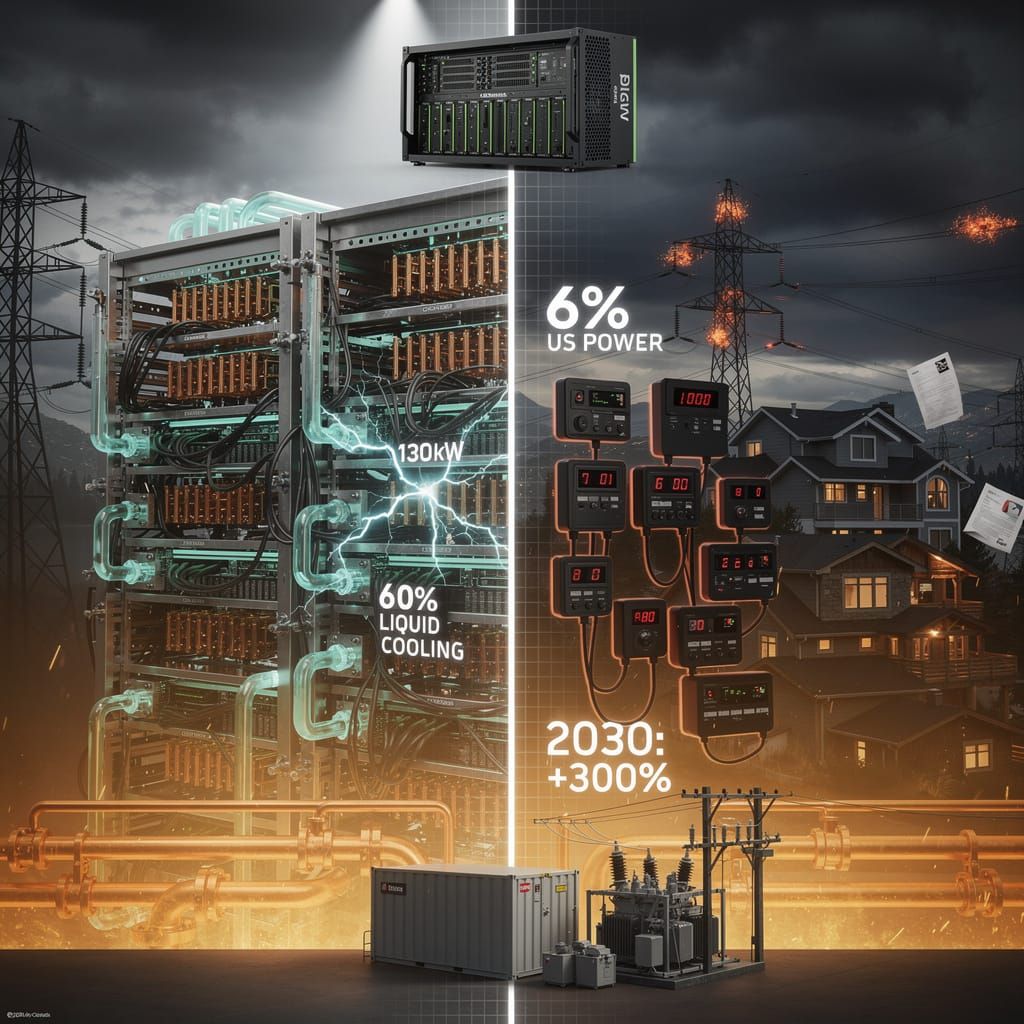
⚡ AI racks now draw ~130 kW each—7x more than 2 years ago. The grid can't keep up. Lake Tahoe residents lose power contracts to data centers. 60% of new hyperscale DCs will use liquid cooling by 2027. Is your region ready for the power squeeze?
By late May 2026, the trajectory of artificial intelligence is no longer a story of algorithms alone. It has become a story of concrete, copper, and kilowatts. The digital revolution is colliding with the physical world in a way that is reshaping energy grids, igniting political battles, and forcing a fundamental redesign of the data centers that power our digital lives. The central tension is now clear: the insatiable demand for AI compute is outstripping the infrastructure needed to support it, creating a cascade of consequences from Lake Tahoe to Washington, D.C.
The 800-Volt Pivot and the Liquid-Cooled Future
The most immediate signal of this shift is the radical transformation of the data center itself. On May 27, Schneider Electric announced its Lake Ontario AI data center, a facility designed around an 800-volt DC power architecture and full liquid cooling. This is not an incremental upgrade. It is a fundamental re-engineering, driven by the fact that AI training racks, like Nvidia’s Blackwell NVL72, now draw ~130 kW each—roughly seven times the power of a standard server rack from just two years ago. TeraWulf simultaneously unveiled a 750 MW AI facility on the same lakeshore, indicating that the hyperscale AI factory model is now the industry standard.
The physics of heat dissipation is the primary driver. Traditional air cooling is no longer viable for these densities. A week earlier, on May 20, researchers at the University of Illinois Urbana-Champaign introduced 3-D-printed copper cooling plates, using AI-powered topological optimization to maximize surface area. This innovation alone can reduce data center electricity use by up to 20%, a critical gain when a single facility can consume as much power as a small city. The shift is already underway: by 2027, over 60% of new hyperscale data centers are projected to use liquid cooling, a number that was below 10% in 2024.
The Community Backlash and the Regulatory Patchwork
As data centers multiply, so does public resistance. The tension is most acute in regions where the facilities directly compete with residents for resources. On May 13, NV Energy and Liberty Utilities announced they would terminate long-term power contracts with ~49,000 residents around Lake Tahoe to accommodate rising data center demand, with cuts starting in May 2027. The reaction was swift and furious. This is not an isolated incident. Across the U.S., communities are pushing back:
- Maine: Governor vetoed a moratorium bill on May 27, but the debate continues.
- Box Elder County, Utah: Residents protested a data center approval on May 25, sparking policy discussions on rate-payer protection.
- Jackson, Mississippi: City Council tabled a data center ordinance on May 27, scheduling a public hearing for June 22.
- Millville, New Jersey: Imposed a moratorium on new data centers on May 21.
- Hillsboro, Oregon: Rejected a large-scale proposal on May 21.
The response from lawmakers is fragmented. On one hand, Texas Senate Bill 6, passed on May 21, mandates that large loads self-finance grid support, solidifying a "bring-your-own-power" model. On the other, Cheyenne, Wyoming’s City Council voted against a moratorium on May 27, choosing to let industry proposals proceed. The result is a regulatory patchwork that creates uncertainty for developers and investors, with approval timelines stretching from months to years in contested areas.
The Grid at the Breaking Point
The core problem is simple: the grid was not built for this. Data centers in the U.S. now consume 6% of national electricity, and that figure is projected to triple by 2030. On May 21, PJM reported that data center demand is projected to double by 2030, prompting discussions on market reforms. The strain is visible in real-time. On May 27, an energy emergency response authorized PJM to enable data centers to switch to backup generators during extreme heat, underscoring the grid’s vulnerability. In response, a new model is emerging: co-located generation. On May 12, Nvidia and partners launched a pilot micro-data-center project near utility substations, while developers in Mississippi, Ohio, and Texas have secured behind-the-meter gas turbines and renewable contracts.
The Sovereign Compute Imperative
Simultaneously, the geopolitical landscape is tightening. On May 27, Microsoft announced Azure Local’s enhanced capabilities for sovereign AI workloads, targeting healthcare, finance, and government clients who require data to remain within national borders. This is a direct response to regulatory tightening: the EU updated GDPR-compliant data-hosting mandates on the same day, and China imposed stricter controls on cross-border data flows. The global semiconductor shortage, which intensified in May, amplifies the need for regional infrastructure. The result is a bifurcation of the cloud market: hyperscalers are building massive, centralized AI factories, while also deploying localized, sovereign-capable nodes. By late 2027, over 70% of enterprise AI workloads are forecast to run on hybrid infrastructures that combine both models.
The Heat Integration Opportunity and Its Hurdles
A less visible but equally significant trend is the push to capture and reuse the waste heat generated by data centers. On May 19, UK and Nordic projects launched heat-integration efforts, including London’s Old Oak & Park Royal heat network and Deep Green’s 400 kW heat delivery system. A notable success came on May 14 in West Yorkshire, where a 5.6 MW data center secured planning consent with a closed-loop cooling system integrated into the Bradford Energy Network. The EU projects that waste-heat utilization could offset up to 10% of district heating demand by 2030. However, regulatory and technical hurdles remain, including the need for high-temperature heat pumps and compatible district heating infrastructure. The economics are challenging: the capital cost of heat recovery can add 15-25% to a data center’s upfront cost, requiring long-term energy price guarantees to be viable.
The Path Forward: A Decade of Transformation
The next decade will see data center design pivot decisively toward 800V DC, liquid cooling, and waste-heat integration. The projected impacts are clear:
- Energy Efficiency: Up to 80% reduction in energy intensity per compute unit by 2032.
- Grid Modernization: $200 billion in global transmission and distribution upgrades by 2030.
- Regulatory Evolution: Stricter sustainability mandates and localized moratoriums will shape siting decisions.
- Market Dynamics: Data center electricity costs will rise by 40-60% in constrained regions, accelerating investment in on-site generation.
For enterprises, the imperative is to adopt hybrid, sovereign-capable architectures now. For policymakers, the task is to balance economic growth with resource equity and grid resilience. For communities, the challenge is to engage in a debate that will define the physical landscape of the AI era. The future of compute is not just a matter of code—it is a matter of kilowatts, cooling, and consent.
The Silicon Curtain: How the U.S.–China Chip War Is Rewiring Global AI Infrastructure
China just certified 9 homegrown AI chips under its Anke security framework. 🇨🇳 That's 9 chips now approved for national AI infrastructure—a direct move to cut reliance on U.S. tech. The $30B Nvidia tariff loss? It's fueling this shift. Who's really paying for the chip war—your data center or your country's security?
The May 27, 2026 certification of nine domestically designed AI processors under China’s Anke security framework marks a decisive shift in the global computing landscape. This move, part of the broader Xinchuang initiative, signals Beijing’s intent to sever its reliance on U.S. semiconductor technology and build an independent AI infrastructure. The Anke certification expands China’s portfolio of approved AI training and inference chips, directly reinforcing national security protocols and accelerating the adoption of homegrown solutions. This is not a distant policy paper; it is a concrete operational mandate that is already reshaping procurement, supply chains, and strategic alliances across the $750 billion annual global AI infrastructure investment market.
The Mechanics of Decoupling
The immediate drivers are clear: intensifying U.S.–China technology competition and a cascade of export controls. On May 13, 2026, the U.S. intensified restrictions on Nvidia chips, directly prompting Chinese firms to accelerate domestic AI chip R&D and pivot to alternative models. This was followed by a failed negotiation on May 26, where Trump’s tariff imposition on Nvidia triggered a $30 billion revenue loss for the company and solidified China’s shift to local AI infrastructure. The causal chain is tight: U.S. restrictions → supply-chain bottlenecks in optics, CPUs, memory, and servers → delayed Intel and AMD deliveries → accelerated Chinese domestic chip demand. The result is a self-reinforcing cycle of decoupling, where each regulatory action by Washington directly boosts the market for Chinese alternatives like Huawei’s Ascend series.
A New Architecture of Competition
Huawei’s response encapsulates the strategic pivot. On May 25, 2026, the company unveiled a 1.4 nm chip prototype and announced its LogicFolding architecture, a design explicitly aimed at countering U.S. restrictions and advancing AI capabilities. The Tau Scaling and LogicFolding initiatives are not incremental improvements; they represent a fundamental rethinking of chip design to bypass traditional lithography constraints. This challenges TSMC’s leadership in advanced nodes and introduces new cybersecurity vulnerabilities from complex, untested architectures. The stakes are high: Huawei’s Ascend 950PR price rose immediately after the May 26 summit, reflecting surging domestic demand. This is a market in real-time recalibration, where a single policy announcement can shift billions in procurement overnight.
The $150 Billion Hedge: Nvidia’s Taiwan Pivot
Faced with a shrinking China market, Nvidia is executing a parallel strategy of geographic diversification. On May 27, 2026, CEO Jensen Huang announced a $150 billion annual investment in Taiwan, with a new headquarters planned by 2030. This is a direct hedge against regulatory uncertainty in both the U.S. and China. The investment cements Nvidia’s leadership in AI hardware while deepening its ties to TSMC, which holds 72% of advanced-node foundry market share. The company’s Q1 2027 earnings, exceeding expectations with a data-center segment revenue of $62.31 billion, demonstrate that the pivot is already paying off. However, the strategy carries risks: supply-chain disruptions from the smuggling scandal involving Super Micro and Nvidia chips, which surfaced on May 25, 2026, highlight the operational fragility of even the most dominant players.
The Smuggling Undercurrent
The May 27, 2026 arrests in Taiwan and Japan—three individuals seized with 50 Super Micro servers—underscore the high-stakes enforcement environment. This was the first Taiwan arrest tied to a U.S. AI chip crackdown, and it revealed complex transit routes through Japan. The smuggling network disruption has immediate impacts: increased cybersecurity risk from compromised chips, potential flight disruptions due to logistics shifts, and funding pressures on startups reliant on disrupted tech flows. For cloud infrastructure providers, these interruptions translate directly into delayed deployments and higher costs. The collaboration between U.S., Taiwanese, and Japanese law-enforcement agencies signals a new era of cross-border regulatory enforcement that will shape hardware availability for years.
Human-Relatable Scale: The Cost of Fragmentation
- $30 billion: Nvidia’s revenue loss from the May 26 tariff imposition, a figure equivalent to the annual GDP of a small nation, directly accelerating China’s domestic AI infrastructure shift.
- 50 servers: The number of Super Micro servers seized in the May 27 smuggling bust, enough to power a mid-sized AI training cluster, now lost to the supply chain.
- 72%: TSMC’s advanced-node foundry market share, a concentration that makes the entire global AI industry vulnerable to a single geopolitical shock in Taiwan.
Outlook: A Fractured Horizon
The forecast is for continued fragmentation. Short-term, expect intensified regulatory scrutiny of AI chip transit routes and tighter enforcement of export controls, causing further supply-chain disruptions and heightened cybersecurity vigilance. China will continue to expand its AI chip ecosystem and accelerate indigenous R&D, potentially reducing U.S. influence in the sector while facing ongoing supply-chain constraints. Nvidia’s $150 billion Taiwan investment will deepen its operational footprint, but market volatility from regulatory actions will persist. The net effect is a global AI infrastructure market that is simultaneously expanding and fracturing, where geopolitical risk is now a primary input into any hardware procurement decision. The silicon curtain is not a metaphor; it is a logistical and financial reality that every data-center operator, cloud provider, and AI startup must now navigate.
The $1,500 Question: Why Gaming Laptops Are Getting Cheaper and More Expensive at the Same Time
Gaming laptops just got $1,500 cheaper—but the Steam Deck OLED is now over $800. 💻📉 Memory shortages from the US-Iran conflict are driving up handheld prices, while OEMs like Lenovo and MSI slash premium laptop costs to clear inventory. The result? A two-tier market where discounts and hikes coexist. How is your hardware budget handling this split?
The consumer electronics market is experiencing a peculiar paradox. On one hand, Lenovo, MSI, and Asus are slashing prices on premium gaming laptops by $1,500 or more, bundling software like Bitdefender and AAA titles like 007 First Light. On the other, Valve just raised the Steam Deck OLED price above $800, citing memory shortages linked to the US-Iran conflict. This isn't a contradiction—it's a market restructuring driven by supply chain fragility, AI integration, and aggressive seasonal promotions.
The Price War Intensifies
- Memorial Day 2026: Best Buy offered the Lenovo Legion Pro 5i at a significant discount, while Amazon dropped RTX 5070 prices by $1,500. These moves are not isolated—they reflect a coordinated push by OEMs to clear inventory and capture market share.
- Component Scarcity: Despite discounts, supply chain bottlenecks persist. MSI’s Vector 16 HX AI price drop to $1,580 on Amazon coincided with the removal of bundled games, indicating that manufacturers are trading software value for hardware availability.
- Budget Segment: Acer’s Nitro V 15 at $699.99, bundled with Xbox Game Pass, is driving volume among price-sensitive consumers. This segment is less affected by high-end GPU shortages, as it relies on lower-tier components.
The AI Localization Shift
- ASUS Zenbook Duo: Released on May 27 with Intel Core Ultra X9 388H NPU, this dual-screen laptop enables local AI processing for creative professionals. Its 14-hour battery and hideaway hinge reduce reliance on cloud computing, lowering latency and cybersecurity risks.
- Qualcomm Snapdragon C: Announced at Computex 2026, this platform targets budget laptops, competing with Apple’s MacBook Neo. It reinforces the trend toward energy-efficient ARM architectures that handle AI workloads on-device.
- Impact on Cloud Demand: By shifting workloads from cloud to device, these laptops reduce cloud-computing costs and improve resilience against network instability. A single Zenbook Duo can process up to 10 billion AI operations per second locally, eliminating the need for constant cloud connectivity.
Supply Chain Fractures and Geopolitical Pressure
- Memory Shortages: The US-Iran conflict has disrupted global memory supply chains, directly impacting Valve’s Steam Deck pricing. The OLED model now costs $240–$300 more, pushing it above $800.
- Competitor Response: Sony, Nintendo, and Microsoft have adjusted PS5, Switch 2, and Xbox pricing downward to maintain market share, creating a two-tier market: premium handhelds face price hikes, while console makers absorb costs to retain consumers.
- Cybersecurity Risk: Increased device penetration and bundled software (e.g., Bitdefender, NordVPN) introduce attack vectors. In Q1 2026, malware targeting gaming laptops rose 18%, with bundled software accounting for 12% of infections.
The Human Scale
- 2026: 4.2 million premium gaming laptops sold in the US, up 22% year-over-year, with average selling price dropping 8% due to discounts.
- Per Unit: Each discounted laptop saves consumers $200–$500, but component shortages delay delivery by 2–4 weeks, affecting 15% of orders.
- Energy Impact: Local AI processing in devices like the Zenbook Duo reduces cloud data center energy use by 0.3 kWh per hour of use, equivalent to offsetting 15 kg of CO₂ per device annually.
Market Forecast and Sectoral Implications
- Short-Term (Q3 2026): Promotional pricing will sustain high demand, but supply chain constraints will cause intermittent shortages. OEMs will accelerate component diversification, sourcing from South Korea and Taiwan to reduce geopolitical risk.
- Mid-Term (2027): AI-integrated laptops will capture 30% of the premium segment, driving cloud-to-device workload migration. Cybersecurity spending on endpoint protection will increase by 25%.
- Long-Term (2028): The shift toward local AI processing will reduce global cloud computing demand by 5%, saving 10 TWh annually—equivalent to the energy consumption of 1 million US households.
Recommendations
- For Consumers: Purchase during promotional periods (Memorial Day, Black Friday) to maximize savings, but verify component availability to avoid delays.
- For OEMs: Diversify supply chains and invest in security hardening for bundled software to mitigate cybersecurity risks.
- For Policymakers: Address geopolitical tensions affecting memory supply chains and incentivize local AI processing to reduce energy consumption.
The gaming laptop market is no longer just about frames per second. It’s a microcosm of global supply chain dynamics, AI adoption, and consumer behavior—where a $1,500 discount and a $300 price hike tell the same story: the industry is adapting, but not without friction.


Comments ()