The Great Funding Squeeze: Proof Beats Pitches in 2026
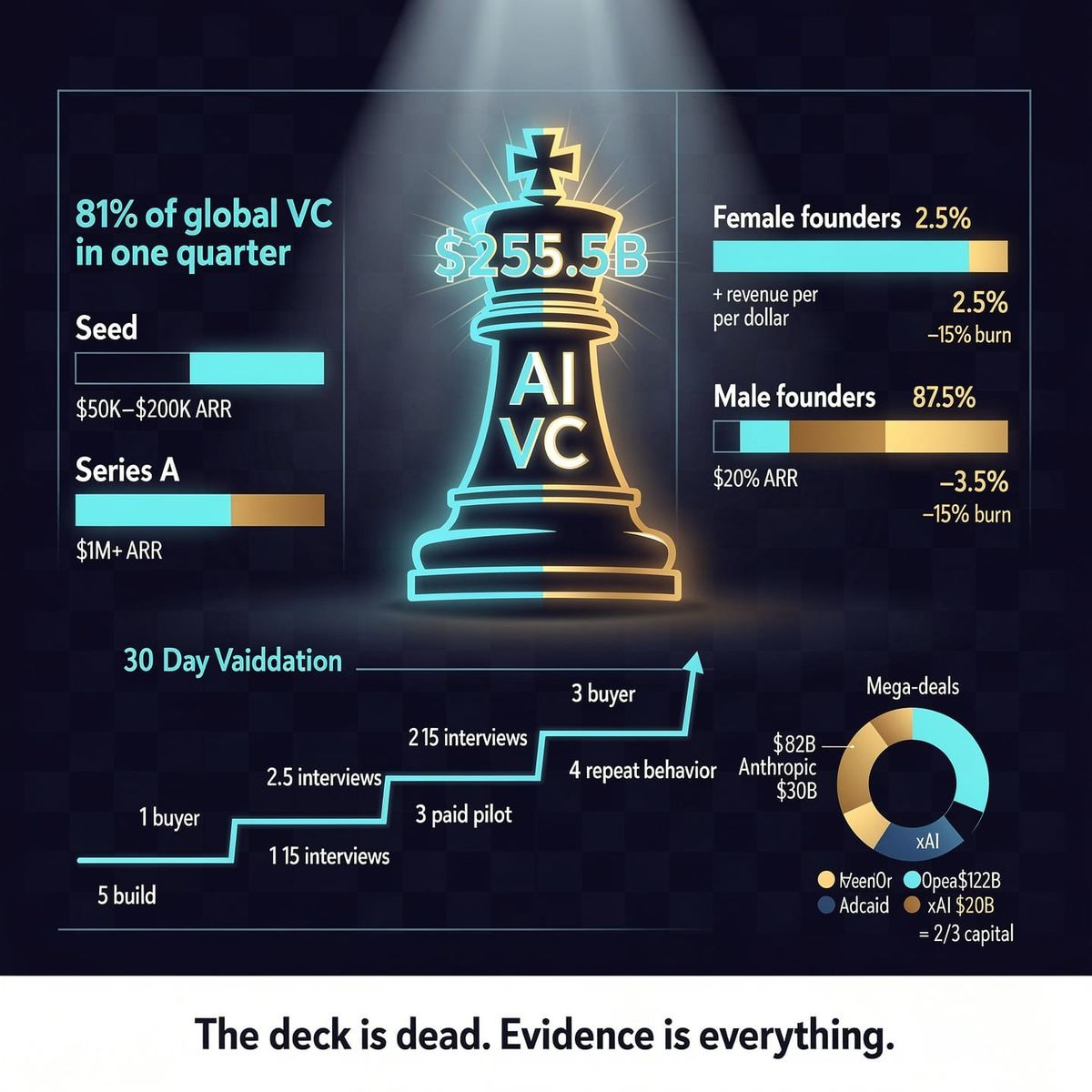
The startup deck is dead in 2026—evidence is everything. A single Q1 quarter saw $255.5B pour into AI startups, about 81% of global venture dollars. For everyone else, the bar has moved sharply: seed rounds now demand $50K–$200K in ARR, and Series A wants $1M+, with median ARR up 75% since 2021. Only ~10–11% of seed companies make it to Series A. Founders are flipping the playbook: validate first, fund later. Find one buyer, run a manual paid pilot, demand a payment, build only what repeats. The winners won't pitch what they will build. They show what's already working.
Picture the hustle: a founder with a deck, a dream, and a demo that kind of works. That was the startup playbook for a decade. In October 2026, that deck is about as useful as a printed map at an airport. The game changed, and the new rules are written in cold, hard cash.
Let's start with the headline math, because nothing says "reality check" like a number. Venture capital in 2026 isn't just tight—it's surgically focused. Q1 2026 alone saw a jaw-dropping $255.5B pour into AI startups, already beating 2025's entire yearly total. And here's the mind-bender: a single quarter of AI funding hit 81% of global venture dollars. If you're not running an AI-adjacent play, you're not just in the minor leagues—you're not on the field. But even being in the game isn't enough anymore.
Here's the punchline rewriting founder behavior: seed rounds now demand $50K–$200K in annual recurring revenue (ARR), and Series A wants $1M+. Not a decade ago—today. Investors inspect evidence like IRS auditors at a yacht club. Paid pilots, retention curves, signed design partners, lab results, patents, clean legal/IP records, and an 18-to-24-month cash map are the new currency. Vanity metrics and "nuclear growth potential" stories are dead on arrival.
The Women's Paradox
Now for the plot twist that leaves everyone scratching their heads. In 2025, European data showed all-female founding teams pulling in just ~2.5% of equity investment versus under 10% for mixed-gender teams, with a stunning 87.5% of investment flowing to male-founded companies. They get grilled with prevention-focused questions while men get growth-oriented ones—research shows founders hit with "prevention" grilling raise around $500K versus $7.9M for those asked "promotion" questions. They carry heavier unpaid care burdens. And yet—here's the kicker—women-led startups generate more revenue per dollar invested, with 15% lower burn rates. A wave of 10 European VC funds (Auxxo, SISTAFUND, Borski) now carries explicit women-founder mandates, but the gap remains stubborn.
It's the least efficient market in the world, and it's leaving value on the table.
Bootstrapping Is the New Front Door
Since the old "idea → pitch deck → accelerator → seed" pipeline is now a leaky boat, the smart money—and smart founders—are going the other way. October's trend data is loud: validate first, fund later. The winning playbook is textbook-lean:
- Find one buyer and one expensive, repeated problem
- Run 15–25 interviews, then offer a manual paid pilot (yes, ask for money early)
- Build only the part that gets repeat behavior
- Track cash runway, MRR, gross margin, sales cycle, and founder time like your life depends on it—because it does
The best niches? Narrow B2B offers, service-backed software, micro-SaaS, compliance and IP tooling, productized specialist services. The common pitfalls? Building before selling, underpricing because cheap AI tools made you confident, ignoring legal/IP risk, and copying venture-backed competitors with deeper pockets.
The 30-Day Truth Test
Beyond the usual "validate with customers" advice, there's a disciplined framework making the rounds: pick one buyer and one problem, write one testable assumption, talk to 15 potential buyers, run a manual pilot, and demand a payment or deposit. Document repeat behavior, build only what repeats, review the evidence after 30 days. If the evidence says no, you just saved yourself a year and a pile of someone else's money.
Make no mistake about the bar, though. The AI gold rush is a mirage for most—three mega-deals (OpenAI's $122B, Anthropic's $30B, xAI's $20B) captured two-thirds of Q1's capital, and nearly 75% of US Q1 investment went into just five deals. Carta's data confirms Series A arrival is now the grown-up version of the hustle: median ARR at Series A has climbed 75% from 2021 to $2.5M, while median headcount fell to about 16 people. Only 10–11% of the latest seed cohort graduates to Series A. Meanwhile, the unsexy agent-infrastructure layer stays chronically underfunded next to the model-provider giants.
So What Changes?
The October market is harsher but healthier. Capital is available, but it has a low tolerance for theater and a high bar for proof. For female founders especially, the numbers say what strategy should be: bootstrap first, test demand with no-code and AI, then raise on your own terms. For everyone else, the lesson is identical—the winners in this market don't pitch what they will build. They show what's already working.
The deck is dead. The evidence is everything.
Comments ()