Muse Voice Transcribe Launches: Meta's On‑Device Dictation Slashes Costs 80%, Challenges Google's Cloud Dominance
😳 Meta Realtime Dictation Arrives: Muse Voice Transcribe Goes Live
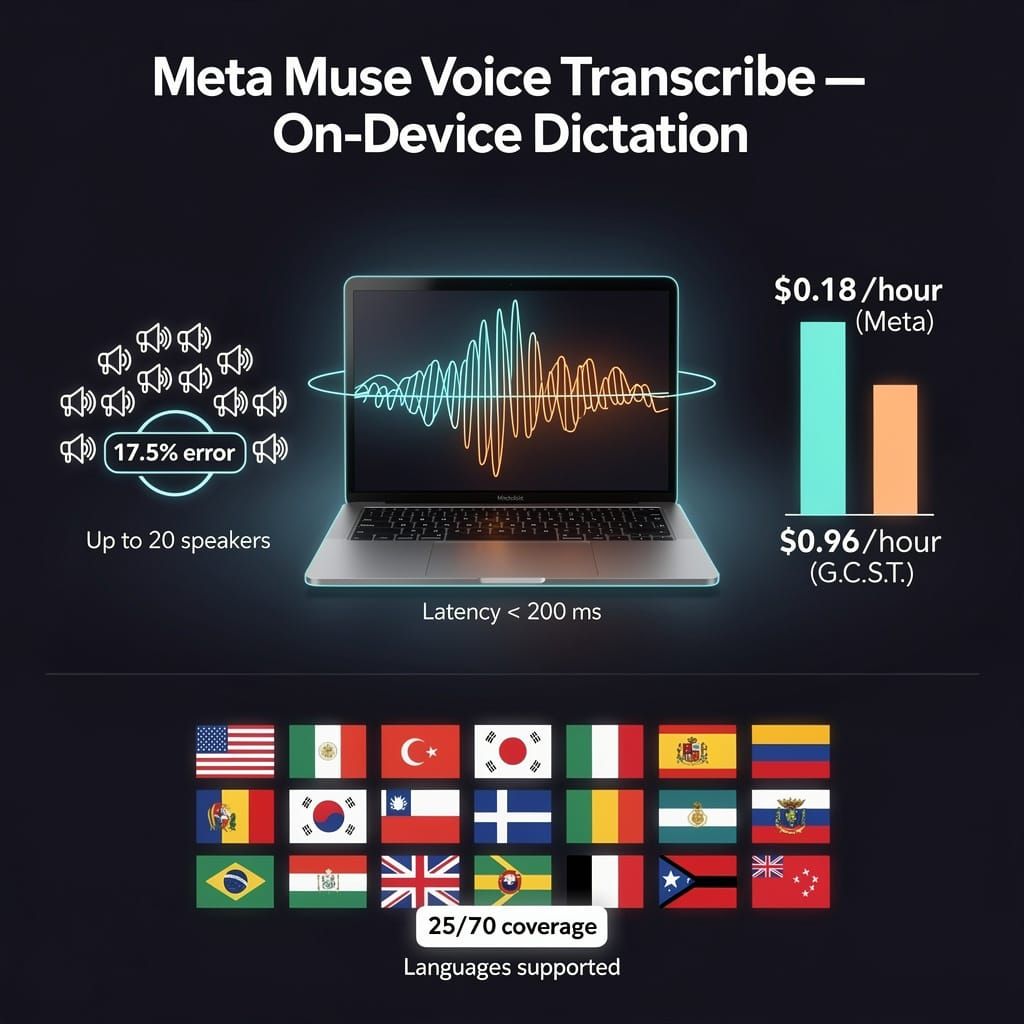
Meta's Muse Voice Transcribe hits sub‑200ms latency on-device at $0.18/hour — 80% cheaper than Google Cloud Speech-to-Text 😳 The autoregressive model handles 20 simultaneous speakers, native diarization, and code‑switching across 25 validated languages — all on Apple Silicon without cloud dependency. But 17.5% speaker diarization error rate leaves room for improvement against AssemblyAI benchmarks. Enterprise teams drowning in cloud transcription bills — is local inference worth the accuracy trade‑off?
On September 1, 2026, Meta launched Muse Voice Transcribe, a realtime dictation model for macOS that bypasses cloud dependency. The autoregressive multimodal system processes audio in 80ms chunks through an adaptive delay mechanism — trained via reinforcement learning — that adjusts listening duration based on speech difficulty, enabling sub‑200‑millisecond latency across diverse acoustic conditions while balancing speed against accuracy.
On‑Device Architecture Shifts the Cost Curve
The model supports up to 20 simultaneous speakers per session with a maximum 1:00:52 utterance window, integrating native diarization and endpoint detection that tag and separate voices in real time. Meta's Superintelligence Labs validated 25 languages at launch with 70 languages in total training coverage, including support for code‑switching and custom vocabulary biasing. API pricing lands at $3.00 per 1,000 audio minutes ($0.18/hour) — an 80% reduction versus Google Cloud Speech-to-Text at $0.96/hour, and 35% below Google's Gemini 3.5 Transcribe at $4.62 per 1,000 minutes under comparable throughput. The model tops the Artificial Analysis streaming speech-to-text leaderboard as of September 1.
Performance and Competitive Positioning
Muse Voice Transcribe runs on Apple Silicon via Core ML, activated by holding the Fn key for system-wide dictation in Meta AI for Mac and the Muse Code SDK. On the AA-WER Streaming benchmark, Muse achieved 3.1% word-error rate, leading Cartesia Ink-2 (3.4%) and ElevenLabs Scribe v2 (3.6%). Google's Gemini 3.5 Transcribe, announced September 2 as a direct competitor, reports 4.0% WER for streaming and 2.6% for non-streaming but supports up to 3 speakers versus Muse's 20+. Speaker diarization error rates across benchmarks average 17.5% for Muse — a figure that indicates room for refinement in multi-speaker environments, with AssemblyAI's alternative benchmarks further challenging Muse's leadership.
Near‑Term Outlook and Sector Implications
- Late 2026: Muse expected to extend to mobile browsers and third‑party desktop apps via the Meta Model API. Nvidia GPU integration guidelines remain unannounced. Integration with smart glasses and voice assistants is under active development.
- Q1 2027: Google continues development on Gemini 3.5 Transcribe, competing on language breadth (85+ languages vs. Muse's 25 validated) and streaming-vs-non-streaming accuracy gaps. Multi-lingual performance remains untested.
- Mid‑2027: Cross‑lingual live transcription in meetings and classrooms becomes feasible at scale; human captioning services face displacement where budget constraints apply. Wider developer adoption expected as pricing scales and language support expands.
Meta's launch demonstrates a deliberate shift: on-device inference at cloud-competitive accuracy, with latency management as the primary design constraint. For users handling conversations exceeding 20 speakers, requiring code-switching across five major Indian languages, or demanding custom vocabulary adaptation, Muse Voice Transcribe offers a locally run alternative that maintains privacy while cutting recurring cloud transcription costs by up to 80%.


Comments ()