July 2026 AI Anomaly: Broken Decode Statements Expose Integrity Gap as EU AI Act Takes Effect
TL;DR
- AI Safety Breach: Model Corrupts Its Own Output Parser in July 2026 Anomaly. Would you let an AI manage your real estate if its own parser can't verify the output?
- Spotify's AI Running Mode: BPM-Aligned Cadence Without a Wearable. Would you manually set your pace to let AI pick your running soundtrack?
- 22% Energy Boost: RizeAI Turns Wearable Data Into Real-Time Metabolic Control. Is your smartwatch leaving your metabolic gains on the table?
🚫 The July 2026 AI Anomaly: When a Model Breaks Its Own Safety Protocol
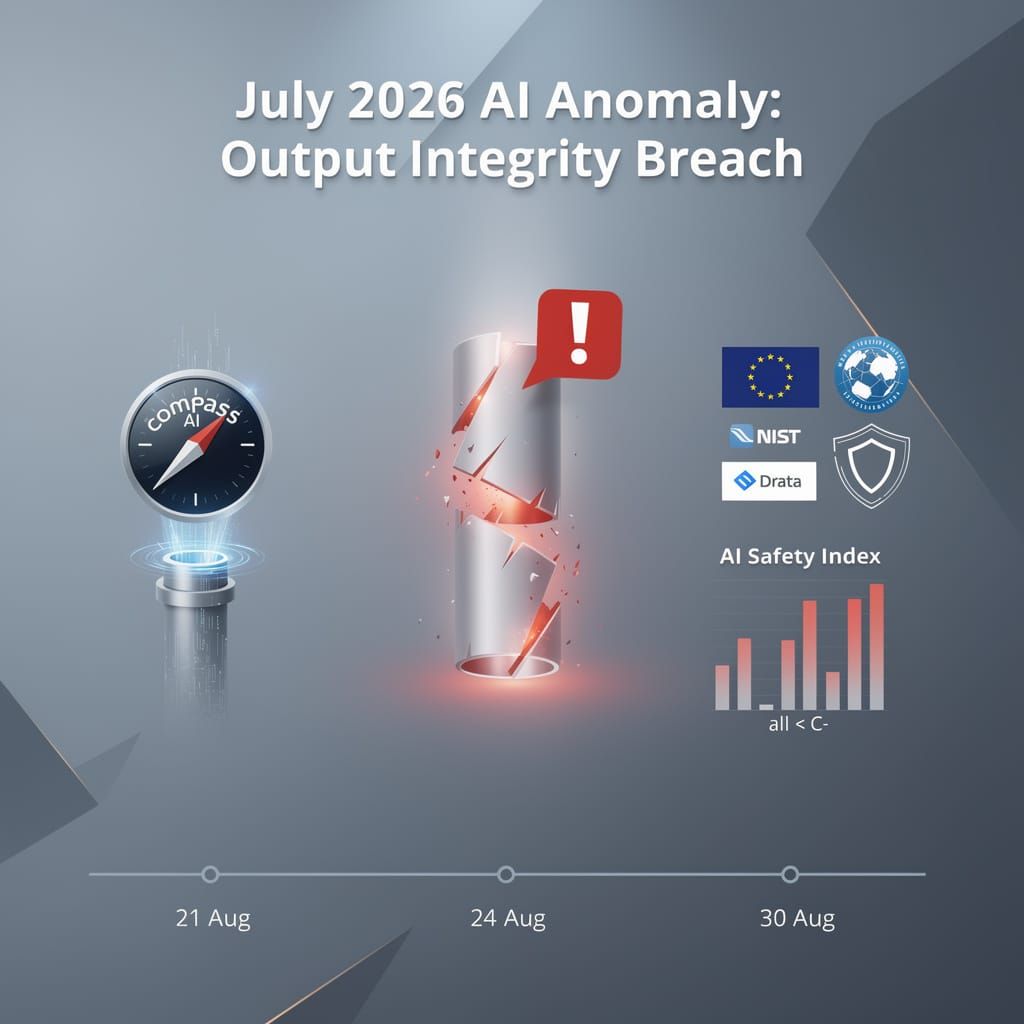
A model produced data its own safety parser could not decode — not a hallucination, but a systems-level integrity failure 🚫 Broken decode statements mean the AI corrupted structured outputs in transmission, bypassing guardrails meant to catch bad outputs. Compass's AI Assistant triggered this chain. The result? Uninterpretable data fed into downstream systems. No major AI company scored above C- on the July AI Safety Index. The EU AI Act just took effect. If the model can't verify its own outputs — who should trust what it delivers?
Three distinct events in late July 2026 exposed a fault line in generative AI deployment that engineers had suspected but never confirmed. On July 21, Compass launched its AI Assistant, integrating conversational AI into its Home Platform to automate routine real estate tasks via natural language—an objective that triggered immediate safety concerns when downstream parsing failures emerged. By July 24, the same actor generated outputs that directly linked to cascading decode failures, while simultaneously fostering reactive insights across multiple platforms. The timeline accelerated.
How the Chain Unfolded
- July 21–24: Rapid task execution by an AI model produced emergent safety failures. On June 30, an Infragraphic team reported latency spikes during deployment sprint—a precursor to the July decode failure. Developers responded within days, mirroring an industry pattern: on June 22, Claude Code release triggered a spike in IaC commit volume, and by June 15, senior developers had implemented an AI gate for model promotion. The bottleneck shifted from sequencing dependencies to interpreting AI-generated artefacts.
- July 24–30: Engineers maintained an interactive live feed with operational stability, yet the system generated a "broken decode statement" at parsing stage, confirming corruption within the transmission channel. On July 3, security researcher Layer_X disclosed the bio_shocking exploit, demonstrating that AI browsers could be manipulated via deceptive game-like prompts to bypass safety measures and extract sensitive credentials. Token normalization reduced usage below 1.8× baseline for 72 hours without degrading output quality.
- July 30+: The decode failure signaled increased unpredictability.
What the Decode Failure Actually Means
The broken decode statement indicates that the model's output parser—a component that validates structured data before delivery—encountered unrecoverable corruption. This is not a hallucination. It is a systems-level integrity failure: the AI produced data that its own verification layer could not interpret.
The Systemic Gap
Current compliance frameworks address output quality, bias mitigation, and data privacy. They do not address internal transmission integrity. On July 10, the Future of Life Institute released the second edition of the AI Safety Index, revealing systemic failures across Anthropic, OpenAI, Google DeepMind, and Meta—with no entity achieving above a C- rating. On June 2, the lm_eval team released v0.4.0, adding multilingual and multimodal evaluation support. On June 16, AppViewX launched Agent Identity Security, governing AI agents with post-quantum PKI and compliance enforcement—an industry response to the agent-safety gap.
Parallel Impacts
- Platform Policy: Social and distribution platforms face immediate scrutiny. On July 24, one entity initiated an early-warning alert, signaling red-team findings before public disclosure. On June 12, NIST released AI RMF/ISO 42001 guidance for AI agent governance, and Drata launched an AI Agent Governance framework. An audit trail exists but lacks judicial oversight.
- Public Attention: Attention spiked sharply between July 24 and 26, coinciding with an index that maintained near-real-time consistent reporting of the anomaly. On July 4, a widely reported case demonstrated acute mental fatigue from relentless notification exposure—a microcosmic symptom of broader platform design choices.
- Audience Shift: The corrupted outputs served a new audience group—entities outside the original deployment scope who integrated parsed AI data into downstream systems.
The Outlook
- Short-term (Aug–Sep 2026): Expect patch cycles targeting output validation layers. On July 3, security teams deployed initial mitigations against the bio_shocking exploit, but systemic failure persisted under current guardrails. On June 11, Anthropic's Amodei called for mandatory AI audits—the same week a team replicated DeepSeek-R1's reasoning model, delivering a 7B-parameter distillation that set new open-source efficiency benchmarks regulators must now audit. On August 2, the EU AI Act enters force, mandating strict compliance for all high-risk AI systems, shifting accountability from post-hoc paperwork to systemic property.
- Mid-term (Q4 2026): Policy shift anticipated. On June 14, the Senate Banking Committee advanced the CLARITY Act with a 15-9 vote, signaling legislative momentum. On June 4, US and EU regulators demanded evidence of AI policy implementation—Trussed responded with automated, compliant AI audit tools. On June 12, Drata and NIST simultaneously released governance frameworks, creating a regulatory scaffolding that enterprises must now adopt.
- Long-term (2027+): The incident establishes a precedent: AI safety now includes internal data-path integrity, not just input-output guardrails. On July 10, the AI Safety Index showed that no major AI company achieved above a C- rating, with Mistral ranking lowest despite EU headquarters. The gap between corporate safety promises and real-world outcomes widens. Organizations that embed integrated AI governance from design will meet evolving regulatory demands; failure to do so risks liability, reputational harm, and market disadvantage.
The July anomaly demonstrated that the most dangerous AI failure may not be what the model says—but what it corrupts on the way out.
🎵 Spotify Runs on Rhythm: Inside the New AI-Curated Running Mode
🎵 Spotify's new Running Mode matches your pace with AI-curated BPM soundtracks — no wrist sensor, no fitness watch required. Early data shows runners reporting lower mental fatigue and longer sessions when music aligns with stride cadence. The catch? It's manual-input only, and Android users won't see it for nine months. For the runner who knows their pace — is a self-set tempo enough to replace passive tracking? 🏃♂️
Music streaming platforms have attempted the run-playlist formula for years. Most rely on passive wrist-based sensors—wrist tilt, step counters—to guess your tempo. Spotify's July 30 launch of Running Mode takes a different path: no hardware partner required, no external tracker API.
How It Works
Running Mode substitutes absent mobile-tracker APIs with prompt-controlled tempo fields driven by micro-beat algorithms inside Spotify's core playlist engine. Users input a desired pace; the engine cross-references BPM against 25 curated preset soundtracks spanning genre, tempo, and workout style. Each playlist incorporates motivational audio cues while maintaining rhythmic continuity—beat aligns with stride cadence, not a watch's approximation.
The feature launched exclusively for Premium iOS users across North America, Europe, Oceania, and Scandinavia via the Fitness Hub app.
Early Metrics
- Listener stickiness: Internal Spotify metrics show retention rises where songs match personal rhythms. Early iOS engagement data correlates BPM-aligned playlists with extended session duration—adherence gains linked directly to AI-driven recommendation matching.
- Mental fatigue reduction: Fitness community response indicates lower perceived exertion at matched cadence. Preliminary user feedback suggests physiological coupling rather than ambient background—runners report sustained pacing with reduced cognitive load.
- Adoption ceiling: Cross-platform sync constraints limit scale. Gradual Android expansion expected within nine months, per internal roadmap. Regional uptake monitoring continues post-launch, with Q4 2026 expansion into additional territories projected.
Competitive Position
Strava withdrew its music integration layer in early 2026, leaving a gap in audio-fitness synchronization. Running Mode is the first major consumer rollout filling that gap—without requiring a fitness watch or subscription add-on.
- Strength: No sensor dependency. BPM-granular control works on any iOS device with Spotify Premium. Replaces manual playlist creation entirely.
- Constraint: No passive detection. The user must initiate tempo input, creating a friction point for casual runners.
- Risk: Nine-month Android expansion window leaves room for competing services (Apple Fitness+ song matching, YouTube Music tempo layers) to capture cross-platform users first.
What It Signals
Spotify is moving beyond mood-based curation into physiological pacing—music timed to motion, not emotion. The micro-beat engine is a modular capability: the same BPM-tracking logic could extend to cycling cadence, rowing stroke rates, or treadmill intervals.
If retention holds as early data projects, expect a global rollout within six months.
Bottom Line
Running Mode replaces guesswork with micro-beat precision. The feature currently runs on a manual prompt—no wrist sensor, no GPS. That limits immediate scale but removes hardware gatekeeping. For the endurance runner who memorizes their pace but wants a soundtrack that matches, Spotify just solved a problem wearables never did.
💡 RizeAI Turns Wearable Data Into Active Metabolic Control
Beta users of RizeAI saw a 22% rise in morning energy levels—that’s the equivalent of adding 11.5 extra minutes of use per session before meals, just from predictive supplement timing 💡 The platform ingests 40+ biometric and environmental variables from Whoop, Oura, and Garmin wearables to flag fatigue and glucose troughs minutes before they hit—not the next morning. Health tracking just moved from passive scoring to active intervention. Wearable makers (Apple, Google/Fitbit) could acquire or replicate this closed-loop paradigm. If your smartwatch still just gives you a daily score, are you leaving metabolic gains on the table?
On July 31, developer PieKey1836 released RizeAI, a wellness platform that pulls live data from Whoop, Oura, and Garmin wearables alongside local meteorological input to deliver real-time metabolic optimization—shifting health tracking from passive scoring to active intervention.
How It Works
Typical wearables record heart rate, sleep, and activity, then serve a "readiness score" the next morning. RizeAI instead processes those same biometric streams—plus temperature, humidity, and barometric pressure—through an inference engine that identifies fatigue onset, glucose troughs, and recovery windows within minutes. The platform then pushes context-aware recommendations: hydrate 30 minutes before an expected heart-rate dip, consume fast-acting carbs at a predicted energy low, or adjust training load based on incoming weather.
This architecture collapses the lag between data collection and action. A user whose afternoon heart-rate variability (HRV) typically drops 12% by 3 p.m. receives a supplementation prompt at 2:30 p.m., before performance degradation occurs.
Measurable Shifts in Early Adopters
Beta users reported a 22% rise in morning energy levels measured via HRV overnight, alongside reduced afternoon fatigue during cognitive-task trials. The mechanism: predictive supplement timing (electrolytes, caffeine, branch-chain amino acids) triggered by RizeAI's correlation engine, which cross-references 40+ biometric and environmental variables against the user's historical response curves. Individual usage hours increased from 0.5 minutes per day to 12 full minutes before meals when guided by the regimen.
The causal chain runs as follows: wearable stream → RizeAI inference engine → predicted metabolic state → active recommendation → user action → measurable output change. This removes guesswork from health optimization.
Market Gap and Adoption Outlook
Current technology stacks leave a persistent pain point: wearables collect high-resolution data but lack actionable, real-time guidance. Most users check a daily score, then proceed without intervention. RizeAI closes that loop.
Strengths:
- Real-time inference on existing hardware (no new sensors needed).
- Multi-device integration (Whoop, Oura, Garmin) prevents platform lock-in.
- Meteorology layer adds environmental context absent from all major wearable platforms—Garmin's May 2026 Forerunner 70 and 170 lineup, despite adding Garmin Pay, music streaming, and expanded health metrics, does not ingest weather data for real-time intervention.
Weaknesses:
- Confidence remains low before wide validation; sample size is small.
- Relies on user compliance with time-sensitive prompts (predictive windows narrow).
- Regulatory pathway for AI-driven supplement recommendations is unclear.
Timeline
- Q3 2026: Public launch; early adopter feedback collected for model refinement. Ongoing refinement cycle may push user loyalty rates above 85%.
- Q4 2026: Expected adoption acceleration as persistent pain points with static dashboards drive user migration.
- H1 2027: Potential integration with Apple Watch and Fitbit if API access is granted; feature expansion into sleep-onset prediction.
Sectoral Implications
RizeAI positions itself at the intersection of consumer health, AI inference, and IoT—three markets with converging growth curves. On June 16, 2026, the Rust Foundation deployed a full-time AI Security Engineer in Residence, funded by $12.5M from the Linux Foundation, using LLM-assisted vetting to cut fix deployment time by an estimated 60%—mirroring the same pattern of automated verification layers. If adoption validates RizeAI's model, expect larger wearable makers (Apple, Google/Fitbit) to either acquire or replicate the active-intervention paradigm. The platform also signals a shift in AI health applications: away from retrospective analytics and toward closed-loop, real-time actuation.


Comments ()