Judge halts Big Bend border wall construction
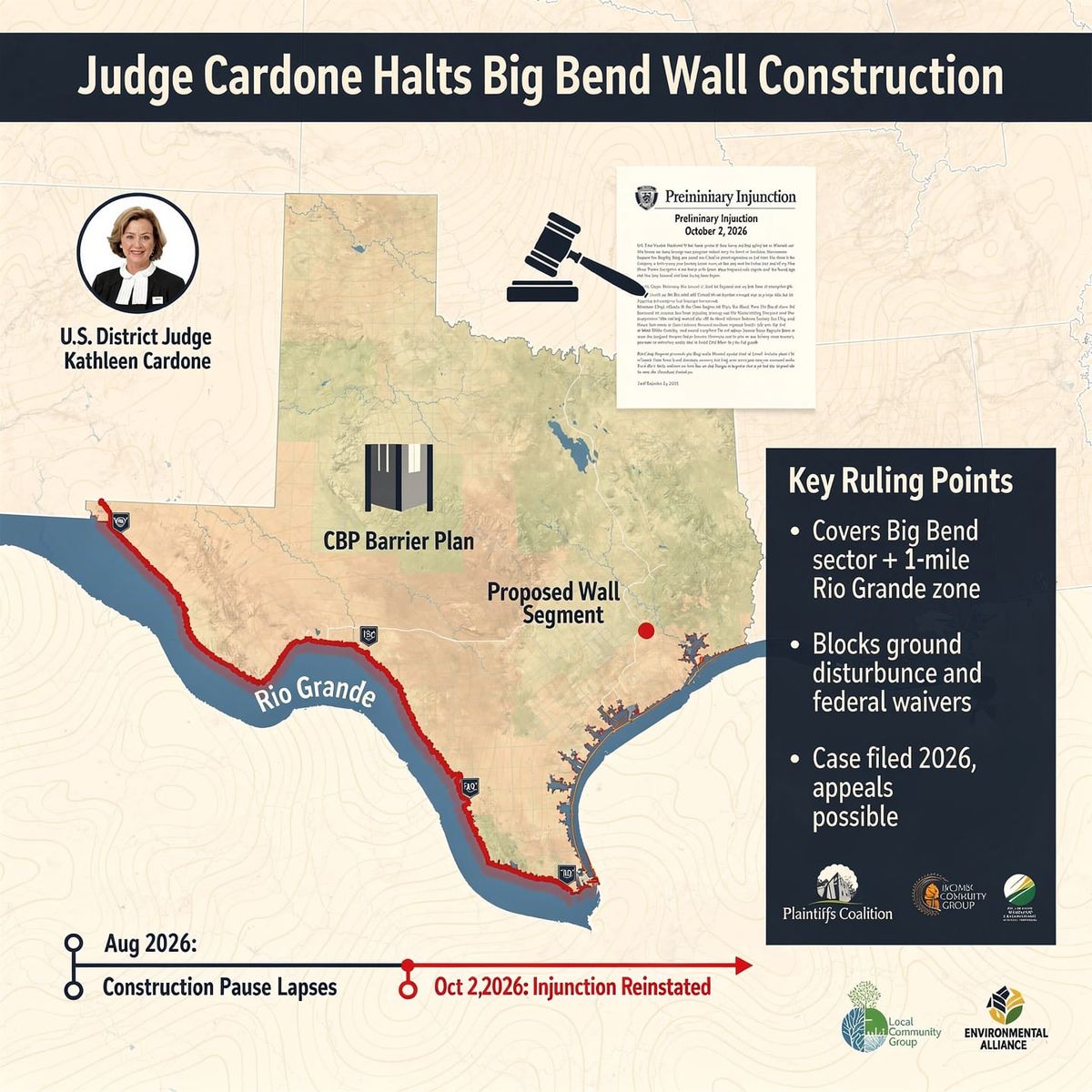
A federal judge halted U.S. border barrier construction in West Texas' Big Bend region, finding plaintiffs likely to succeed on the merits and face serious irreparable harm. The preliminary injunction stops ground-disturbing work and blocks the environmental waivers that let construction skip NEPA and archaeological reviews. It's preliminary—not a final ruling—so the government can appeal while the underlying case proceeds.
U.S. District Judge Kathleen Cardone on Oct. 2 granted a preliminary injunction barring any further ground-disturbing activity tied to U.S. Customs and Border Protection's border barrier effort in the Big Bend region of West Texas. The ruling stops construction immediately and remains in force until the federal government complies with applicable laws or the underlying case is resolved.
The injunction covers CBP's barrier work around Big Bend National Park and the surrounding area within a mile of the Rio Grande. The measure also blocks officials from using federal waivers that had let construction proceed without reviews under the National Environmental Policy Act or the archaeological preservation act. Those waivers are no longer in effect during the pause.
Judge Cardone's order stems from a lawsuit filed earlier in 2026 and argued in El Paso. Plaintiffs include the Center for Biological Diversity, the Friends of the Ruidosa Church, and Big Bend river guide and landowner Danny William Miller. They argued the barrier work threatened the desert ecosystem and, for landowners like Miller, risked cutting off access to the Rio Grande. The judge found plaintiffs were likely to succeed on the merits and would face serious irreparable harm without the order.
The practical consequence is immediate. CBP can no longer disturb the ground, build barriers or related infrastructure, or run road and lighting work in the covered region while the injunction holds. The ruling also bars use of the environmental waivers, so any resumption would require a different legal basis.
The wider context factors into the dispute: the Big Bend sector spans roughly a quarter to a 28.5 percent share of the southwest border in miles yet accounts for only about 1.3 percent of apprehensions in the last fiscal year. Big Bend National Park's superintendent and a Washington Office on Latin America analyst testified to the sector's low enforcement traffic, arguing the remote landscape already discourages crossings — evidence that factored into the court's assessment.
Construction had already paused earlier in 2026. In late August, the administration extended a pause at Big Bend National Park through Sept. 15 after a San Antonio federal court hearing. That pause and related stops lapsed, and the Oct. 2 order reinstates the halt on firmer footing.
What the injunction does not do is resolve the underlying dispute. It is preliminary, not a final judgment on the merits. The federal government can appeal, and the case could ultimately reach the Supreme Court. A successful appeal could modify or dissolve the order; absent that, construction is suspended while litigation runs.
For now, the operational consequence is a hard stop on barrier construction and related work in the Big Bend sector, with the environmental review process left to define the terms of any future attempt.



Comments ()