Iran's crude hits zero as 17 ships cross Hormuz
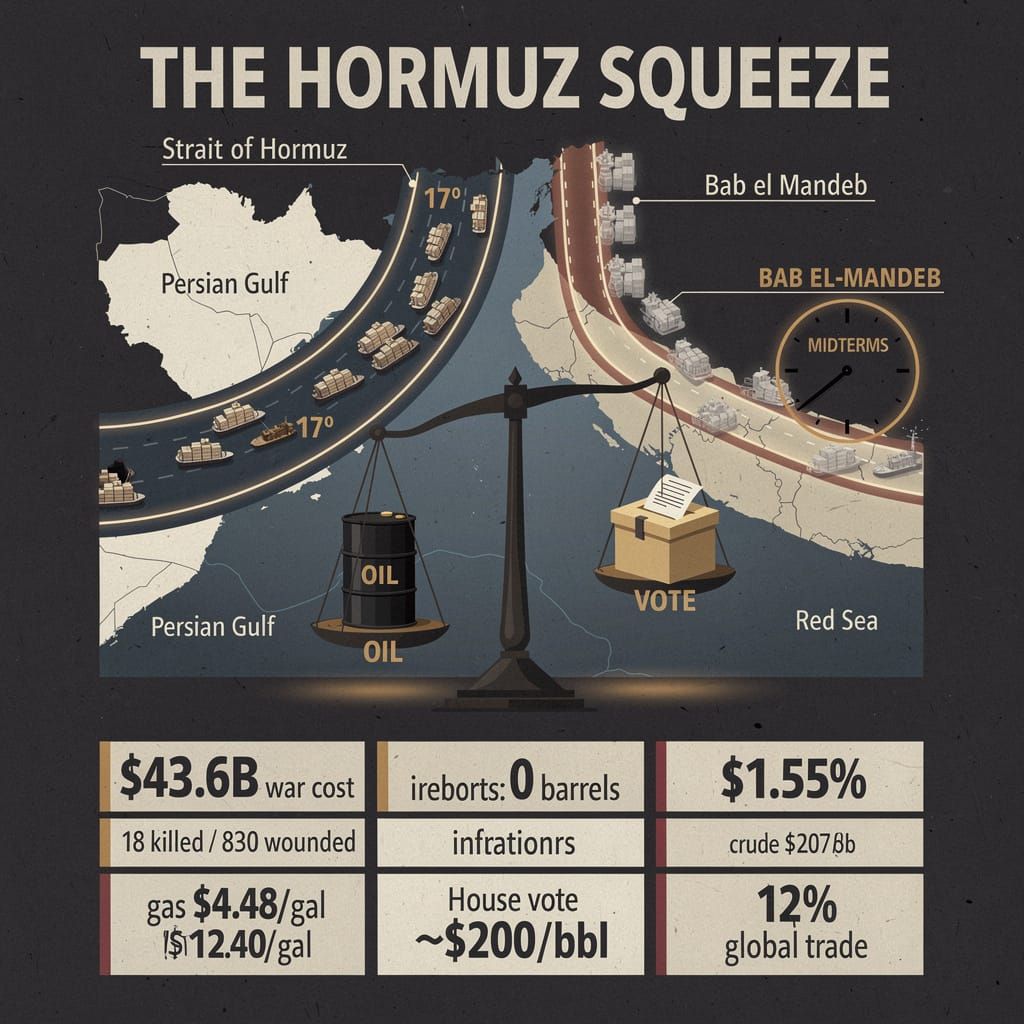
Just 17 ships transited the Strait of Hormuz last weekend—down from 37 and far below the ~130 a global economy needs. Iran's oil exports: zero. 🛢️ CENTCOM touts 1 billion barrels moved; Iran keeps 127.5% inflation and $4.48 U.S. gas as its counter-story. Trump's "very big things" offer three paths: strike, rot, or deal. With midterms six weeks out, voters feel this at the pump. Is the blockade a win or a hostage situation?
Let's be honest about where we are: the world's most important oil chokepoint just became a highway ghost town—for Iran, anyway. Last weekend, a grand total of 17 commercial vessels transited the Strait of Hormuz—down from 37, down from the 35 a week ago, down from the bustling 130-some odd a global economy actually needs. Iran is exporting exactly zero barrels. And yet, somehow, CENTCOM is touting support for "more than 1 billion barrels" of crude moved through that same strait, with Admiral Brad Cooper announcing the number himself.
Wait—zero barrels exported, but a billion barrels moved? Let's unpack that math, because it's doing heavy lifting.
Point of clarity first: We're not talking about a hypothetical. War with Iran started February 28, 2026. The U.S. military tab has already hit $43.6 billion, with 18 service members killed and 830+ wounded—and that's the official count, which has a documented habit of aging poorly. Recall the July days when Lieutenant Tyler Feehan fell in Iraq and Private Isabella Gonzales in Jordan. The House just voted 220-204—the third such vote since the conflict began—to try to put a leash on unauthorized operations. Seven Republicans defected, the largest GOP break since the fighting started. The leash White House treats as a suggestion.
So on Sunday, President Trump did what he does at a fork in the road: he grabbed the map, pointed at all three paths, and announced "very big things" were coming. The options, per multiple briefings: wipe Iran out ("blow the entire nation up" was the operative phrasing), let them "rot economically," or make a deal. That's not a strategy—it's a pick-your-own-adventure novel where the reader is the Iranian economy and the Middle East is the page.
Meanwhile, Tehran's military command has made a counter-offer: touch us again, and every U.S. base gets sustained attention. Iran's top security official, Mohsen Rezaei, says another American strike is "very much on the cards." The IRGC claims it's holding back "unused strategic weapons" for a "long-term war." Grand. Everyone's holding something back.
Let's talk about the actual squeeze—and the CENTCOM spin.
Here's what Admiral Cooper wants you to believe: it's all going swimmingly. More than 2,000 commercial transits supported, mine clearance completed, cargo volumes at a six-month high, the strait "open and safe." And sure, the blockade is working brilliantly—Iran's crude exports are at zero, down from 740,000 barrels a day in July to maybe 255,000 in August, and Tehran has gone about seven weeks without shipping meaningful crude. Mission accomplished, right?
Unless you're China, Iran's last remaining oil customer, which now has to siphon from floating storage in Asia. Unless you're the IMF, which pegs Iranian inflation at nearly 70% and creeping toward that eye-watering 127.5% headline. Unless you're the Iranian civilian paying 100% more at the pump, or waiting to see if the rial's collapse sparks currency devaluation and money printing. The blockade is "working"—if the goal was to make sure nobody can even sit at the negotiating table without a tank of oxygen first.
And the other chokepoint isn't helping.
The Houthis have taken a bite out of the Bab el-Mandeb Strait—that strip carrying roughly 12% of global trade—capturing Mocha, Perim (Mayyun) Island, and the coastal town of Dhubab, their biggest territorial gain since the 2022 truce. Forty-six thousand Yemenis displaced, the truce dead, and Saudi Aramco's East-West Pipeline shut down. Global crude is pushing ~$100/barrel, and your average gallon of U.S. gas just crossed $4.48.
The clock nobody mentions.
November midterms are six weeks out. Polls project a brutal Republican wipeout. When your re-election depends on voters paying $4.48 a gallon, "very big things" is less a strategic document than a campaign soundbite with a targeting computer attached. The decision isn't about Iran. It's about Michigan and Pennsylvania gas stations.
So here's the honest read: three paths, all expensive, none fast. A deal no one believes in, an economy already broken, or a strike Tehran has price-tagged in blood. The only question left is whether 17 ships becomes 12, or 12 becomes zero—and how many zeros get tacked onto the billion-barrel boast before anyone notices the math.
Somewhere in New York, the world's diplomats are hoping the "big decision" includes a very small first step. Fingers crossed. Maybe also a compliant oil tanker.



Comments ()