IBM Granite 4.2: 512K-Token Reasoning at Sub-Second Latency Without Degradation
🧠 IBM Granite 4.2 and Speech 5.0: Sub‑Second Reasoning Meets Unlimited Audio
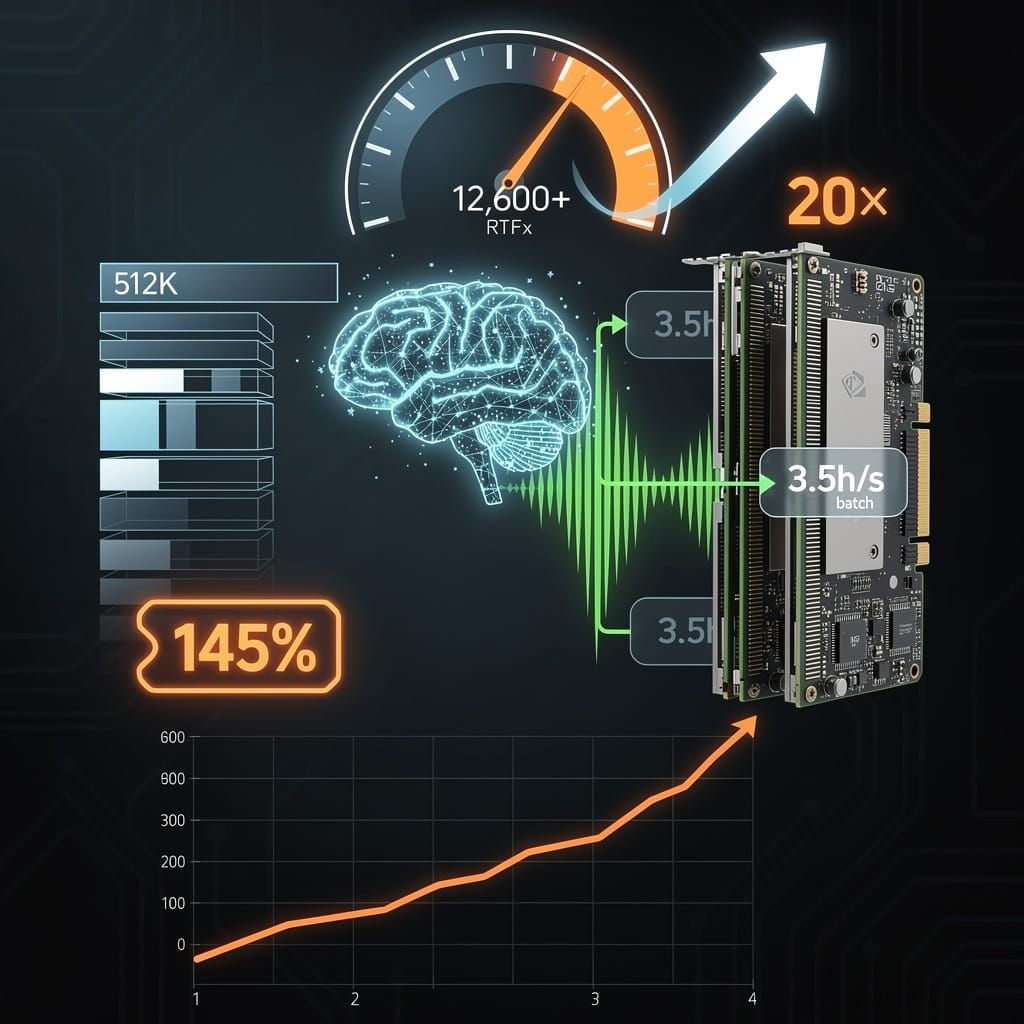
IBM Granite 4.2 (8B, 30B) hits 512K-token context with no attention degradation—rivals like Qwen 3.8 27B must chunk and retrieve at half that length. 🧠 Granite Speech 5.0 Turbo CTC processes 3.5 hours of audio per second at 12,600+ RTFx, 20× faster than prior. NVIDIA's GPU prices just jumped 145% in the US. For enterprises running real-time speech + reasoning pipelines—can you afford to stay on pay-per-token architectures?
On August 25–26, 2026, IBM released the Granite 4.2 family of large language models alongside Granite Speech 5.0 Turbo CTC. The combined release addresses two enterprise bottlenecks: reasoning latency and speech‑pipeline fragmentation. The models span 3 billion, 8 billion, and 30 billion parameters, all using a decoder‑only dense Transformer with grouped query attention (GQA) and rotary position embedding (RoPE), released under Apache 2.0.
Architecture and Throughput
Granite 4.2 returns to a full‑attention dense design after previous hybrid approaches, eliminating the overhead of sparse attention mechanisms. The 8B variant supports a 131K‑token context window, and the 30B variant reaches 512K tokens. This maintains consistent throughput as context length grows—an advantage over rivals such as Qwen 3.8 27B, whose attention degradation on long prompts forces chunking and external retrieval, adding latency.
Optional thought generation inserts intermediate reasoning tokens before the final answer. The 8B and 30B variants include agentic RL training enabling tool use, code execution, and web search. Enterprise agents built on Granite 4.2 can chain reasoning across documents, logs, and conversation histories without breaking context.
Granite Speech 5.0 Turbo CTC: 470 Million Parameters at 12,600+ RTFx
Granite Speech 5.0 Turbo CTC compresses an encoder‑only CTC architecture into 470 million parameters and achieves 12,600+ RTFx throughput on an NVIDIA H200 GPU—a 20× improvement over prior Granite Speech models. The noncommercial variant scores 4.85% WER; the Apache 2.0 variant scores 5.00% WER. The model removes all truncation limits, processing over 3.5 hours of speech per second via batched inference, enabling real‑time transcription and voice‑driven automation without segment‑and‑reassemble overhead.
Competitive Position vs. Qwen 3.8 27B and GPU Pricing Context
Qwen 3.8 27B dominates narrow coding benchmarks through aggressive programming‑dataset fine‑tuning. Granite 4.2 outperforms it on composite reasoning tasks mixing code, natural language, and structured data—the gap widens beyond 32 K tokens. Independent benchmarks show the 30B variant delivering strongest scores on AIME25, HMMT, GPQA, and SWE‑Bench for tool use.
IBM’s timing coincides with NVIDIA’s September 2026 GPU price escalation across its RTX 5xx–9xx lineup. US MSRPs rose 20–145% per tier (RTX 5090: $4,900, +145% US). These increases raise inference costs for GPU‑dependent competitors, strengthening the relative value of IBM’s efficient, Apache‑2.0‑licensed alternatives.
Outlook
IBM projects deployed agents integrating Granite 4.2 will realize scaling benefits within weeks of adoption. The combination of sub‑second latency, unlimited audio streaming, and sustained long‑context reasoning positions the 4.2 family as a baseline for real‑time, memory‑intensive workloads in regulated and operational environments.

Comments ()