High Court Rejects Coal Mine Expansion Over Exported Emissions
Australia's High Court rejected Mach Energy's bid to expand the Mount Pleasant coal mine, upholding that NSW planning approvals must account for emissions from exported coal burned overseas. The case returns to the Land and Environment Court, which will decide whether the operation can continue…
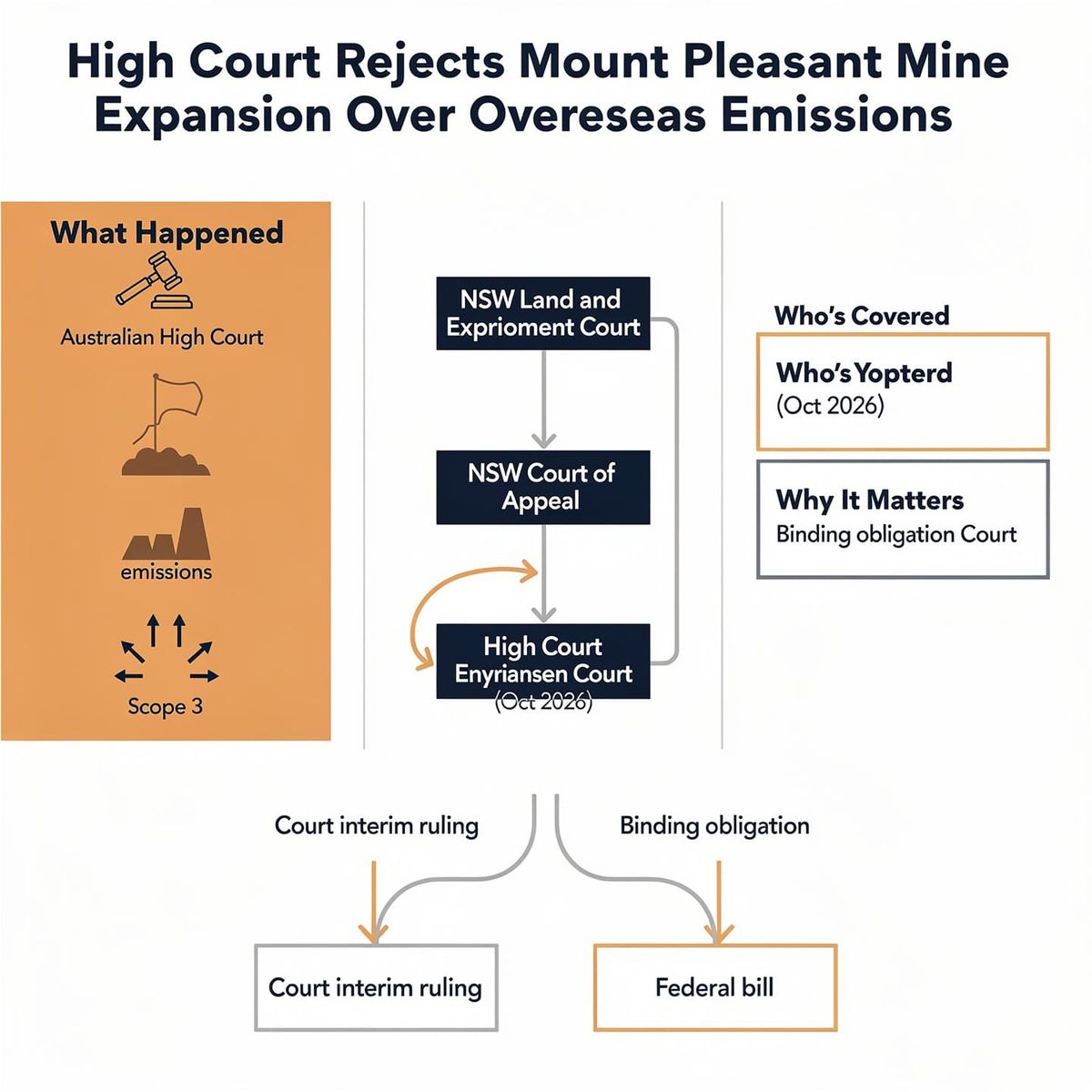
Australia's High Court ruled against Mach Energy's bid to expand the Mount Pleasant coal mine near Muswellbrook in the NSW Hunter region, dismissing the company's challenge in early October 2026. The ruling came after the NSW Court of Appeal upheld findings that the project's planning approval failed to account for emissions from burning the coal overseas. The matter now heads back to the NSW Land and Environment Court to decide whether the existing operation can keep running — and under what conditions.
What happened
The dispute turned on the Land and Environment Court's conclusion, upheld on appeal, that the mine's scope 3 emissions — the greenhouse gases released when exported coal is combusted in other countries — made the project inconsistent with state climate-change objectives. The High Court did not overturn that reasoning; it dismissed the challenge to that approval process, agreeing the expansion had not adequately addressed downstream emissions.
The decision follows the Australian Resources Exports and Jobs Protection Bill, a proposed federal law that would prevent state, territory, and federal laws or approval processes from requiring consideration of overseas emissions. As Queensland Premier David Crisafulli framed it, the ruling's effect does not extend beyond the NSW legislation. Industry voices argue the bill would insulate major projects from what they call activist-driven legal delays, while critics note the High Court's reasoning already signals that Australia bears general responsibility for the emissions from the coal it exports.
Who's covered
The immediate consequence is narrow but significant. The High Court sent the matter back to the Land and Environment Court to decide whether Mach Energy can keep operating Mount Pleasant while its approval is revised. That's an operator-specific outcome — the judgment doesn't automatically suspend mining approvals across the industry. Actually, the ruling itself applied only to the NSW planning framework; it did not establish a national mandate.
Still, the legal logic extends further. The framing that scope 3 emissions must be minimized in NSW planning decisions could apply to other large-scale projects in the state, at least until the proposed federal bill or other state legislation changes the rules of the game.
What's established, what isn't
What the court established is that a coal mine's NSW planning approval must show it can keep downstream emissions within climate limits — and that failing to do so is a genuine legal defect. Elaine Johnson, in her reading of the decision, concluded that the High Court's outcome suggests Australia has a general responsibility to mitigate emissions from exported coal. Federal Resources Minister Madeleine King described the decision more narrowly, calling it technical and not a verdict on the future of fossil-fuel industries.
What isn't established is how the NSW Land and Environment Court will rule on whether Mach Energy can continue mining under interim conditions. That hearing is the next gate, and its outcome determines whether this is a suspended expansion or a forced shutdown.
Nor is it clear how far the "imported emissions" logic will travel. The proposed federal bill, if enacted, would directly counter the High Court's reasoning by barring approval processes from considering overseas emissions. Matt Canavan put the industry case for the reforms as protecting jobs and projects "held hostage by radical green activists"; Angus Taylor pledged protection for coal and gas projects from emissions-based legal challenges. Those are positions under debate, not settled outcomes.
Why it matters
The practical consequence today is that NSW coal and gas projects carry what the courts have now endorsed as a binding obligation: account for downstream emissions within climate objectives before expansion approval is granted, or risk a legal challenge that halts the project.
Mount Pleasant's status is genuinely uncertain — it faces the possibility of closure or scaled-down operation depending on what the Land and Environment Court decides. The proposed federal bill, if passed, could rewrite that obligation entirely. The decisive unknown is which happens first: the court's interim ruling on Mach Energy's license, or federal legislative action that snaps the scope 3 thread for good.



Comments ()