⚠️ Seven laid off at FuturLab after Project X scrapped
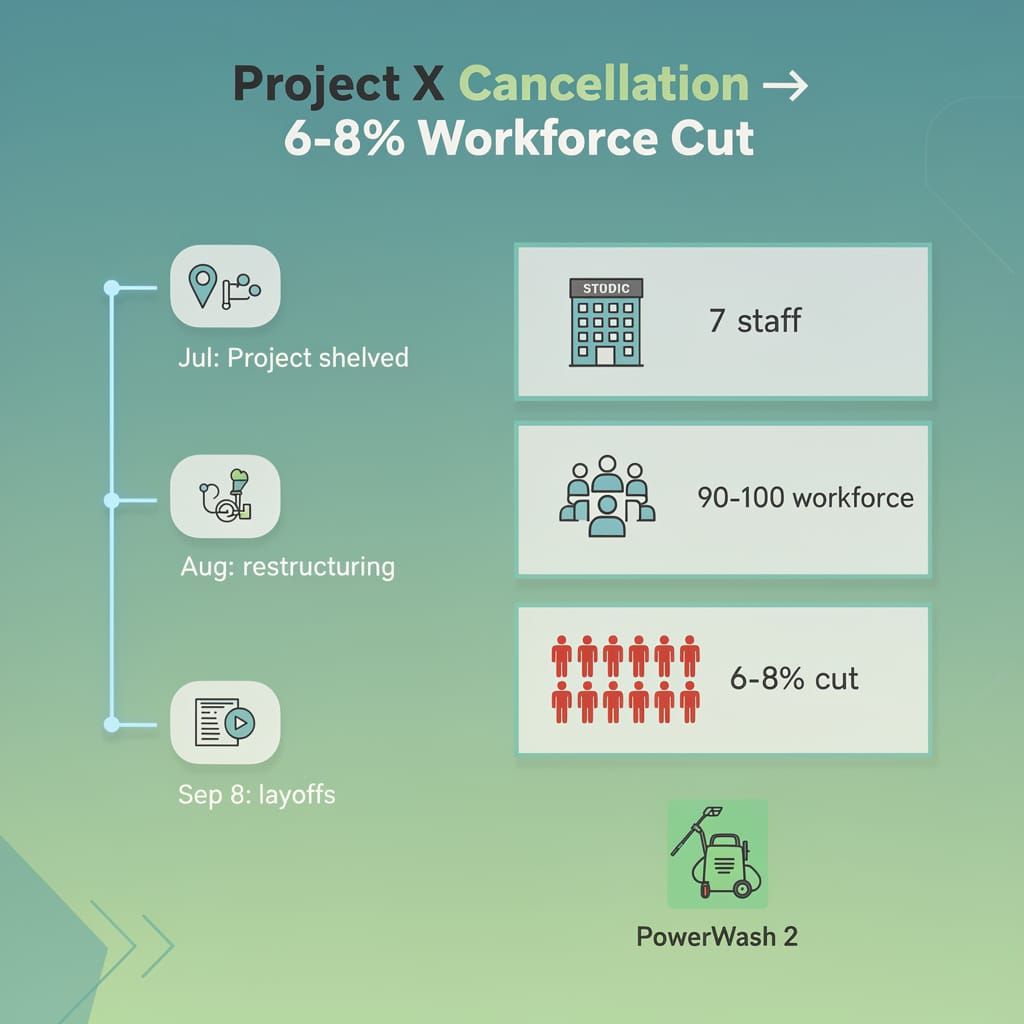
7 staff laid off at UK studio FuturLab (~6–8% of workforce) after Project X cancellation — a project scrapped after 2–3 years in pre-production. CEO says costs would have exceeded projected ROI. Managers weren't told about the selection criteria. Staff told not to say "redundancy." One senior employee called it "a linear termination of identity." Across the US, 52,881 job cuts were announced in August 2026 — down 38% YoY, the lowest since 2022. Tech still leads with over 155,000 cuts this year, driven by restructuring and market conditions, not just AI. A profitable studio, a well-reviewed sequel, and people still lose their jobs — without explanation. Are you factoring project risk into your career planning?
On September 8, 2026, UK-based studio FuturLab—developer of the PowerWash Simulator series—laid off seven staff members following the cancellation of an unannounced project referred to internally as Project X. The reduction represents roughly 6–8% of FuturLab's estimated 90–100 person workforce. CEO Kirsty Rigden confirmed the layoffs via a statement to This Week In Videogames, stating the cancelled project—two to three years in pre-production—would have exceeded its projected return on investment.
Why it happened: FuturLab leadership canceled Project X after determining development costs would exceed projected revenue. CEO Kirsty Rigden confirmed the decision while emphasizing commitment to PowerWash Simulator 2. The project had been in development for 2–3 years before being scrapped during pre-production. Workers were left without reassignment for weeks after the June 2026 shelving. The company began broader restructuring in August 2026 under COO Chris Mehers.
What went wrong at the managerial level: According to reporting from This Week In Videogames, managers and team leads were not informed about the layoffs or the selection criteria for affected employees. Remaining staff were instructed not to use the term "redundancy" and instead refer to departing colleagues as "leavers." One affected senior employee described the process as a "linear termination of identity"—meaning the exit severed not just employment but the professional reputation and project history the individual had built over several years.
Impact analysis:
- Communication: The lack of structured offboarding messaging created uncertainty among remaining staff. When terminated employees cannot explain why they were let go, rumors fill the gap. Managers were left unaware of the reasons for their team members' removal, amplifying psychological distress during a two-week transition period.
- Identity: For senior staff, the abrupt termination erased years of institutional knowledge. The "linear terminated identity" effect means those individuals lose the ability to reference their work on Project X in future interviews or portfolios, since the project remains undisclosed.
- Workplace culture: Seven departures in a studio of ~100 people is not catastrophic numerically, but the manner of exit—poorly explained, impersonally executed—damages trust. Remaining employees now face reduced headcount without clarity on whether additional cuts are coming.
Broader labor context: The video game industry in 2026 continues to see studio restructurings. Across the broader US economy, employers announced 52,881 job cuts in August 2026—a 38% decline year-over-year and the lowest monthly total since 2022, per Challenger, Gray & Christmas data. That figure rose 58% from July's 33,429 cuts. Through August, nearly 530,000 workers had been cut across all sectors, 41% below the same period in 2025. AI remained the top restructuring cause at 16,173 cuts in August, though it fell to fourth place among sector drivers. Consumer products led with 10,057 cuts (driven by Procter & Gamble and Estée Lauder), followed by food producers at 7,982 amid cattle shortages. The tech sector added 6,103 cuts in August, bringing its eight-month total to over 155,000—still the highest of any sector, driven primarily by restructuring and market conditions rather than AI adoption alone. Meanwhile, hiring rose to 12,325 new positions in August, the strongest August hire count since 2022. Layoffs at studios with recent hits—PowerWash Simulator 2 launched in 2025 to strong sales—indicate that project cancellations are driven by publisher portfolio pruning rather than studio financial distress.
What this signals for other developers and hiring managers:
- For employees: Project cancellations can happen even at profitable studios. Maintain transferable skills and external networks independent of any single project.
- For managers: A layoff handled poorly—vague reasoning, no individualized acknowledgment—amplifies the negative impact. It is possible to reduce headcount while preserving departing employees' dignity and remaining staff's confidence.
- For recruiters: Senior talent from cancelled projects carries high-value experience but may need help framing non-disclosable work in interviews.
Comments ()