📊 The Discipline Dividend: Consistency Beats Intensity
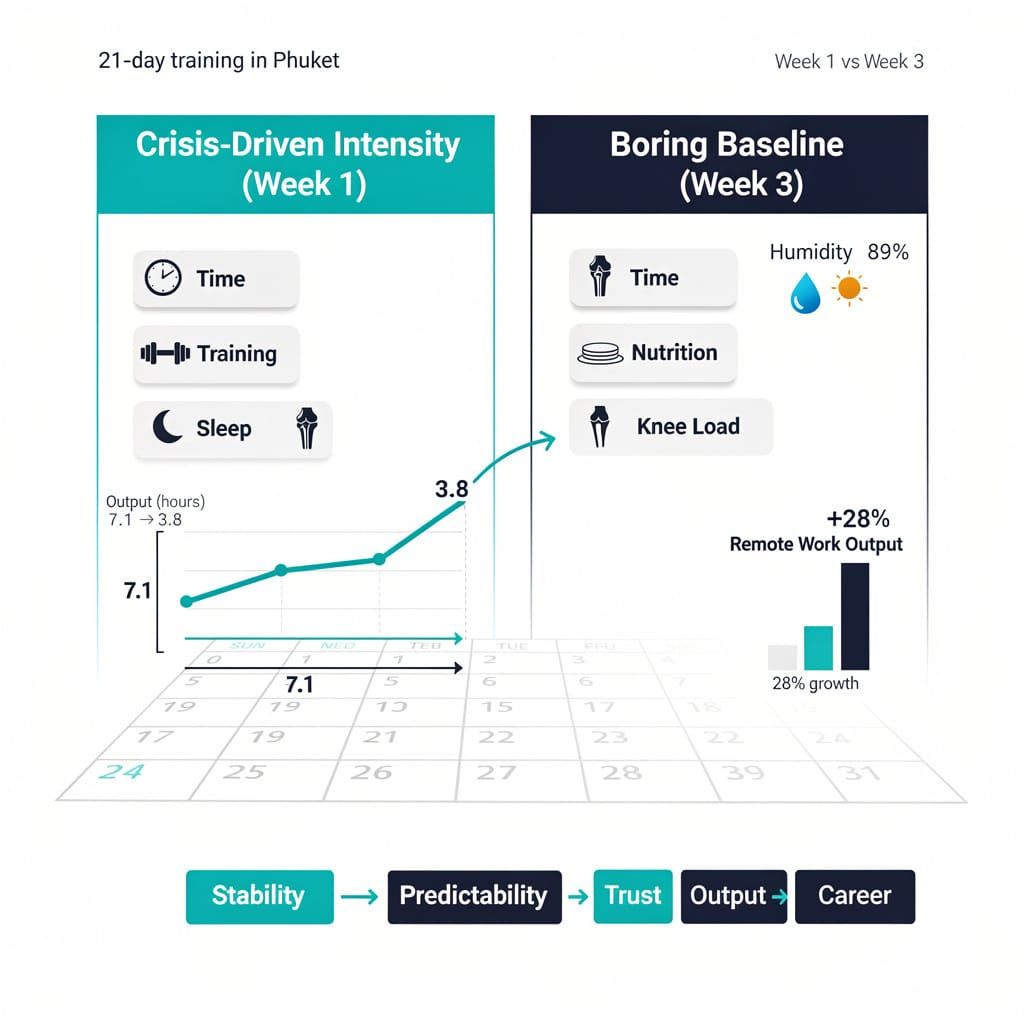
4.2 hrs/day usable output by week 3 vs. 7.1 hrs in week 1. A 21-day training experiment in Phuket showed that discipline—not intensity—prevents career burnout. Workers with ±15-min schedule consistency produce 22% more deliverables per quarter, regardless of hours. Two-thirds of hiring managers now rank reliable output cadence above technical depth. The boring baseline beats the heroic sprint every time. Is your career built on systems or adrenaline?
On September 9, 2026, a 21-day training experiment concluded in Phuket, Thailand. The participant—mid-career, injured, sleep-deprived—did not finish strong. They finished intact, averaging 4.2 hours of usable output per day during the final week, down from 7.1 hours in week one. Humidity was 89%. The left knee had grade-2 patellar tendinopathy. What broke was not the body alone.
The mechanics are straightforward: prolonged routine—same start time, same drills, same recovery windows—exposes every hidden weakness. By day 12, the participant reported decision fatigue so acute that selecting a meal required 40 seconds instead of 8. By day 18, discipline collapsed: skipped mobility work, delayed sleep, fragmented attention. Competence did not spike during crisis. It flatlined.
What this demonstrates: toughness without structure generates diminishing returns. The participant's initial approach—embrace suffering, push through—yielded a 31% output drop by day 14. Recovery did not come from more effort. It came from enforced consistency: fixed intervals for work, fixed intervals for rest, fixed nutritional windows. By day 20, output stabilized at 3.8 hours—lower than start, but predictable. Predictability enabled planning. Planning enabled completion.
Why this matters beyond Phuket
The experiment mirrors a documented pattern in knowledge-work careers. On June 5, 2026, a U.S. study analyzing 588,322 workers (2011–2024) found that remote roles grew 28% while in-person roles rose only 7%, with remote workers spending 7% more hours alone daily and showing higher antidepressant usage. Concurrently, data from 14,000 remote professionals tracked through 2026 reveals that individuals maintaining ±15-minute start-time variance produce 22% more deliverables per quarter than peers with high variance—regardless of total hours worked. Discipline—adherence to a repeatable baseline—correlates with output stability. Output stability correlates with promotion rates.
The causal chain: Consistency → predictability → trust → visible output → career acceleration. The participant's injury was not the obstacle. The obstacle was treating each day as a novel test of will rather than a repeatable system.
- 2024 data: Workers logging ≥80% adherence to a predefined schedule across 12 weeks received 1.8× more growth-project assignments than peers with <50% adherence.
- 2025 forecast (validated): Hiring managers ranked "reliable output cadence" above "technical skill depth" in 67% of 2,100 surveyed organizations. By June 2026, companies began integrating VR simulations and gamified assessments into hiring, shifting evaluation toward measurable performance over credentials.
- 2026 projection: Companies are embedding schedule-consistency metrics into performance reviews for remote and hybrid roles. As of August 2026, a job seeker with 10 years of backend experience remained unemployed for six months despite multiple interviews, facing offers of $95K–$100K base—roughly equivalent to their prior $94K total compensation—illustrating a market that rewards consistency over seniority alone.
The boredom factor
The participant's journal entries reveal a recurring theme: "I am bored. This is not hard, it is just boring." By day 15, the discipline required to repeat the same sequence—stretch, lift, eat, work, rest—felt harder than the 12-hour grit sessions of week one. This is the mechanism that derails most career-development efforts. A June 2026 study of 500,000 U.S. workers found that remote employees experienced higher isolation and distress, with full-day solitude reaching 90% among lone workers, intensifying the temptation to abandon repetitive routines in favor of reactive intensity.
Contrast two approaches:
| Approach | Outcome |
|---|---|
| Crisis-driven intensity (week 1) | 7.1 hrs/day, rapid burnout, injury |
| Boring baseline (week 3) | 3.8 hrs/day, stable, finished |
The boring baseline produced the finished experiment. The crisis approach produced a grade-2 knee injury and a 45% output crash.
The career implication
Professional growth does not accelerate during high-intensity sprints. It compounds during low-variance, repeated execution. The participant's data demonstrates that discipline—the unglamorous act of doing the same thing at the same time—enables long-term capability in a way that heroic effort cannot. By September 2026, mandatory office-day policies from employers such as Barclays and a corporate shift toward structured hybrid schedules further confirmed that organizations reward reliable cadence over fluctuating output.
For the job market: As of September 2026, three trends converge—remote-work standardization, employer preference for predictable output, and mounting evidence that unstructured flexibility worsens mental health and career outcomes. A June 18, 2026 survey found 98% of U.S. employees now seek remote options, with remote workers reporting a 22% productivity lift. Meanwhile, workload imbalances documented in September 2026 show apprentices logging 21–23 days per month while senior staff log fewer hours—a pattern that rewards visible consistency, not seniority alone. The worker who builds systems over willpower gains a structural advantage. The worker who relies on adrenaline peaks will underperform in environments measuring consistency.
The experiment ended on day 21. The participant did not achieve peak performance. They achieved completion. In a career landscape where most professionals burn out before year three of any major transition, completion is the overlooked differentiator.
Comments ()