Claude Fable 5.1 & Mythos 5.1: 75% Cache Cut, 1.7× Token Burn — Anthropic's Efficiency Paradox
TL;DR
- Anthropic Fable 5.1 Doubles Benchmarks as Cache Costs Plunge 75% — But Token Bloat Drives Net Per-Task Cost Up 20%. Is 1.7× token burn worth it for Mythos-level safety guardrails?
- 9.24-Hour Solar Storm Warning: AI Detects Eruptions Before They Become Visible. Could 9-hour AI storm warnings replace the 30-minute scramble for satellite operators?
🧠 Claude Fable 5.1 and Mythos 5.1: Anthropic's Targeted Efficiency Play
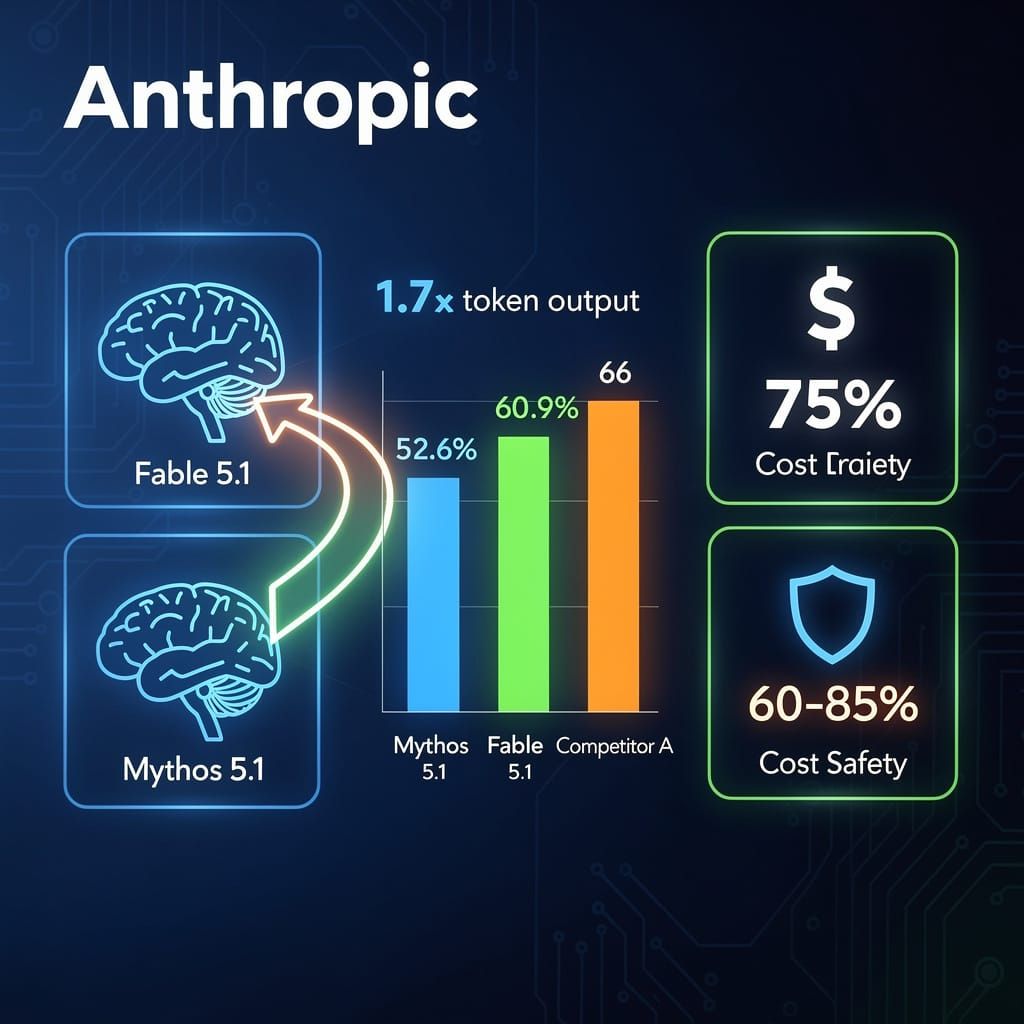
Fable 5.1 doubled Terminal-Bench-Science scores to 52.6%, while Mythos 5.1 hits 60.9% and tops the Intelligence Index at 66 — three points above Opus 5 🧠 Cache read pricing plunged 75% to $0.25/M tokens, slashing per-task costs ~$1.40. But Fable 5.1 also burns 1.7× more output tokens, netting a 20% higher per-task cost. Organizations running high-volume inference pipelines see total costs drop 25–45%. Yet users pay more per task than before. Cybersecurity and biotech teams with verified access — is 1.7× token consumption a fair trade for Mythos-level guardrails and CB-1 capability?
On September 1, 2026, Anthropic launched two specialized model variants: Claude Fable 5.1 for general-purpose workloads and Claude Mythos 5.1 for verified cybersecurity, security research, and biotechnology applications. Both models share identical base weights but differ in safeguard layers—Fable 5.1 blocks high-risk dual-use domains while Mythos 5.1 permits them under verified access programs.
Measured Performance Gains
Fable 5.1 doubles prior performance on Terminal‑Bench‑Science 0.1, scoring 52.6% against Fable 5's 24.7%. On Terminal‑Bench‑4.0, it reaches 55.8% versus 42.0%. Mythos 5.1 leads Terminal‑Bench 4.0 at 60.9% and outperforms Opus 5 across nearly all cyber evaluations, including ExploitBench and OSS-Fuzz. The model tops the Artificial Analysis Intelligence Index at 66—three points ahead of Opus 5—with a 9-point gain on the θ³-Banking benchmark over Fable 5.
Cost Reduction Through Smarter Caching
Cache read pricing dropped from $1.00 to $0.25 per million tokens—a 75% reduction—cutting per-task costs by ~$1.40 in agentic evaluations. Independent research published August 25, 2026, confirms prompt caching reduces API costs by 41–80% and improves time-to-first-token by 13–31% across Anthropic, OpenAI, and Google for multi-turn agentic tasks. Strategic cache placement—placing dynamic content at prompt end, excluding dynamic tool results—yields more consistent gains than naive full-context caching. Anthropic also reduced classifier overhead fees on August 7, removing 15–28% variable add-ons for Claude Code high-volume users.
Organizations running high-volume inference pipelines see total workload costs decline 25% for typical tasks and up to 45% for complex agentic workflows. However, Fable 5.1 consumes ~1.7× more output tokens than Fable 5—Anthropic's July tokenizer update increased Claude token counts by ~30%—resulting in a net 20% higher per-task cost ($3.76 vs $3.14 on the Intelligence Index) despite the cache savings.
Targeted Safety Architecture
Mythos 5.1 introduces domain‑specific guardrails for cyber and biotech contexts. Injection‑risk scores dropped by 60–85% depending on attack vector, and potentially malicious agentic coding requests are refused at rates comparable to recent models. The system card assessed alignment risk from "very low" to "low" and classified CB-1 capability in biological and cybersecurity domains—sufficient to help synthesize known weapons but not replace rare expert talent. This follows Anthropic's July 20 expansion of Mythos access through Project Glasswing, which uncovered over 10,000 high/critical severity CVEs but triggered stricter safeguards routing risky queries to Opus 4.8.
Deployment and Ecosystem Impact
Anthropic updated Fable 5.1 on September 2 with High‑effort as default in Claude Code. On September 3, Mythos 5.1 was applied to terminal‑benchmark security vulnerability discovery tasks. Fable 5.1 is excluded from Pro and standard Team plans but available via usage credits for Max and premium seats with up to 50% weekly limits. On August 21, Claude Security deployed on Mythos 5 scans codebases for vulnerabilities and suggests patches—each finding includes CWE category, severity rating, and required human sign-off. A $35M Defender Advantage Fund now supports open-source security, and partners previously using Opus are transitioning to Mythos 5.
Key affected sectors:
- Software development: Cache reuse and per‑run token cost reductions accelerate iteration loops; Claude Code overhead cuts of up to 28% improve economics.
- Cybersecurity: Mythos 5.1 reduces false positives by half and cuts alert fatigue for SOC teams, while enabling verified exploit discovery. The Cloud Security program extends Mythos-class defense to hospitals, utilities, and banks.
- Life sciences and biotech: Verified guardrails with CB-1 risk classification lower compliance overhead for regulated research.
The dual‑model release signals a shift from monolithic frontier models toward role‑specific variants optimized for cost, speed, and risk tolerance—without sacrificing benchmark leadership.
🛰️ NJIT's EarlyDetect Reads the Sun's Hidden Signals
EarlyDetect AI spots solar storms 9.24 hours before they become visible — that's 9x the warning time satellite operators get today 🛰️ Traditional filters treated precursor signals as noise. NJIT's transformer model found them instead. Satellites can now safe-mode, grids can reroute, comms can switch frequencies — all before proton flux rises. Princeton, NASA Ames, NJIT — could this turn hours of warning into a full workday?
Solar storms begin invisibly. By the time a flare or coronal mass ejection appears in optical imagery, the active region has already been building energy for hours. New Jersey Institute of Technology researchers, collaborating with Princeton University and NASA Ames Research Center, have closed that detection gap.
How the System Works
The AI, named EarlyDetect, ingests unfiltered acoustic and magnetic field data from NASA's Solar Dynamics Observatory. A transformer-based neural network identifies faint precursor patterns that previous observational filters systematically removed as noise. Traditional filtering methods worsened forecasts by discarding weak signals, but the unfiltered data combined with Transformer architecture enables earlier detection.
Performance metrics from the August 2026 study in the Journal of Geophysical Research:
- Detection lead time: up to 9.24 hours before an active region becomes optically visible, validated by the February 1, 2026 eruption of active region AR4366.
- Data supporting the findings released via the SolARED dataset, enabling broader community validation.
Why the Delay
EarlyDetect triggers on subtle magnetic signatures that sometimes resemble, but do not produce, solar flares. The false-alarm rate oscillates across solar-rotation cycles, so the team, led by Spiridon Kasapis, is running a multi-spacecraft test suite across larger event datasets. Real-time forecast capacity requires further validation before operational deployment.
What It Changes
Satellite operators currently rely on optical signs — brightening active regions — which provide 30–90 minutes of warning. EarlyDetect extends that window to approximately nine hours, enabling:
- Satellites: Gyro-damping and safe-mode transitions before proton flux rises.
- Power grids: Activation of shielding protocols and rerouting of vulnerable transformer banks.
- Communication providers: Preemptive frequency switching and buffer allocation.
No service interruptions are expected during the validation phase.
The Broader Signal
The study, published August 2026, demonstrates that transformer networks applied to raw heliophysical streams can extract precursors that classical filtering discards. The same approach may apply to magnetospheric forecasting and geospace monitoring. On August 14, 2026, NASA announced the COFFIES program, signaling institutional adoption of AI-driven storm prediction for operational warning capability.
Operational deployment pending completion of the cross-spacecraft validation suite.


Comments ()