⚡ Claude Code Ships 8-12× Faster, but Open-Source Rival Already Has the Users
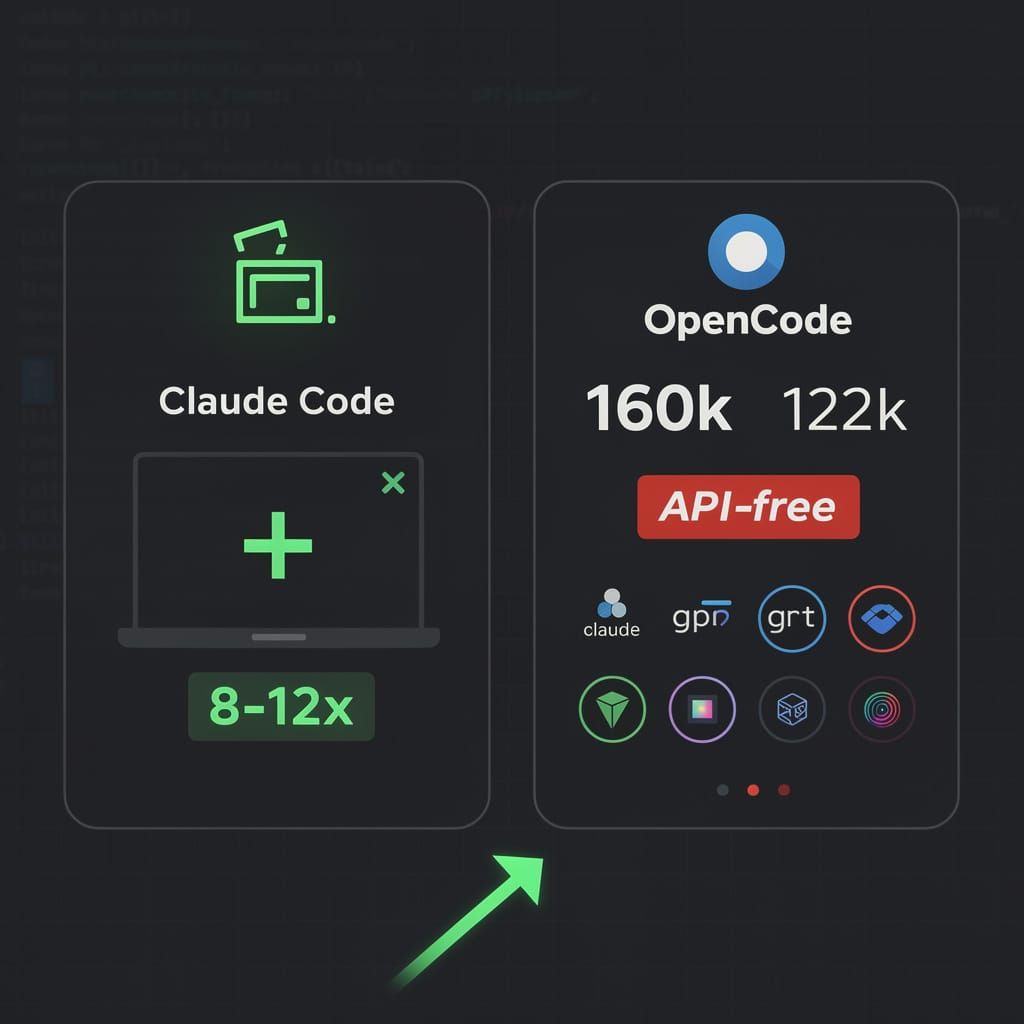
Developers using Claude Code report 8–12× faster project delivery per session — a step-change in individual productivity. But Claude Code lost the GitHub star race to open-source rival OpenCode (160K vs 122K) after Anthropic blocked third-party authentication in January, pushing devs to frictionless alternatives. One founder burned $4K in 3 days on token-based pricing; another shipped 6 mobile apps via prompt-driven iteration. Proprietary agents lead on benchmarks. Open-source agents win on access. For enterprise teams, the bottleneck is no longer model capability — it's authentication, cost, and legal risk. Which coding agent can your team actually run without a disruption from policy, security, or finance? ⚡
On September 13th, Anthropic released Claude Code—a coding agent designed to live entirely in the terminal. No graphical interface. No chat sidebar. Just a command line, a prompt, and a model that orchestrates tool calls, file edits, and shell commands autonomously.
The headline figure: developers using Claude Code reported 8 to 12 times faster project delivery per session. That is not a marginal improvement. That is a discontinuity—a step change in what a single developer can produce in a single sitting.
But the more interesting story isn't the release. It's what happened before it.
The Architect, the Agent, and the Ban
Claude Code's architecture is called "Thermal First," and its designer built the system that became Claude Code by re-engineering how Anthropic's models interact with development environments. Instead of responding to individual requests, the agent maintains a persistent context over a session, plans multi-step operations, and executes them against the filesystem and shell directly. It watches output, detects errors, and iterates without waiting for human intervention.
The result is a coding assistant that behaves less like a chatbot and more like a senior engineer who never sleeps.
But Claude Code was not the first agent to capture developer attention. Earlier in 2026, an open-source project called OpenCode had already begun eating into its trajectory. On August 5th, OpenCode surpassed Claude Code on GitHub star counts—160,000 to 122,000—a symbolic but telling lead.
The cause traces to a single corporate decision. On January 9th, 2026, Anthropic blocked third-party applications from authenticating via Claude AI accounts, affecting OpenCode users who relied on Claude Pro login. The policy change broke the authentication flow for users who used Claude-powered tools. Developers who lost access did not wait. They migrated to OpenCode, which required no authentication gate, no API key, no corporate blessing—and supported 75+ LLM providers including Claude, GPT, Gemini, and local models via Ollama, with model switching possible mid-session.
By the time Claude Code officially launched, OpenCode had already become the default for a large slice of the developer population.
What the Capability Gap Actually Means
An 8-to-12× productivity multiplier compresses a two-week feature into a day and a half. The mechanism is straightforward: the agent handles boilerplate, test scaffolding, refactoring, and error triage in parallel with human reasoning about architecture and requirements. The developer focuses on what to build; the agent handles how to implement it.
The real-world output is visible. By late August 2026, one developer (ExplorerEconomy8233) had shipped six complete mobile applications built primarily through Claude Code sessions—a home appliance lifespan tracker, an AI outfit-rating app, a congressional stock-trading bot, a smart-mirror check-in tool, a sleep-tracking app, and an AI email assistant drafting replies at roughly 10× speed. All emerged from prompt-driven iteration using Expo and React Native, demonstrating that the speed gain translates into functional, deployable products across multiple domains simultaneously.
The implications extend beyond individual velocity. Continuous integration pipelines that once required manual triage can now be fully agent-driven—the agent reads a failing test, diagnoses the cause, writes a fix, runs the suite again, and opens a pull request if all passes. Enterprise software maintenance, historically a slow grind of ticket-triage-patch-deploy, becomes a process that runs in hours instead of weeks.
The constraint is not the model's capability; it is the authentication and deployment infrastructure. Claude Code's launch demonstrated state-of-the-art agentic coding performance. OpenCode's rise demonstrated that open-weight, API-key-free alternatives can capture the same user base when a corporate policy creates friction.
The Cost of Blind Vibe Coding
Raw speed numbers do not tell the full story. By May 26th, 2026—months before Claude Code's official launch—developers already observed a decline in lines of code per token, a rise in token consumption, increased edit rejection rates, and spikes in API retry failures, indicating efficiency degradation. On June 1st, a startup founder accidentally spent $4,000 in three days using Claude Code after switching to per-token AI pricing, driving their annual Anthropic bill from $400,000 to $1.4 million. The problem: "blind vibe coding" with black-box AI tools, where developers generate large volumes of output without architectural guidance or context management, producing a "hallucination tax" of wasted tokens and rework.
Benchmarks from June 1st showed an alternative harness achieving 64% faster execution and 56% lower cost compared to Claude Code across multiple tasks, by using a glass-box architecture with precise context routing and native caching. The mechanism difference is structural: black-box tools consume tokens on every generation, including hallucinated or redundant output; glass-box tools route context selectively and cache aggressively, reducing waste.
By July 7th, developers responded by releasing open-source repositories like "ccusage" for tracking Claude API token consumption, reflecting growing demand for cost visibility and direct CLI-based interaction over opaque web interfaces.
The underlying architecture amplifies this tension. Claude Code operates with full local filesystem access, enabling interactive debugging on complex multi-file tasks—a capability that helped it score 80.9% on SWE-bench Verified in early 2026. In contrast, OpenAI's Codex CLI runs inside a sandboxed container, which provides security isolation for CI/CD pipelines but blocks interactive debugging of live code. On June 12th, direct comparisons showed that Claude Code outperforms Codex CLI on complex multi-file refactoring while Codex CLI better suits teams needing predictable monthly costs (included in the $20/month ChatGPT Plus subscription) and sandboxed execution.
The Open-Source Ratchet
The divergence between the two projects reveals a pattern likely to repeat. Proprietary coding agents deliver higher raw capability because they control the model, the context window, and the tool orchestration. But open-source agents win on accessibility and resilience. No one can ban OpenCode. No API key can be revoked. No authentication change can break a user's workflow.
The numbers back this. OpenCode overtook Claude Code on GitHub before Claude Code even officially existed—because developers who lost access to Claude under Anthropic's authentication block had already adopted OpenCode as their replacement. OpenCode's support for 75+ providers meant users could switch to Gemini as their default backend overnight, or run local models via Ollama for privacy and cost control. Its three pricing tiers—OpenCode Zen (pay-as-you-go), OpenCode Go ($5 first month then $10/month), and higher-tier plans—offered model autonomy at a fraction of Claude Code's token-based cost structure.
OpenAI's response signals where this market is heading. On September 12th, OpenAI hired Git AI co-founders Aidan Cunniffe and Sasha Varlamov to join its Codex team, with the goal of leveraging Git AI's open-source platform to measure coding agent performance and ROI per token—enabling businesses to compare Codex, Claude Code, Cursor, and Gemini on actual production impact.
Pricing and policy instability compound the risk for enterprises relying on Claude Code. On June 15th, user Karl Kahn filed a class-action lawsuit accusing Anthropic of overstating usage caps for Claude Max tiers. The next day, Anthropic paused a billing change intended to raise API rates for the Claude Agent SDK, restoring free-tier allowances. On August 17th, Anthropic clarified that while customers own Claude outputs, they cannot use those outputs to train competing models without explicit permission—and abruptly canceled a previously scheduled September 1st price increase for Sonnet 5, keeping rates at $2 input and $10 output per million tokens. On August 20th, Anthropic imposed a mandatory 30-day retention policy for prompt and output logs on Mythos-class models, cutting off prior voluntary retention agreements and pushing GDPR-compliant clients toward customer-controlled cloud storage.
The outlook: open-source coding agents will continue to outpace corporate platforms in adoption even when the corporate platforms outperform on benchmarks. The developer tooling market has always rewarded low-friction onboarding over maximum capability. Claude Code may be faster per session. OpenCode is harder to lock out of.
What Comes Next
Two dynamics will define the next stage. First, proprietary agents like Claude Code will attempt to decouple capability from authentication—perhaps by offering local model execution or offline modes that bypass cloud dependency. Second, open-source agents will close the capability gap by fine-tuning on agentic traces distilled from frontier models. The gap between the two tracks will narrow not because proprietary models get slower, but because open-weight models get better at tool use.
The long-term trajectory points toward a market where developer productivity tools are defined by their distribution model as much as their intelligence. A coding agent that requires a cloud login and a paid API key competes against one that runs from a single pip install command and never calls home.
For enterprise engineering teams, the calculus is changing. The question is no longer "which AI model can write the best code?" It is "which coding agent can we run without an interruption from legal, security, or cloud operations?"
The terminal won that argument the day Anthropic blocked third-party Claude authentication. The launch of Claude Code just made the terms explicit.

Comments ()