Boston Dynamics' 25,000-robot goal collides with a narrow Savannah testbed
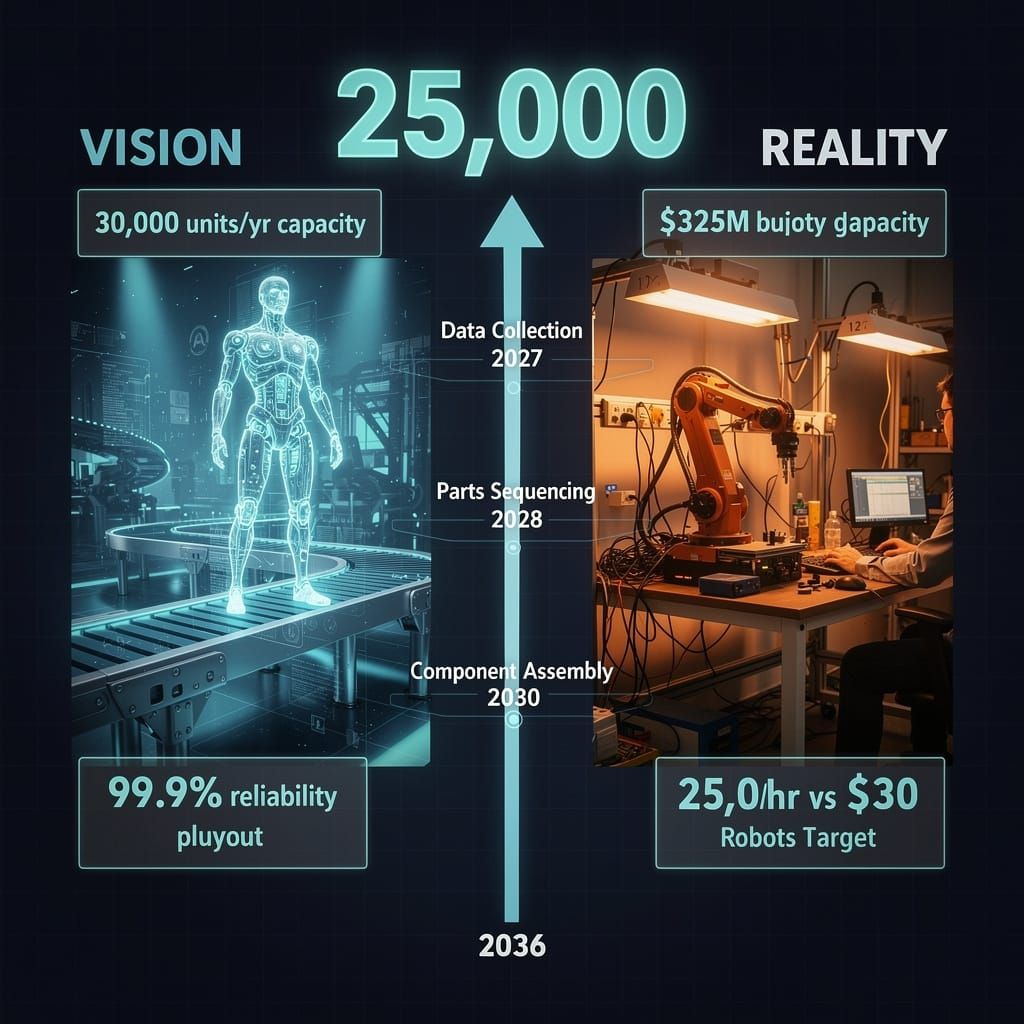
$325M buyout, ₩1.7T in losses, and a target of 25,000 humanoids—yet no plant has an Atlas on a line. 🤖 Hyundai's Savannah "Robot Behavior Factory" trains parts-sequencing in a controlled room, with scaling deferred to 2027. That's a 4-year roadmap, not a result. Would you bet your assembly line on it?
The press releases came fast in late September, and by the time the dust settled on the "Robotics Metaplant Application Center" (RMAC) outside Savannah, Georgia, the numbers being thrown around sounded less like factory planning and more like science fiction. Twenty-five thousand humanoid robots. Thirty thousand units of annual production capacity. A tenfold facility expansion within a year. Component assembly by 2030.
Hyundai and Boston Dynamics are telling a spectacular story about the Atlas humanoid entering automotive manufacturing. But strip away the PR, and what the September 21 opening actually demonstrates is a company that still hasn't proven its robot can do the job it's being asked to do—let alone at the scale being promised.
What the Facility Actually Does
RMAC is a training ground, not a production line. Inside Metaplant America, Atlas units are learning "logistics preparation and sequencing" tasks—essentially arranging automotive parts in the right order at the right time. That's real work, but it's deliberately narrow work, chosen because it's a controlled environment where a struggling robot can fail without stopping an entire assembly line.
The sequence being so confidently rolled out—data collection expansion in 2027, parts-sequencing deployment in 2028, component assembly by 2030—is a roadmap, not a schedule with results. None of these milestones have been met. The June pilot shifted to "full operations" in September, but that phrase still describes a facility whose own materials describe it as a "Robot Behavior Factory" using teleoperation, reinforcement learning, and novel UMI devices to prep parts. That's not a robot working unattended on a line; that's a robot being hand-fed demonstrations.
The Gap Between Headlines and Hard Numbers
Here's what the announced figures actually measure: ambition and factory capacity targets, not current output. Hyundai hasn't deployed 25,000 Atlas units anywhere. No plant has a working Atlas on an assembly line—and Hyundai's own shareholder documents confirm the target, with a goal of building manufacturing capacity for 30,000 Atlas units annually by 2028 and deploying 25,000 across Hyundai and Kia plants. The "30,000 units annual production capacity" refers to capacity, meaning Boston Dynamics says it could build that many if demand and manufacturing maturity existed. Neither is established.
Even the timeline behind the ownership is worth weighing. Hyundai only became Boston Dynamics' sole owner in July, via a $325 million buyout that ended SoftBank's involvement and converted the firm into a wholly owned subsidiary. Glovis filings confirm Hyundai previously held an 11% stake, while the residual ~9.65% went to SoftBank. The full transaction—executed just two months before the Savannah opening—arrived after a robotics business that had operated at a loss every year since 2021, with cumulative losses steadily pushing toward 1.7 trillion won by 2025, alongside a CEO retired by early 2026. On that record, a company that can't yet sequence a single production shift reliably is asking you to trust a four-year leap to 25,000 deployed units.
The Skeptic's Reading
The economics deserve scrutiny too. Hyundai's stated rationale—that a general-purpose robot cuts the cost of extending individualized automation systems—is plausible on paper. But the cost comparisons being circulated lean on analyst projections rather than measured Hyundai data. JPMorgan's models put humanoids at $10/hour versus $30/hour for human labor and forecast 1.2–1.3 robots per worker by 2030—useful projections, but projections. No plant operator has published measured cost-per-task data showing Atlas outperforming a purpose-built robotic arm on Hyundai's own line. What we have instead is a claimed 99.9% operational reliability pledge and a roadmap.
What's actually happening is a strategic hedge. Hyundai controls Boston Dynamics outright—a consolidation that itself signals pressure, since the $325 million buyout resolves a messy decade that began with Hyundai's initial 80% stake valued at $1.1 billion. Opening a facility to train a robot that remains years from production readiness is a low-risk way to keep the narrative alive and keep hardware development funded, while the hard questions about reliability, cycle time, and maintenance cost remain unanswered. Tellingly, senior Hyundai executives have already conceded that even accelerating a Nasdaq IPO toward 2027–2028 is the priority—early deliveries, sustained factory operation, and a public listing are treated as separate milestones.
The 2027 "tenfold expansion" is the quiet tell: if Atlas were performing spectacularly in June's pilot, expanding a facility in September would have been the obvious move. Instead, the plan defers the real scaling to next year—after more training data is gathered on a robot that has not yet demonstrated it can consistently sequence a single production shift.
Twenty-five thousand units by 2030 is a compelling vision. It is not, as of September 2026, a measured reality. Consider the gap before betting the assembly line on it.
Comments ()