Atlassian races to patch critical unauthenticated file-read flaw
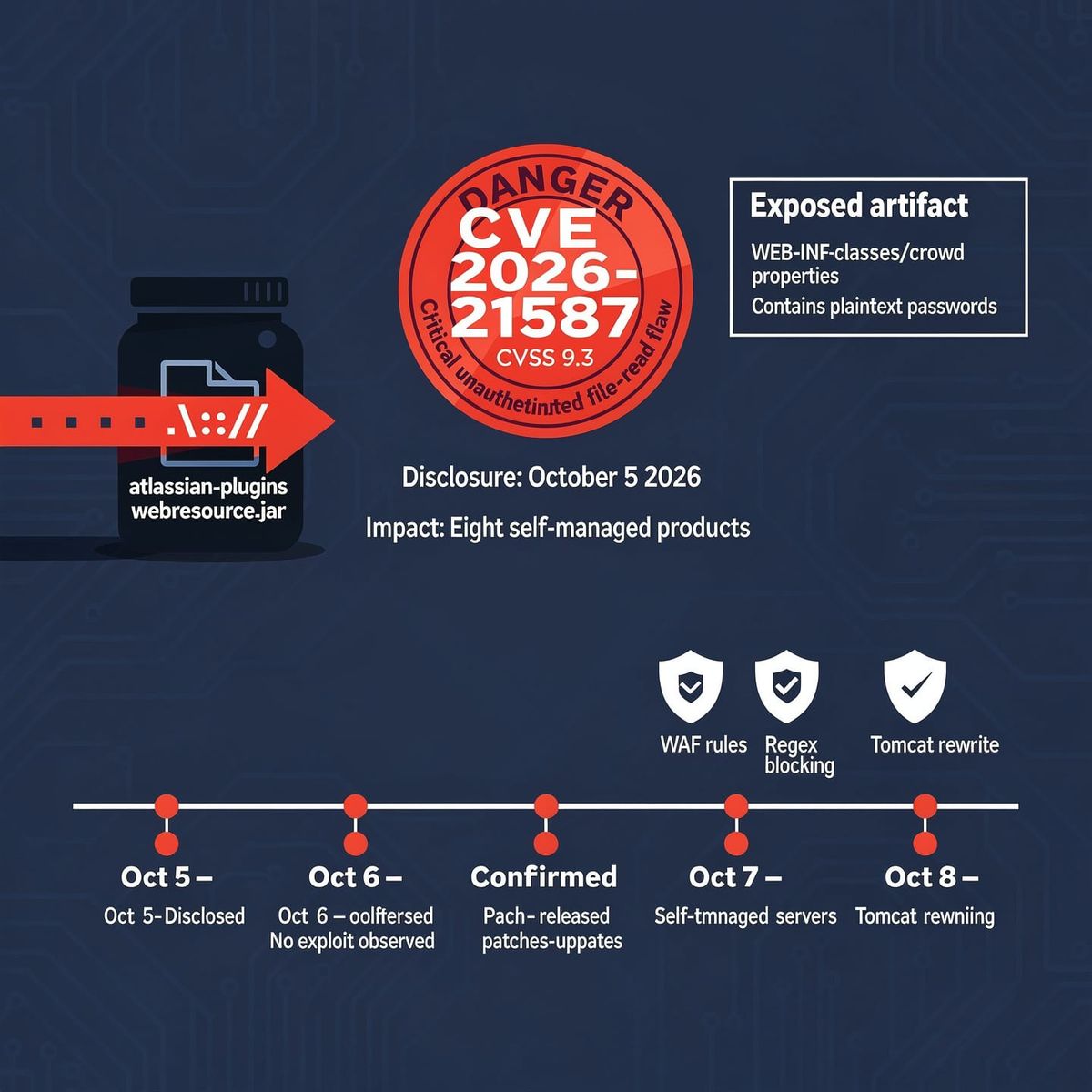
Atlassian disclosed a critical arbitrary file access vulnerability on October 5, 2026, and by October 6 confirmed it affects eight self-managed data-center product lines: Bamboo, Bitbucket, Confluence, Crowd, Crucible, Fisheye, Jira Service Management, and Jira Software. Tracked as CVE-2026-21589 with a CVSS v3 severity score of 9.3, the flaw lets an unauthenticated remote attacker read files from the web application root directory with no login or user interaction.
The mechanism is a path traversal in the web-resource plugin. The vulnerable code in atlassian-plugins-webresource.jar sets up a shared web resource endpoint that reads paths under the web app's root directory, but it fails to validate that a requested path stays inside that intended location. A double-colon traversal can walk outside it. Because the check is absent at the trust boundary, an unauthenticated request can pull configuration files and secrets the app should never expose. Researcher WatchTowr points to targets such as configuration files like WEB-INF/classes/crowd.properties, which may hold plaintext passwords that enable further lateral movement.
There is still a constraint on just how blind this read is. Exploitation requires prior knowledge of the target file's exact name and path, so it is not a free directory listing or sweep. The attacker needs to know precisely what to ask for. That is a narrower window than a blanket file dump, but it still matters because the material an attacker can reach includes the credential-bearing configuration other services trust for authentication.
There is a helpful distinction between vulnerable and exposed. Atlassian flagged the flaw as critical with a high CVSS score, but severity is not incident prevalence. As of October 7, no confirmed exploit was on record, and the patch situation changed the calculus for some customers in an important way: the cloud products were already fixed, while self-managed servers lack automatic updates. That split is what makes this worth attention, not just the CVSS number.
For the self-managed side, patches have been released across the affected service lines, though some versions were still pending updates as of October 8. Patch availability is the grounded fact; how fast the long tail of deployments applies it is the open question, especially given that self-managed Atlassian servers do not auto-update. In the meantime, Atlassian has reported mitigations such as web-application firewall rules, regex-based blocking, or Tomcat rewrite rules to defuse the shared web resource endpoint until patching completes.
What this adds up to: an interaction-free file read that can hand over credential-bearing configuration is the kind of flaw that can be weaponized quickly, and the deployments carrying it are the ones least likely to patch themselves. The decisive unknown is whether public exploit code closes the gap between "vulnerable" and "compromised" before self-managed installations catch up. Atlassian's own monitoring has not yet detected a confirmed breach, but that is a "not observed," not a "safe" verdict—the window is still open on every unpatched instance, and the margin for closing it is thin.
Comments ()