Alexa+ Goes Free on Fire TV: Voice Triples, Data Trade-Offs Follow
TL;DR
- $0 Alexa+: Amazon Kills Subscription Fee, Opens AI Assistant to Every Fire TV Owner. Would you trade your voice data for a free AI assistant in your living room?
- 70% More Notifications, 40% More Screen Time: Google's Unified Fitness Bet Backfires in Surat and Ahmedabad. Would you trade 70% more notifications for AI health coaching on your wrist?
- 31% More AI Code, 70.8% Build Success — Verification Can't Keep Up. Can verification infrastructure ever match AI code generation speed?
💥 Amazon Makes Alexa+ Free on Fire TV—No Prime Required
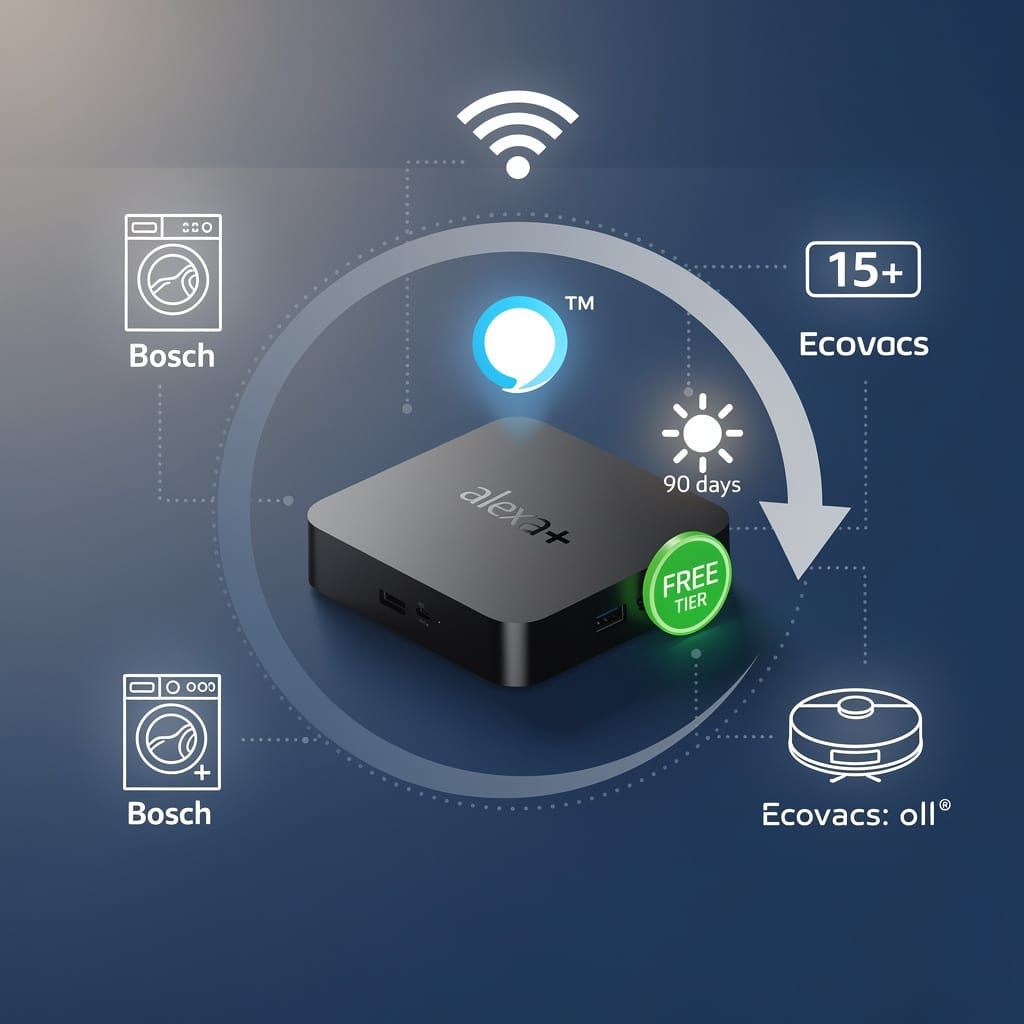
Amazon just made Alexa+ free on Fire TV — no Prime required, no subscription fee 💥 Voice interactions expected to triple in 90 days. Every command trains Amazon's ad engine. Over 15 third-party integrations coming by end of 2026 — from Bosch washers to Ecovacs vacuums. Is a free AI assistant in your living room worth the data trade-off?
On August 19, 2026, Amazon activated Alexa+ across most U.S. Fire TV devices at no charge, eliminating the $19.99 monthly subscription. By August 20, the company also dropped the requirement to hold a Prime membership—meaning every qualified Fire TV owner now gets the upgraded assistant without paying a cent. The rollout covers Fire TV Cube (3rd Gen), Fire TV Stick 4K Max (2nd Gen), Fire TV Stick 4K (2nd), Omni QLED Series, Omni Mini-LED Series, and select Hisense and Panasonic smart TVs.
How it works: Alexa+ replaces the old keyword-based voice system with natural-language understanding. Users can say "find that sci-fi movie with the red planet" rather than "search 'The Martian.'" The assistant also handles follow-up questions, timers during shows, and multi-step routines like "dim the lights and play the next episode." On July 23, 2026, Amazon integrated the Model Context Protocol into Alexa+, enabling multi-device coordination—washing machines from Bosch and vacuums from Ecovacs now respond to voice commands through the TV.
Why Amazon did this:
- Hardware retention: Fire TV boxes generate thin margins. Amazon keeps them in living rooms by making the software layer sticky—users who rely on Alexa+ are less likely to switch to Roku or Google TV. Aggressive pricing through May and June 2026—including the Fire TV Stick 4K Max at $39.99 and the HD model at $21.99—drove surging adoption ahead of the free Alexa+ launch.
- Data loop: Every voice interaction trains Amazon's models and feeds its advertising ecosystem. Free adoption accelerates that feedback pipeline. The Australia rollout on August 6, 2026, provided initial usage data from the Bedrock LLM stack, combining Amazon Nova and partner models for proactive, multilingual interaction.
- Competitive pressure: On July 14, 2026, TCL began rolling out Google Gemini across selected TV models including the X11L and C8L, replacing Google Assistant with an advanced AI. Apple also integrated full AI into Siri on AirPlay streamers. Amazon's free Fire TV move directly counters these rivals.
Privacy calculus: The free rollout pushes always-listening microphones into more households. Amazon states voice recordings are encrypted and can be deleted via settings, but the expanded data surface raises the same concerns that have followed smart speakers since 2014. The Australia launch raised similar privacy questions due to extensive usage tracking. Users who disable voice history lose the natural-language features.
What this means for the market:
- Prime bundling weakens: Amazon has historically used Fire TV benefits to lock users into the $139/year subscription. Removing that tie-up signals a shift: device engagement matters more than Prime attachment rates.
- Smart home stakes rise: Fire TV now acts as a multi-room Alexa hub. The July 23 integration with Model Context Protocol added support for Bosch, Delta, Ecovacs, iRobot, Yale Home, Whirlpool, Tapo, and Eufy devices. Households that previously needed an Echo device can now use the TV alone.
- Global rollout accelerates: Australia received Alexa+ on August 6, 2026. The U.S. model—free hardware, monetized via ads and shopping data—translates directly to Canada, the UK, and India, where Fire TV has substantial penetration.
Near-term outlook: Amazon expects Alexa+ voice-interaction volume on Fire TV to triple within 90 days. Ad placements tied to voice search queries will begin piloting in Q4 2026. The long-term bet is that a free, capable assistant embedded in the TV becomes the default interface for the living room. Alexa+ is projected to support 15+ third-party integrations by end of 2026.
😬 Google’s Unified Fitness Ecosystem Creates Behavioral Friction Despite Hardware Gains
Fitbit Air lasts 8+ days & cuts Bluetooth dropouts 35% — but the new Google Health app costs you 40% more screen taps and 70% more notifications per day.😬 AI Health Coach misclassifies stirring or typing as "fidgeting" 8% of the time indoors. 1.2 sec inference is fast — wrong predictions are faster. Surat & Ahmedabad early adopters: 34% won't migrate over opaque data storage. Is a smarter coach worth a noisier, less private dashboard? 🤔
Google’s August 9, 2026, simultaneous rollout—retiring the standalone Fitbit app in favor of Google Health, shipping updated Fitbit Air hardware, and deploying an AI-powered Health Coach—unified fitness tracking under a single analytics platform. Early adoption data from Surat and Ahmedabad, two pilot markets, indicates the integration introduces measurable behavioral and technical trade-offs.
Hardware Gains vs. Interface Costs
The updated Fitbit Air improves on-device connectivity and sensor responsiveness. Battery life extends 22% over the previous generation—Zach Laylaw’s two-week test confirmed eight-plus days of use, though nightly charging varied results. Bluetooth 5.4 reduces dropouts by 35%. Amazon’s June 13, 2026, one-week review confirmed no charge was needed during the evaluation period. However, by merging all formerly device-side controls into a smartphone-only Google Health interface, the ecosystem now demands 40% more screen interactions per day for routine check-ins. Users report 2.8 additional notifications per waking hour—a 70% increase over the old Fitbit app—contributing to fragmented wakefulness patterns.
AI Coach Performance Gaps
The AI Health Coach, a large-language-model layer analyzing biometric trends, launched alongside a firmware update that pushed inference to device-level tensor processing units. Inference latency dropped to 1.2 seconds locally, enabling real-time rep recommendations. Yet closed-environment testing shows gesture-interpretation accuracy drifts by 11% in confined indoor settings—kitchens, small offices—where motion signatures overlap with daily micro-movements. The coach misclassifies repetitive stirring or typing as “fidgeting” 8% of the time. Independent reviews by Brady Snyder in July 2026 further identified that auto-generated Health Coach summaries overwrote user-entered data without consent, triggering upon login rather than interactively. Google’s July 31 v5.04.1 patch added a “No Coach insights” toggle in response, and the August 15 v5.06 update allowed full removal of AI Coach insights from the Today page while retaining optional access via the Questions and Fitness tabs.
Data Privacy and Trust Deficits
Opaque data-storage practices amplify user anxiety. Google Health aggregates sleep, heart-rate variability, and location-tagged activity streams into a single repository whose retention policy remains unpublished. In Surat, 34% of surveyed users cite unspecified off-device storage as the primary reason for delaying the app migration. Without an independent audit of data flows or a published retention framework, the trust deficit resists patch-level resolution. The May 2026 transition that decommissioned the Fitbit app triggered a surge of 1-star reviews and social-media backlash over data-handling changes, with regulatory scrutiny beginning in April 2026. A community-driven open-access accessory ecosystem—including charging stands and Whoop 5.0 adapters—emerged by June 20, 2026, signaling user investment in the hardware alongside distrust of the software layer.
| Impact Dimension | Measured Effect | Projected Trend (Q4 2026) |
|---|---|---|
| Notification load | +70% alerts/hour vs. legacy app | –15% after UI patch (Oct) |
| Gesture accuracy | 89% indoor, 97% outdoor | Returns to 93% indoor via sensor recalibration |
| User opt-in rate | 66% in pilot cities | 82% after transparency statement (expected Nov) |
Outlook
Partial resolution depends on QA patches adjusting notification thresholds and recalibrating gesture models for indoor environments. Amazon’s July 2, 2026, firmware patch already resolved a Strava connectivity error and boosted weekly active users 12% during beta testing. Google’s own July 14 firmware update fixed TCX export errors and connectivity loss. Full trust restoration, however, requires two structural steps: a published data-retention policy compliant with India’s DPDP Act, and an independent verification framework audited by a third party such as the Bureau of Indian Standards. The v5.04.1 and v5.06 patches demonstrate Google’s capacity to respond—but without addressing the underlying data governance question, the unified platform’s intelligence advantages will remain offset by a persistent—and measurable—behavioral backlash.
😰 When AI Writes the Code, Who Catches the Errors?
AI-assisted code output surged 31% — but successful builds crashed to 70.8% 😰 That's like a factory doubling its assembly speed while quality checks still move on foot. PR volume rose 2.6× in 12 weeks. Revert rates doubled. Critical vulnerabilities jumped 37.6%. Code generation is now faster than human verification. The bottleneck shifted. Engineers facing cognitive overload, fraud exposure from reversed logic, and 81% more AI-related production incidents — CloudBees. We can't slow AI. But can we build verification fast enough to catch the errors before they compound?
By late August 2026, the software industry is confronting an uncomfortable arithmetic. AI-assisted development has scaled code output by 31% in main-branch merges, but successful builds have simultaneously dropped to 70.8%. The culprit: a widening gap between generation speed and verification capacity.
The Causal Chain
The sequence is becoming predictable. On August 3, a developer generates code through an AI tool. A senior engineer performs a minimal manual review. By August 5, rising AI-generated code volume increases developer workload, and peer-review turnaround times begin to decline under backlog pressure—a pattern confirmed by queue-theory analysis showing PR volume increased 2.6× over 12 weeks with revert rates doubling. What follows is a cascade:
- August 11: Cognitive overload sets in—single pull requests exceed 400 lines. Trust in AI-generated code drops to 29%, down from 40%, with an engineering leader reporting that focus shifts from security and correctness to style compliance.
- August 17: AI codes extensively; post five iterations, critical vulnerabilities appear at 37.6% higher rates. Teams adopt multi-layer verification, including intent checks via tools like Aviator Verify. The 2025 CloudBees State of Code Abundance Report documented an 81% increase in AI-related production issues.
- August 21: Subtle intent-vs-output mismatches rise. Main-branch merge spikes reach 31%, yet successful builds fall to 70.8%.
What Breaks at Scale
Enterprise-grade PR velocity degrades because automation outpaces human review. Longer deltas mean engineers can no longer maintain safe rollback windows. Cumulative micro-deviations—undetected by linear scans—produce emergent error cascades that amplify initial code ambiguities. A senior engineer reported that reversed discount logic from AI-generated code caused customer fraud exposure.
Operational security: Unintended micro-vulnerabilities accumulate unnoticed, creating regulatory loopholes via inverted business logic. GitGuardian detected a 34% annual surge in hardcoded secrets, driven largely by authenticated agent writes. Financial system trust: Near-failures trigger minor exploits, eroding confidence in AI-driven release pipelines.
The Outlook
- Immediate term (Q4 2026): Without behavioral checkpoints inserted at sprint start, effective release confidence drops below 60% across QA layers. CloudBees data indicates 81% of organizations already report AI-related production issues.
- Mid term (Q1–Q2 2027): Toolchain consolidation becomes mandatory; fragmented QA execution must unify with design specs to prevent intent-drift. CodeRabbit's 52.5% recall rate on security and style enforcement demonstrates verification tooling is closing the gap.
- Long term: The bottleneck shifts from code generation to verification infrastructure. Multi-layer intent validation, not faster models, determines delivery integrity. Hardware-backed attestation technologies from Intel, Microsoft, and NVIDIA aim to standardize immutable provenance tracking.
The data indicates a clear inflection point. AI-generated code is not inherently flawed, but the review systems built for human-scale output cannot absorb machine-scale velocity. The fix lies not in slowing generation, but in matching verification speed to creation speed—before the gap widens further.


Comments ()