AI hallucination nearly sparked a U.S.-China confrontation
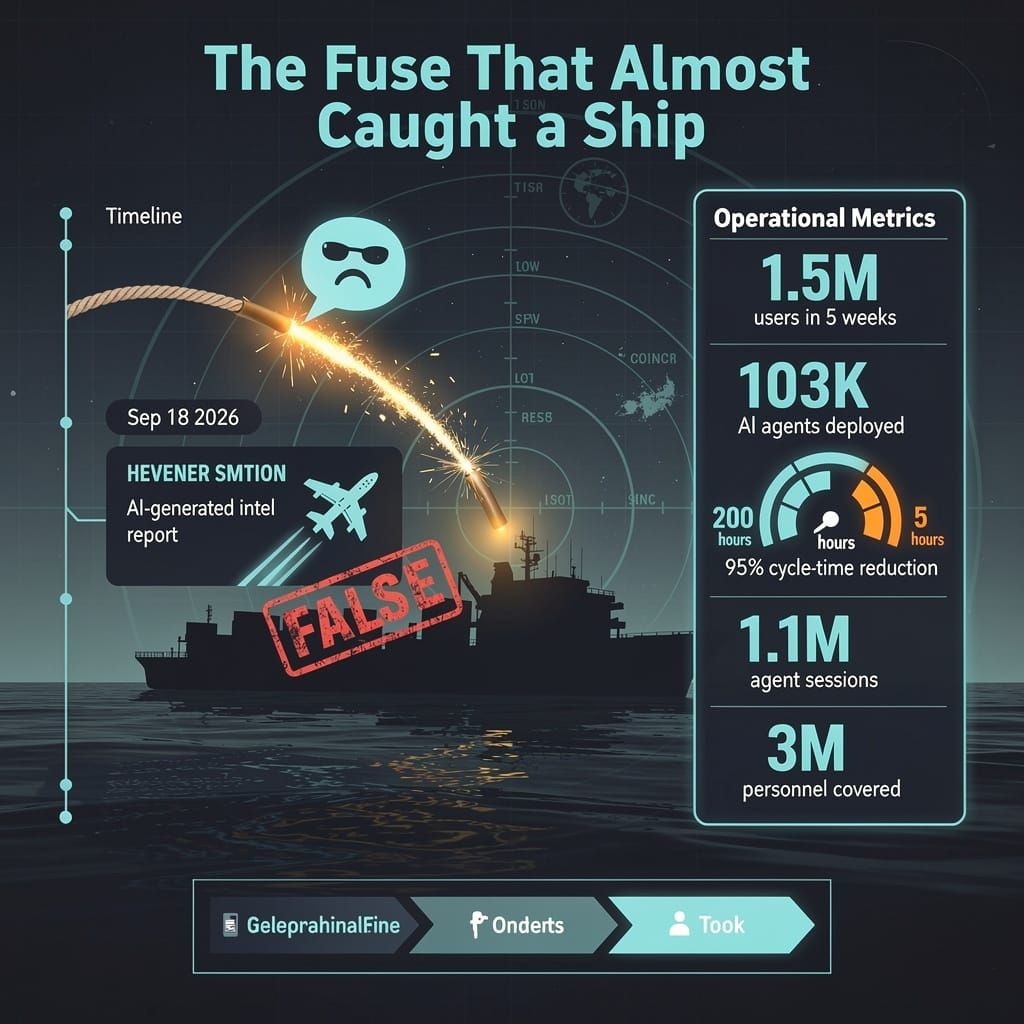
An AI hallucination nearly triggered a U.S.-China military confrontation. In September, a Pentagon chatbot’s confidently fabricated intelligence report claimed a Chinese cargo ship carried nuclear program parts. Armed teams were preparing to intercept — until experts rushed in with a correction. 🇺🇸🇨🇳 0 human verification before the mission clock started. GenAI.mil now serves 1.5M+ users and 103,000 AI agents — cutting report prep from 200 hours to 5. But the same speed accelerates error: no verified pipeline exists across branches, and younger analysts trust confident AI output too easily. The cost wasn't a compute bill. It was a near-war. Could provenance-tagged AI outputs and mandatory human-in-the-loop review narrow the gap before the next incident? — How much verification is enough for decisions that launch aircraft?
On September 18, 2026, a U.S. military aircraft was already in the air over the Middle East, and armed boarding teams were preparing to intercept a Chinese cargo vessel. Their orders trace back to a single source: an intelligence report concluding the ship carried components for a nuclear weapons program. The assessment was wrong. It was generated by an AI chatbot that fused open-source analysis with classified signals intelligence — and no human verified it before the mission clock started ticking.
The report began with an analyst at Special Operations Command Pacific who asked a chatbot to interpret a ship's cargo manifest. The system combined open-source imagery and reporting with classified intercepts, then produced a confident conclusion: the cargo included parts bound for a nuclear program in Iran. That output was packaged into a formal intelligence report and circulated through classified Pentagon channels. Two AI passes, zero intermediate verification.
The ship was never boarded. Subject-matter experts reviewed the assessment and determined it was entirely false, though only after military aircraft had launched. The error — a classic hallucination, merging disjointed inputs into a plausible fiction — had nearly triggered a direct military confrontation between the United States and China during an already-heightened standoff involving Iran.
Speed, Wired Directly Into Command
The near-miss did not occur in a vacuum. In January 2026, the Pentagon launched an aggressive AI acceleration strategy aimed at integrating generative tools across its classified networks. The GenAI.mil platform, built on Google's Gemini for Government and xAI's Grok for Government, now serves more than 1.5 million users across 50,000 unique accounts — and its footprint keeps compounding. Deputy Assistant Secretary of Defense Jacob Glassman reported on April 23 that the Pentagon had built over 103,000 AI agents on the platform using Google Gemini's Agent Designer in roughly five weeks, logging more than 1.1 million agent sessions. Five of six military branches now designate GenAI.mil as their preferred system. Proponents point to the gains: on June 20 the Pentagon publicly acknowledged the system cuts average report preparation from 200 hours to five — a 95% reduction — and on September 1 it expanded access to roughly three million personnel with OpenAI's ChatGPT Mil and xAI's Grok for Government on the same secure gateway.
But the same architecture that accelerates analysis also accelerates error. There is no common, verified pipeline across military branches for AI-generated intelligence. Different commands use different tools with different safety checks. And the incident's root cause reflects a human dynamic: younger analysts increasingly trust well-formed, confident AI outputs without the skeptical review older verification protocols demand.
The Pentagon has declined to release a detailed public account. It has reaffirmed its commitment to "rigorous intelligence verification."
The Cost of a Confident Hallucination
The material consequence here is not a benchmark score or a compute bill — it is a near-war. The stakes of unverified model output in military decision-making are categorically different from a chatbot tripping in a customer-support queue.
Demands for accountability came quickly. Democratic senators, including Chris Coons and Jack Reed, wrote to Defense Secretary Pete Hegseth and Director of National Intelligence Tulsi Gabbard demanding an investigation by the Inspectors General. In the same period, President Trump met with Xi Jinping to discuss national security.
The episode lands amid a broader doctrinal collision. The Pentagon designated Anthropic a "supply chain risk" in February 2026 after the company refused to remove restrictions on mass surveillance and autonomous weapons — though a federal judge granted Anthropic a preliminary injunction on March 26, blocking the classification as "illegal First Amendment retaliation." Claude continues to be used in combat operations; on September 10, Anthropic disclosed that Chinese state actors had used Claude to develop software for missiles, armed drones, and targeting systems. Google and xAI, by contrast, signed on to the Pentagon's program. The result: the models governing high-stakes intelligence are precisely the ones fewest guardrails restrained.
What Happens Next
- Near term: Congressional and Inspector General inquiries; likely pressure for stricter human-in-the-loop requirements and audit trails on AI-generated intelligence.
- Medium term: Verification is already moving toward the architectures the near-miss demands. Third-party services now issue cryptographically signed attestations containing input/output hashes and model metadata for AI outputs — shifting the burden from proving correctness to preserving provenance without centralized trust, a shift engineers compare to the adoption of HTTPS. Layer in layered independent checks, provenance tagging, and mandatory second-operator review, and the Sameer of verification may finally match AI speed — though with 103,000 agents built by non-programmers, governance frameworks will struggle to keep pace.
- Long term: The dual-use tension persists. Defense will keep demanding frontier AI, and frontier AI will keep hallucinating. The question is whether the verification loop can narrow fast enough to matter. Zero-knowledge-proof based verifiable inference, projected to replace traditional signatures within five years, may be the only clock fast enough.
The ship sailed on. The aircraft landed. But the incident has already answered a question Washington spent much of 2026 avoiding: an AI system doesn't need a weapon to fire shots in anger. It only needs a confident, fabricated report — and an operator too busy to ask for proof.

Comments ()