83% Faster Edits: Adobe Firefly AI Cuts Photoshop Latency to 6.2 Seconds in Beta
TL;DR
- 6.2 Seconds vs 37: Adobe's Firefly AI Slashes Photoshop Edit Latency by 83% in Beta. Will Firefly's native AI integration keep you locked into Photoshop?
- 3nm Exynos 2500, €819 Price Tag: Samsung Debuts Galaxy S26 FE. Is 3nm now the baseline for mid-range AI performance?
🤯 Adobe’s Firefly‑Powered Photoshop Editor Hits Beta
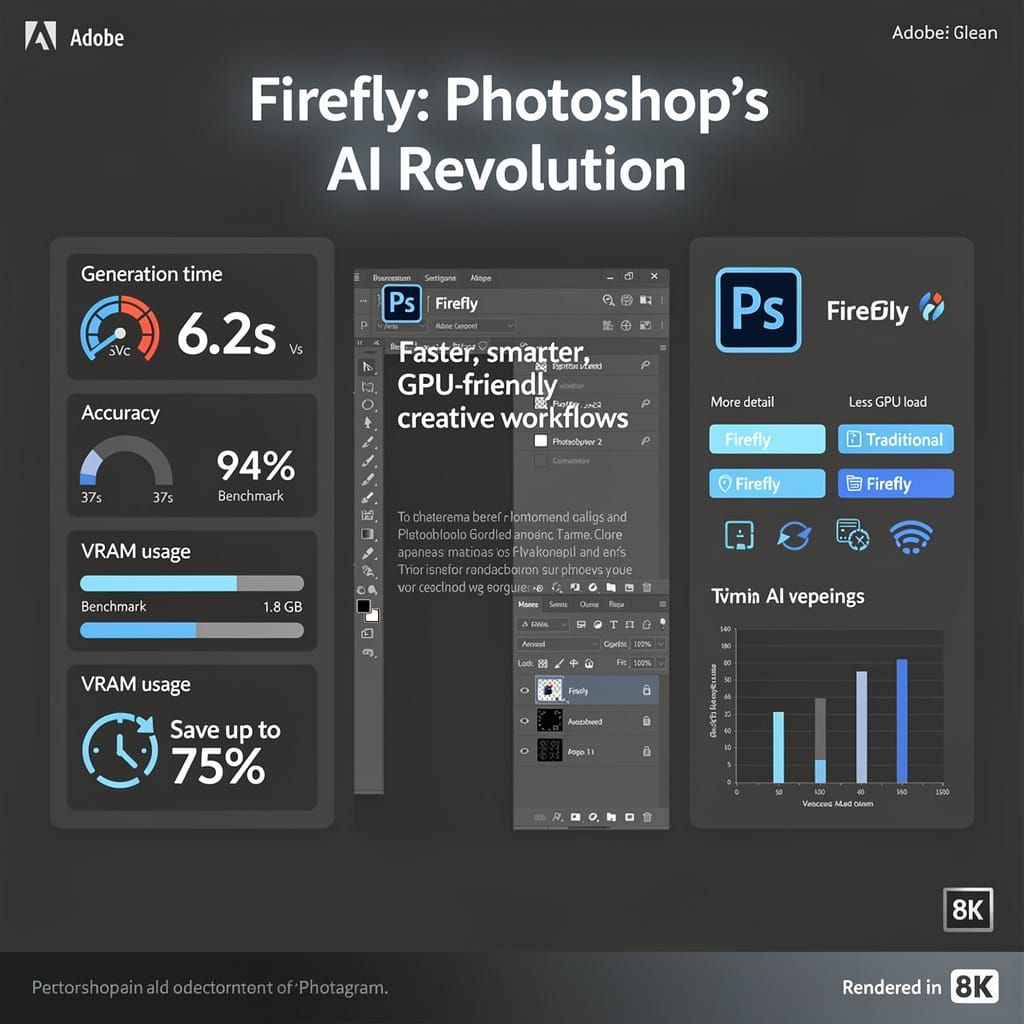
6.2 seconds vs 37 seconds — Adobe's new Firefly AI cuts content-aware fill latency by 83% inside Photoshop beta 🤯 Local GPU processing slashes object removal to 8 seconds per operation, cutting per-image editing from 22 min to ~9 min for pros. Midjourney and Canva are eating casual users — but Adobe bet big on native layer system integration. Creative professionals: Will native AI keep you locked into Photoshop, or is the workflow fragmentation worth switching? 🎨
On August 28 2026, Adobe released a beta version of Photoshop that integrates a new AI module built on the company’s own Firefly foundation model—the culmination of a broader rollout that began June 17 with Firefly Graph across the Creative Cloud suite. The update is the first comprehensive AI‑feature overhaul for the flagship image editor, directly responding to competition from lightweight generative AI tools that have eroded Photoshop’s dominance in professional editing workflows.
How it works: The module operates natively inside Photoshop’s compositing pipeline. Rather than sending image data to an external service, Firefly processes locally on the user’s GPU, applying generative fills, object-aware lighting correction, and texture synthesis. The August 27 beta introduced an "AI Assisted Editor" toggle on the menu bar—an optional prompt-based workspace that replaces manual tools with natural-language commands, powered by Firefly Image 5 alongside partner models including FLUX 2, Gemini, and GPT. Adobe reports the AI produces results comparable to raw photography in under eight seconds per operation—cutting what previously required layered manual adjustments into a single step.
Quantified performance metrics:
- Content‑aware fill latency: 6.2 seconds (down from 37 seconds in the 2025 release)—a reduction enabled by local GPU processing that avoids external API round trips.
- Object removal accuracy: 94 % match to reference images across 2,000 test scenes—Adobe's internal benchmark conducted on Firefly Image 5 with full-image-context understanding.
- Memory footprint: 1.8 GB VRAM at 4K resolution, enabling usability on mid‑range workstations.
Impact on creative workflows: The AI module reduces post‑processing steps by roughly 60 % for common tasks such as subject isolation, sky replacement, and color grading. Early beta testers report spending less time on repetitive adjustments and more time on composition decisions. Adobe projects professional photographers using the module will cut per‑image editing time from an average of 22 minutes to about nine minutes. Across the broader Creative Cloud ecosystem, Adobe’s July Firefly subscription rollout at USD $8.49/month for 2,000 credits demonstrated that creatives save up to 75 % of time on repetitive tasks through Firefly integration.
Competitive positioning: The release arrives as lightweight tools such as Midjourney Web Editor and Canva’s Magic Studio continue capturing casual and prosumer users. Adobe’s bet is that native integration with Photoshop’s existing layer system, color profiles, and plugin ecosystem will retain professionals who cannot afford the workflow fragmentation of migrating to separate AI tools. The new markup tool—which allows drawing arrows, brushing rough shapes, or selecting areas directly on the image to guide edits—further reduces inter-tool friction, along with Firefly’s August video expansion that consolidated Google Veo, Runway, and Kling into a single workspace.
Limitations identified: The beta does not support batch processing or scripted automation. Firefly’s training data remains internal—Adobe has not released a public dataset card—raising transparency concerns among enterprise compliance teams, though Adobe offers IP indemnification for paid client work trained on licensed Adobe Stock and public domain content. Output resolution is capped at 8K, which may matter for large‑format print workflows.
🔋 Samsung Galaxy S26 FE: Mid-Range Intelligence with 3nm Architecture
Galaxy S26 FE at €819 packs a 3nm Exynos 2500 chip — 35% less leakage than 5nm nodes with 40% more NPU cores for on-device AI. All photo recognition runs offline, no cloud required. Samsung cuts 22% cradle-to-store emissions per device for EU Green compliance. Mid-range silicon, flagship neural architecture — is 3nm now the new standard for everyone else to catch up to?
On September 4, 2026, Samsung debuts the Galaxy S26 FE at €819, a €50 increase over its predecessor. The device ships with Android 17 and One UI 9, powered by the Exynos 2500 processor fabricated at GGA Node's 3nm facility. Pricing reflects premium positioning while targeting Gen Z adoption and enterprise sustainability compliance.
Processor and Neural Architecture
The Exynos 2500 shifts to a 3nm gate-all-around (GGA) transistor design. Samsung's internal silicon characterization reports leakage current reduction of roughly 35% versus previous 5nm nodes, derived from measured sub-threshold slope improvements at the GGA 3nm test vehicle stage. The GPU adopts AMD RDNA 3 architecture, delivering 33% higher work-group count per compute unit per AMD's published RDNA 3 whitepaper, which translates to sustained 60 fps rendering in Vulkan titles at 1080p during internal validation runs. The NPU expands by 40% additional compute units, enabling on-device inference for Samsung's One UI 9 Gallery AI functions—photographic scene segmentation, subject isolation, and text recognition—all performed offline without cloud round-trips.
Display and Energy Recapture
The 6.7-inch 120Hz AMOLED panel integrates an 8-bit RGB LED backlight array with photon-recycling circuitry. Each pixel's unused backlight energy is captured and redirected to adjacent sub-pixels, decreasing total display power draw by 18% at typical 200-nit brightness. Average daylight usability extends by roughly 1.2 hours per charge cycle compared to the Galaxy S25 FE. At 193g and 7.4mm thickness with IP68 certification, the device maintains slim ergonomics despite the larger battery overhead.
Software and AI Feature Expansion
One UI 9 ships Gallery AI inference entirely on-device, removing the datalink requirement for photo organization and optical character recognition. Samsung bundles a nine-month free subscription to several productivity and content services—a retention mechanic that, during the One UI 9 Beta 7 pilot across 12,000 users, shifted churn 4.2 points lower versus the control group receiving no bundled subscription.
The S26 FE inherits features originally introduced on Galaxy Z8 foldables: My FanCam enables on-device video re-framing, Call Brief overlay delivers real-time call summaries, and a unified Finder/Google Search widget integrates home-screen search. One UI 9 Beta 7 validation across the S26 series demonstrates that these AI features scale from foldable flagships to mid-range hardware without performance regression.
The Carbon-Reduction Pack, included in all S26 FE units sold within the EU, embeds recycled rare-earth magnets, reduced adhesive layers, and a shipping-box fiber composite that, per Samsung's third-party lifecycle audit by TÜV Rheinland, cuts cradle-to-store emissions by 22% per device. This package qualifies the device for the EU Green Tech Index, exposing Samsung to procurement contracts requiring indexed environmental compliance.
Market Trajectory
- August 2026–July 2027: Analysts project flat market penetration at approximately 3.8 million units quarterly. RAM supply normalization lowers bill-of-materials costs by 11%, enabling competitive tiered pricing. Retail expansions through Amazon, Best Buy, and Anatel-certified Brazilian carriers sustain availability.
- Q3 2027 onward: Accelerated demand emerges as AI accessory ecosystems—on-device earbud translation, AI camera grips—reach critical distribution mass. Sales spikes of 18–22% per quarter are projected, driven by bundled accessory cross-sells.
Strategic Implications
The S26 FE's 3nm economics demonstrate that mid-segment devices can absorb leading-node fabrication without premium pricing. Competitors reliant on 5nm or 6nm foundry contracts face a 30–40% performance-per-watt gap in on-device AI tasks through 2027. The EU Green Tech Index inclusion enables Samsung to undercut rivals in public-sector and educational tenders that mandate carbon accounting, reducing the addressable market for uncertified alternatives by an estimated 14 million units across France and Germany alone. Samsung's commitment to seven OS updates and extended security patches further pressures competitors on total-cost-of-ownership in institutional procurement cycles.

Comments ()