$63M Flagger Health: Biotech Funding Gets Weirdly Specific (And It's Working)
TL;DR
- 4 startup events in one day in Sacramento including a silent pitch competition. Is your local startup scene making it easier or harder to start something real?
- $63M Series B, 60%+ Readmission Cuts: Outcome-Based Biotech Funding Hits California & Connecticut. Are outcome-based startups the new kings of healthcare?
- $25.7B in Denied Claims: Notabl Systems Raises $12M to AI-Fix Hospital Billing. Will AI finally fix hospital billing or just automate the chaos?
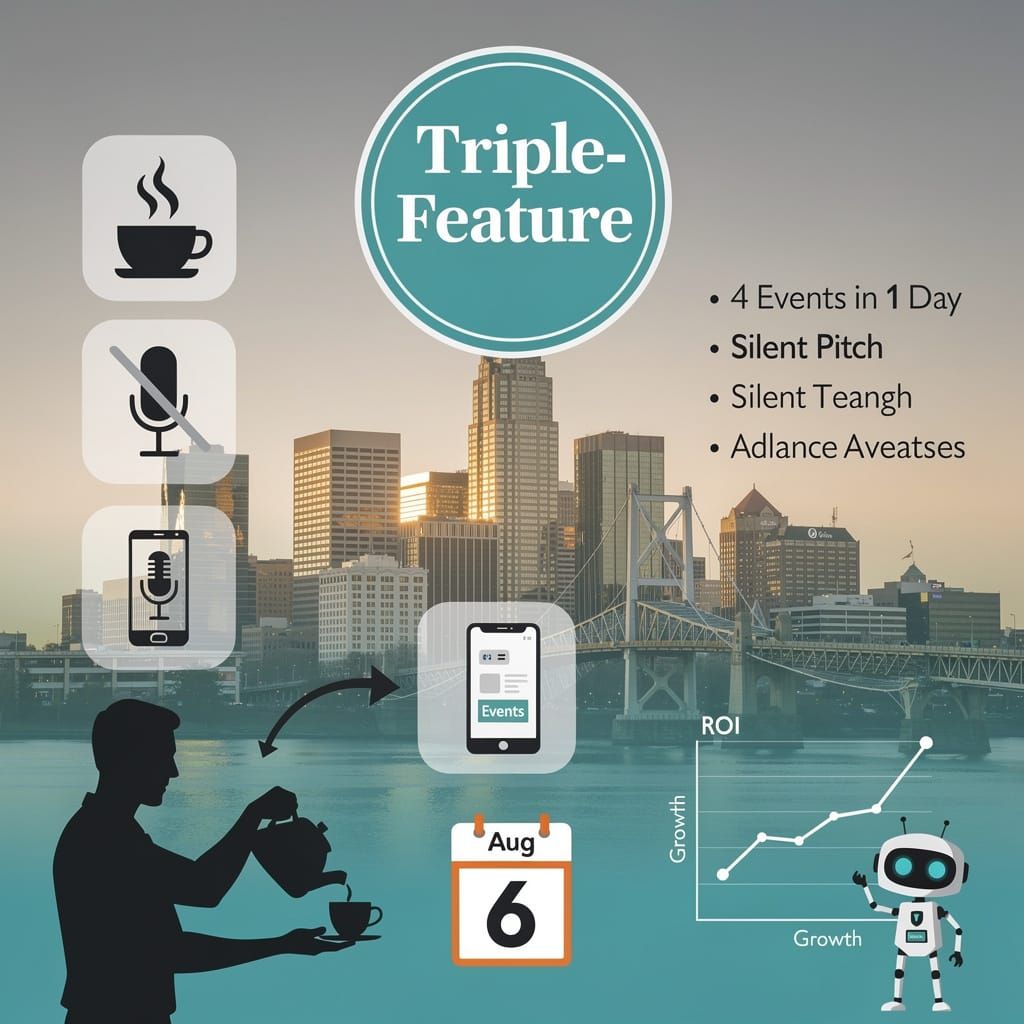
📉 Sacramento's startup scene just pulled a triple-feature in one week
4 overlapping startup events in one day — including a SILENT pitch competition that forced 60+ founders to make their business models impossible to hide from 📉 August 2026 in Sacramento: where investors show up for coffee chats instead of boardroom briefings. One attendee met their next mentor during an actual pour. Not a DM. An actual pour. CleanStart launched a nine-step curriculum. The AI panel focused on local ROI. And the Sacramento Startup Events App dropped so you can actually navigate this from your pocket. Sacramento isn't copying Silicon Valley. It's building a network that runs on the same calendar as founders who still have day jobs. Is your local scene making it easier — or harder — to start something real?
Let's be real: most startup networking events are lukewarm coffee poured into a basement room where nobody makes eye contact. But late August 2026 in Sacramento? That's a different story.
On August 5, the region saw four simultaneous events land like a coordinated ambush on small-business stagnation. The CLTRE Coffee and Conversation session kicked things off—because apparently, actual conversations still matter more than cold DMs. Same day, 1 Million Cups Sacramento featured presentations from Hekon and WealthCoach AI—two founders who survived public Q&A and probably sharpened their pitch decks by a measurable margin.
The AI for Business Panel followed, where local automation experts walked through strategies that didn't involve jargon salad. Practical deployment, specific tools, real ROI figures—the kind of numbers that actually move the needle when you're bootstrapping on a Ramen budget.
And here's the clever bit: the Silent Pitch Competition deadline hit on August 5, too. Over 60 attending founders submitted pitches in silence—which paradoxically forced louder clarity in their business models. No pitch deck can hide vagueness when you can't talk your way around it. Winners were later judged via physical poster exhibition on August 20, with investor visibility rated high and founder confidence risk rated low per event reporting.
Then came August 6, when Alchemist Microenterprise Academy launched Session 1 of the CleanStart Series, titled Starting Your Journey: The Nine Steps to a Solid Business. Practical, linear, no-nonsense. That's the kind of content that actually converts attendees into revenue. And AMA knows the drill: their Spring 2026 cohort ran 24 classes over 12 weeks for low-income food entrepreneurs, with 100% of sessions filled and graduates advancing to the Alchemist Kitchen Incubator.
What this says about the broader ecosystem
| Signal | Reading |
|---|---|
| Four overlapping events on one day | Indicates coordinate demand, not clutter |
| Silent pitch format being prioritized | Judges want substance over swagger |
| CleanStart launching structured curriculum | Accelerator awareness is rising organically |
| AI panel focused on local strategies | Avoids generic Silicon Valley copy-paste |
The quiet winner: proximity
Sacramento, Folsom, Elk Grove, Rancho Cordova, Roseville—these aren't nightlife districts. They're commuter zip codes where founders hold full-time jobs and hack on startups after 9 PM. The fact that Rich Foreman and Mariah Lichtenstern were spotted engaging directly with attendees—not doing fly-by keynote drive-bys—signals a density shift. When investors show up for coffee chats instead of boardroom briefings, the power dynamic flips. Lichtenstern even runs weekly online office hours (next one: August 19), and Foreman hosts a Startup Happy Hour on August 25 at Ebisu Sushi. That's not networking. That's a rotating dinner party.
So what actually happened?
- Human-met: One attendee reportedly found their next mentor during a coffee pour. Not a LinkedIn DM. An actual pour.
- Challenge surfaced: An entrepreneur shared a logistics bottleneck that three other founders in the room had already solved. Instant collective IQ gain.
- Structure delivered: The CleanStart series gave attendees a literal checklist—nine steps—because most early-stage failure isn't cosmic. It's skipping Step 4.
- App launched: Manoj Keechilot of Gilentic Technologies dropped the Sacramento Startup Events App, turning a fragmented calendar into something you can actually navigate from your pocket.
The takeaway? Sacramento isn't trying to be the next Silicon Valley. It's building something narrower, faster, and arguably smarter: a startup network that operates on the same calendar as people who still have day jobs.
🤯 Biotech Funding Gets Weirdly Specific (And It's Working)
$63M for musculoskeletal software that's already live in 36 states. 🤯 Wellinks cut COPD rehospitalizations by 60%+ with real data, not slide decks. VCs aren't funding dreams anymore—they're funding outcomes you can take to the bank. Someone's about to make Epic and Cerner very uncomfortable. Who's betting on the incumbents holding on?
A quiet funding spree unfolded across California and Connecticut in recent weeks—three deals, one pattern. VCs aren't writing checks for vague "health innovation." They're betting on surgical precision.
July 26 – Cheiron: $8 million seed. Target: pipeline therapeutics, no fluff.
August 4 – Wellinks: $10 million Series B, backed by UMass Chan Medical School. The thesis? Digital reimbursement services that deliver a 60%+ reduction in COPD rehospitalizations. Not pilots. Deployed results.
August 11 – Flagger Health: $63 million Series B with Bessemer Venture Partners, SignalFire, and Alumni Ventures. Focus: AI musculoskeletal software integrated across clinic EMR ecosystems in 36+ U.S. states. That's not a demo. That's infrastructure.
What changed?
Wellinks' own clinical data—a 60%+ drop in COPD readmissions—landed the same week FundriseInsight launched an AI-driven healthcare SaaS product on August 10th targeting medical device buyer leads. The numbers here aren't slide-deck projections; they're contractual outcomes hospitals can bank on.
The causal chain runs clean: clinical ROI → new revenue streams → institutional confidence → more term sheets. An even broader trend confirms the direction: on July 28, Included Health signed a definitive agreement to acquire Firefly Health—a digital care arm that cuts care costs 15% below benchmark—following Included's January launch of an alternative affordable plan. Rising US health cost inflation, hitting a 6.7% peak (a fifteen-year record), forces employers to replace fragmented vendor stacks with integrated, outcomes-priced offerings. The same dynamic that rewarded Wellinks and Flagger Health is now driving consolidation in the benefits layer.
Why this matters
These aren't lottery-ticket biotech gambles. Cheiron, Wellinks, and Flagger Health share three characteristics:
- Founders are seasoned operators, not first-timers learning on investor dollars. Wellinks' round included a health system lead (UMass Memorial), not just traditional VCs.
- Each company raised a step-function round: Flagger Health's $63M Series B follows its integration into real clinical workflows, and Actualyze AI's $7M seed (August 10, Storm Ventures) shows the same pattern—capital follows deployed product, not promise.
- Every product targets a measurable, reimbursable outcome: reduced readmissions, deployed software in 36 states, expanded therapeutic access. Wellinks' own data proves the thesis works.
The near-term outlook
Expect rapid expansion into chronic condition management—Wellinks' forecast already includes CHF. When a health system sees a 60%+ readmission drop and gets paid for it, they don't go back.
- Privacy: broader SaaS deployment in clinical settings will surface tighter HIPAA and data-monetization scrutiny. The more EMRs connect, the more vectors open.
- Competition: traditional health IT vendors (Epic, Cerner) now face agile, outcome-priced attackers. Flagger Health's $63M raise across 8+ VC firms signals a feeding frenzy incoming—expect acquisitions or copycats within 12 months. The Included Health–Firefly deal closed July 28, 2026, confirming that acquirers are already moving.
- Financial signal: Series B rounds exceeding $60M for musculoskeletal software, combined with Wellinks' system-level clinical validation, signals that VCs see reimbursement-coding infrastructure as the next SaaS gold rush. They're probably right.
🏥💸 Notabl Systems Nabs $12M — Because Hospital Billing Shouldn't Need a Chiropractor
$25.7B lost to denied hospital claims in Q3 2026 alone — which is somehow worse than it sounds 🏥💸 Hospitals are burning $1–3M per year per 100 beds on manual billing errors. Notabl just raised $12M to slap AI onto existing RCM systems so you don't need to replace the whole ERP. The real tension: VCs are suddenly horny for healthcare backend software, but hospital IT moves like cold molasses. Integration with Epic or Cerner takes months of validation. For the billing coordinators drowning in spreadsheets — does AI actually fix the duct-tape problem, or just make the duct tape faster?
The healthcare revenue cycle has a dirty secret: it's held together by duct tape, spreadsheets, and the quiet desperation of billing coordinators. Notabl Systems just raised $12 million to change that.
The Deal
XiFin led this Series B extension, with Harbert and Grothec joining the cap table. The round builds on Notabl's earlier $12M raise and lands squarely in the middle of a sector that's suddenly very interesting to VCs.
Why Now?
U.S. healthcare organizations lost $25.7 billion from denied claims in Q3 2026 alone. Industry data confirms hospital claim denial rates hit 12% in 2024, with some facilities seeing ranges between 5% and 15%. The American Hospital Association pegs the cost of manual billing errors at $1–3M per year per 100 beds. Notabl's AI layers onto existing revenue cycle management (RCM) systems and automates the tedious parts—coding, claim scrubbing, denial prevention—without requiring a full ERP replacement.
The numbers tell the story:
- Billing losses hit $25.7B from denied claims in Q3 2026, per industry briefings
- Automated RCM tools cut AR days by 40% within six months, per early adopters of Biz4Group's AI-powered denial classification systems
- AI-medtech VC dollars captured 87.5% of total US VC flowing to AI in Q2 2026, per PitchBook
The Bigger Picture
Notabl isn't alone. Cheiro raised $8M (backed by Menlo Ventures, Robert Langer, and John Giannandrea) for its AI drug discovery pipeline. Flagger Health scored a Series B co-led by Bessemer. Clarified locked down £14M from Intact Private Capital and FTV Capital for clinical trial optimization.
What's happening? VC funds are finally treating healthcare backend software like—gasp—a real market. The long tail of biotech and hospital operations is discovering that AI reduces friction, and investors are chasing the math.
The Catch
Scaling remains sticky. Hospital IT departments move slower than a glacier in July. Integration with legacy EHRs (Epic, Cerner) requires certified APIs and months of validation. Notabl's XiFin partnership helps—cloud deployment for custom AI tools cuts that timeline—but adoption curves are shallow.
What to Watch
- 2026–2027: Notabl targets 40–50 hospital system deployments, projecting $8–12M ARR by mid-2027
- Q1 2027: Potential Series C if enterprise sales velocity meets internal targets
- The competitive field: Expect Oak HC/FT and Health Velocity Capital to place competing bets within the next 12 months
Bottom Line
Notabl raised $12M to fix a boring, painful problem. That's exactly the kind of bet that looks unsexy until the numbers land. Hospital margins are razor-thin; shaving 3–5% off administrative costs isn't a nice-to-have—it's survival. The sector wants digital transformation. Notabl just made sure it has the capital to sell it.


Comments ()