₱60B EVIS vs. ₱1.99M Grant: The Philippine EV Math Doesn't Add Up
😬 The ₱60-Billion Bet: Can the Philippines Build Its Own EV?
₱60 billion in EV tax breaks — but one homegrown factory got a ₱1.99M DOST grant. That's a gap of ₱4.998 billion per model 😬 Filipino xEV sales jumped 142% in 2025 while overall car sales dropped 11%. Global oil crisis is forcing the shift. But can a shop in Caloocan that invested ₱1.99M in powder-coating ever reach the ₱5B minimum to qualify? Mitsubishi bet ₱7B on hybrids. MD Juan got pocket change. Which story is the real economy?
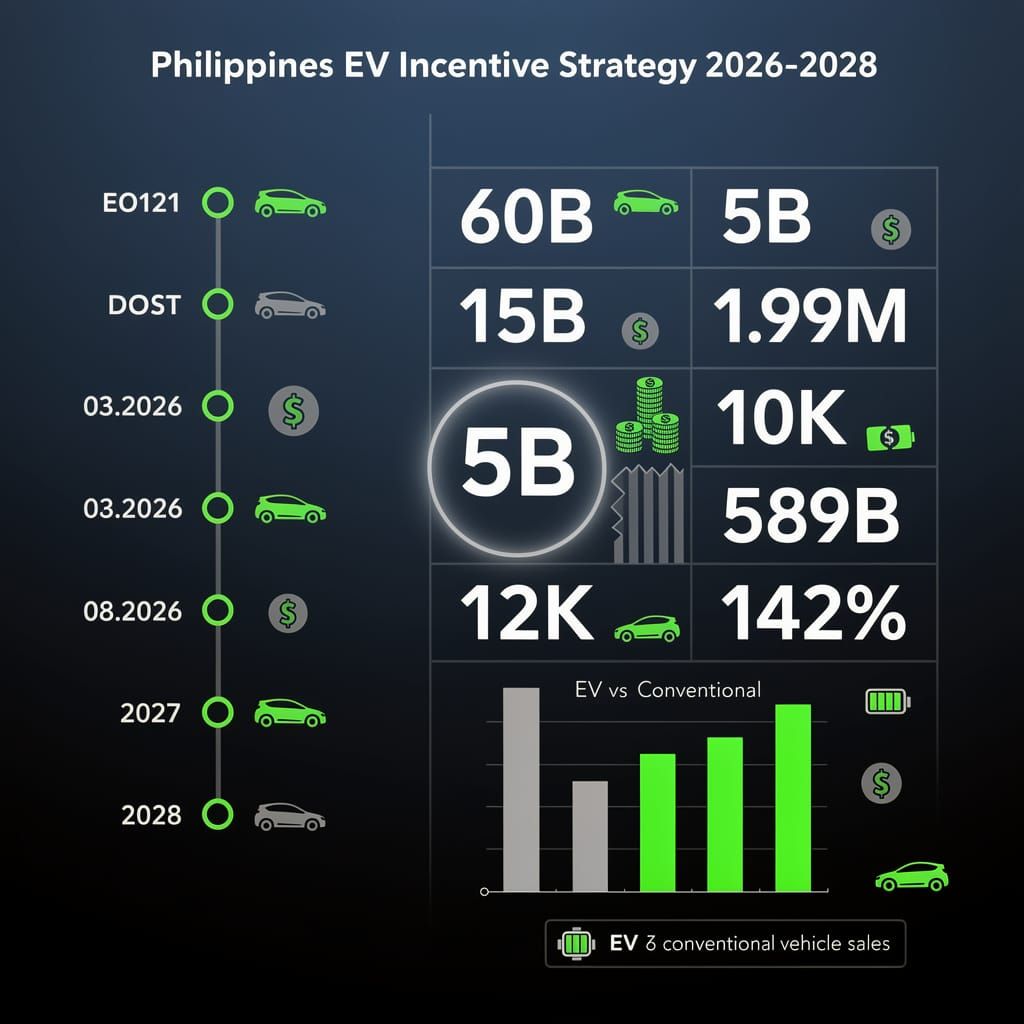
On July 30, 2026, President Ferdinand Marcos Jr. signed Executive Order 121, establishing the Electric Vehicle Incentive Strategy (EVIS) with a ₱60-billion fiscal support ceiling. The program offers up to 40% state backing for battery EVs and 30% for hybrids, plus production bonuses—paid out as tax certificates, not cash. Target annual output: 10,000 units per qualifying manufacturer. By August 25, Marcos was touring MD Juan Enterprises in Caloocan—a shop that used a ₱1.99-million DOST grant to add powder-coating, boosting sales 15%.
Here is what the numbers actually show.
The Mechanics
The EVIS framework enables equity-funded auto plants by requiring a ₱5-billion minimum capital investment per EV model, with incentives capped at ₱15 billion per model. Mitsubishi Motors committed ₱7 billion to build a hybrid facility—a deliberate bet that Filipino consumers are less ready for full BEVs than regional peers, per Deloitte. The Department of Science and Technology launched a nationwide partnership on August 7, pushing technology transfer into local manufacturing lines via LGUs, private firms like Francisco Motors, and academic institutions at CSU's E-Mobility Hub. Three startups have already committed to scaling production.
MD Juan Enterprises sits at the center. It already produces e-tricycle parts and kits. The question is whether it can scale from a ₱1.99-million microgrant to the ₱5-billion minimum investment threshold without fresh capital injection.
The Causal Chain
Rising energy costs—aggravated by Middle East conflicts—are driving EV demand in a country that imports nearly all its petroleum. Every locally built e-jeepney reduces petrochemical import bills directly. The government projects job growth across assembly lines, battery packs, charging infrastructure, and maintenance. Philippine xEV sales reached 58,905 units in 2025—12% of the market, up 142.5% year-on-year—even as conventional sales dropped 11.4% in H1 2026. The global oil crisis accelerated that shift: Q2 2026 saw traditional ICE sales across Southeast Asia fall 11.4% while EVs exploded.
Lower oil deficits. Greener transit. That is the theory.
The Risks
| Factor | Signal |
|---|---|
| Capital gap | MD Juan got ₱1.99M. Minimum plant investment is ₱5B. Gap: ₱4.998 billion. |
| Consumer readiness | Deloitte data: Filipinos less BEV-ready than most of Southeast Asia; hybrids are the bridge. |
| Market contraction | Overall auto sales down 11.4% in H1 2026. EV shift assumes demand holds—risky if macroeconomic headwinds persist. |
| Execution | EVIS uses tax certificates, not cash; underperformance triggers penalties. Firms that miss quotas lose incentives. |
What to Watch
- 2026–2027: Mitsubishi hybrid plant construction. DOST links three more startups to university-developed EV prototypes. MD Juan either scales or stalls.
- Q1 2027: Land Bank financing partnerships explored. If MD Juan cannot access capital, the all-Filipino e-trike stays a prototype.
- 2028: If EVIS attracts 3–5 anchor manufacturers hitting the 10,000-unit threshold, regional e-jeepney production becomes viable beyond Metro Manila.
The Takeaway
The ₱60-billion framework signals serious intent. The ₱1.99-million microgrant highlights the gap between ambition and execution. Mitsubishi's ₱7 billion is real—and its hybrid-first strategy aligns with Deloitte's assessment that Filipinos need a bridge to full BEVs. xEV sales jumped 142.5% in 2025. Overall car sales fell 11.4% in H1 2026. The country has the raw demand—58,905 units last year alone—running on imported fuel. Whether it builds the supply chain fast enough depends on whether more Mitsubishi-sized checks arrive before the political momentum—and the tax certificates—expire.

Comments ()