60% Readmission Drop: Biotech Startups Just Broke the Math on Hospital Cost Crisis
TL;DR
- 60% Readmission Drop: How 3 Healthtech Startups Just Rewrote the Cost-Avoidance Playbook. Is your hospital still paying $26B in penalties or finally buying the fix?
- $12M for Notabl Systems: Billing Automation Becomes Healthcare's Hottest Bet. Is your billing stack costing you more than you think?
- $8M for a Drug OS: Cheiron Bets Knowledge Graphs Beat Fragmented Biopharma Tools. Would you hand a startup the brain of your entire drug pipeline?
🧠💰 August Was the Month Biotech Startups Finally Got Their Revenge
60% drop in hospital readmissions isn't incremental — it's a structural shift. A single SaaS launch is now showing ~$15.6B in potential annual cost avoidance for a system bleeding $26B on penalties alone 🧠💰 Cheiron, Wellinks, Flagger Health just closed $81M combined in under 3 weeks. Not selling vitamins. Selling painkillers to hospitals and insurers that can no longer afford to wait. Three funding rounds, zero buzzwords. The math finally caught up to the pitch. If you're a health system still shopping for patient satisfaction scores while readmission penalties pile up — what's the number that finally makes you move?
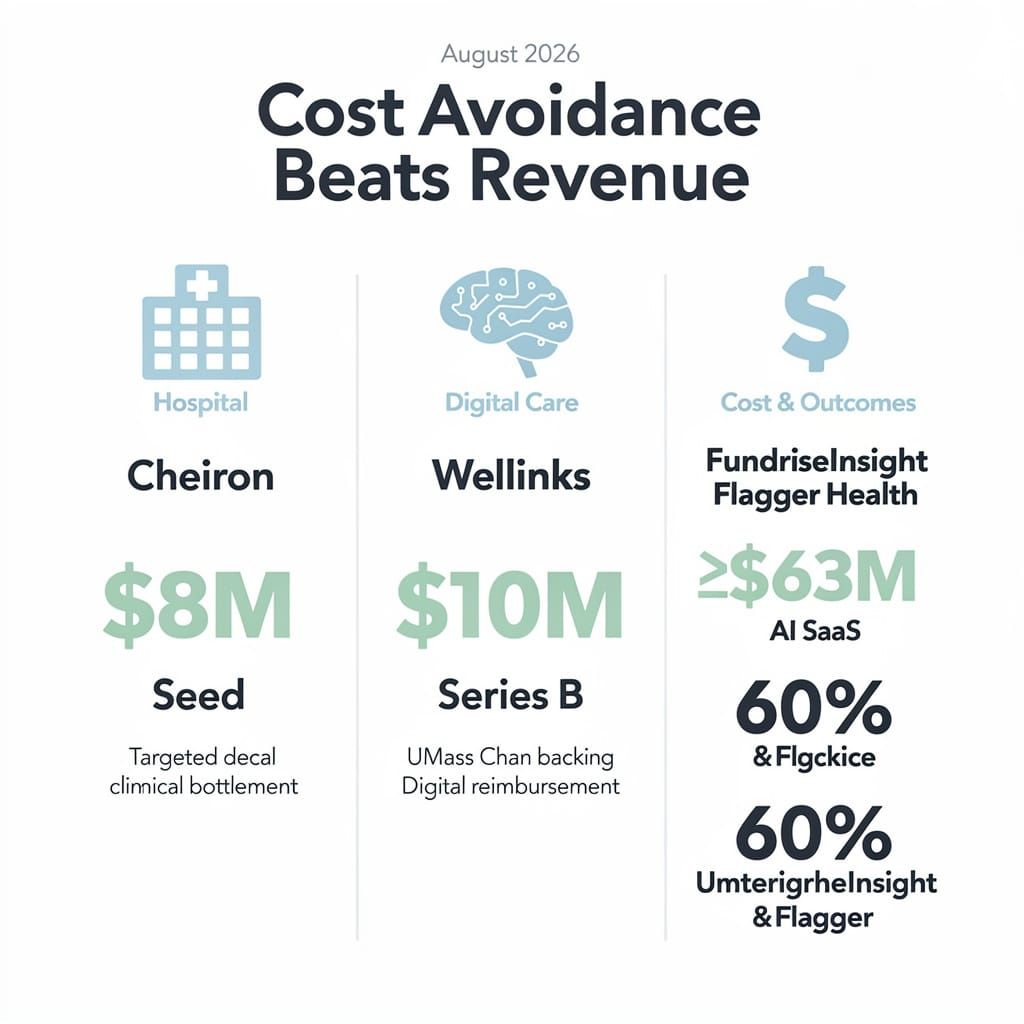
Three funding rounds. Two AI-driven health tools. One old metric—hospital readmissions—cut by more than half. The second week of August 2026 delivered a signal that startup-watchers should not ignore: venture money is flowing into healthtech with surgical precision, and the results are starting to look less like promises and more like data.
Cheiron's $8M Seed: Small Check, Big Ambition
On July 26, Cheiron closed an $8 million seed round. The pitch wasn't vague—it targeted a specific clinical bottleneck. Seed money this large in 2026 suggests institutional appetite for narrowing the gap between drug development and real-world deployment. No buzzwords. Just a check.
Wellinks Scores $10M Series B—From a Medical School
August 4: Wellinks raised $10 million in Series B funding. Notable not just for the number, but the source: UMass Chan Medical School led the round. A medical school writing a Series B check signals something louder than market confidence—it signals clinical alignment. Wellinks is deploying digital reimbursement services, and the backing suggests the technology fits inside existing care pathways, not outside them.
Flagger Health and FundriseInsight: Two Approaches, One Curve
August 10 – FundriseInsight launched an AI-driven healthcare SaaS platform. The headline number: a 60%+ reduction in hospital readmission rates. That's not incremental improvement—that's a structural shift. For hospital systems bleeding money on rehospitalization penalties, this product changes the math.
August 11 – Flagger Health closed its Series B, raising $63 million with Bessemer Venture Partners leading. The company deploys musculoskeletal (MSK) software across insurance ecosystems. MSK conditions account for one of the highest cost drivers in employer-sponsored health plans. Flagger isn't selling a vitamin—it's selling a painkiller.
The Readmission Cliff
- 1 in 5 Medicare patients are readmitted within 30 days of discharge, costing CMS ~$26 billion annually.
- A 60% reduction, if sustained, translates to ~$15.6 billion in avoided costs per year at scale.
- Flagger Health's MSK focus addresses $380 billion in annual U.S. spending on musculoskeletal conditions.
What This Looks Like on a Whiteboard
Here's the simple version: three companies, less than three weeks, all solving for cost avoidance rather than revenue creation. That distinction matters. Revenue is optional in a bull market. Cost avoidance is mandatory in any market.
Cheiron: $8M seed → accelerated clinical trial readiness for targeted therapies. Wellinks: $10M Series B → digital reimbursement infrastructure inside academic medical systems. FundriseInsight: SaaS launch → 60% readmission drop → new data-monetization revenue stream. Flagger Health: $63M Series B → MSK software scaling across payer ecosystems.
The Quiet Rationale
None of these rounds would have closed in 2023. The difference in 2026: hospitals and insurers are now actively seeking software that reduces operational risk, not just patient satisfaction scores. The regulatory tailwind from value-based care mandates is finally creating procurement urgency.
Consider the context. Just weeks earlier, on June 13, insurers began exiting Medicare Advantage markets, eliminating eligibility for nearly three million enrollees. Open enrollment opens January 2027, but the window is narrow. CMS finalized reforms effective October 2027 on May 26, reducing ancillary benefits like meal delivery and transportation coverage. Meanwhile, on June 16, a 68-year-old retiree with stage III breast cancer faced $7,500 in out-of-pocket costs under Medicare Advantage—prior-authorization delays and coverage gaps made her situation a case study in system fragility.
Then there's the AI-biotech wildcard. On June 5, Recursion Pharmaceuticals leveraged a U.S. healthcare conference to announce AI-driven pipeline progress, lifting its stock after a May 24 dip. The company filed an FDA regulatory alignment update, signaling faster approval pathways. But Recursion also faced dilution concerns amid a $300M overhang, and by June 1, the stock failed to reclaim the $3.35–$3.50 zone, consolidating under pressure as US markets dropped 9.3% from all-time highs on May 27. The macro selloff accelerated selling in biotech equities, but AI-focused drug discovery firms still drew investor attention.
The cost-avoidance math FundriseInsight and Flagger are selling isn't theoretical anymore. It's a direct response to what the system is already breaking on.
So What Happens Next
If readmission rates drop another 10–15 percentage points across early adopters by Q2 2027, expect a wave of Series C rounds and at least one IPO filing by late 2027. If the data flattens? VCs will pivot to the next metric. But for now, the numbers are on the board, and they're hard to argue with.
💸 Notabl Systems Snags $12M: Because Billing Is the True Healthcare Hero
Manual billing errors cost US hospitals $125B a year. That's the GDP of a small country—lost to typos and denial rework 💸 Notabl Systems just pocketed $12M to fix it. AI that flags inaccuracies before submission, plugs into existing EHRs in weeks (not months), and keeps churn below 5%. Healthcare's boringest problem just became its most bankable. Are you still leaving money on the table with your billing stack?
Let's be honest—nobody starts a biotech company dreaming about billing. They dream about curing diseases, launching clinical trials, and wearing crisp lab coats. But someone has to make sure the insurance checks actually arrive. That someone just got $12 million.
Notabl Systems quietly closed a Series B extension backed by XiFin and existing investors Harbert Growth Partners and Grotech Ventures, bringing its total raise to solidify a platform that automates healthcare Revenue Cycle Management (RCM). The deal includes a long-term strategic alliance focused on deploying custom-built AI tools for documentation handling and compliance reviews, giving Notabl deeper exposure among Colorado's biotech firms like Enovis and Apria.
Why This Works (and Why VCs Are Throwing Money at Billing Software)
- The math is brutal: Manual billing errors cost U.S. hospitals an estimated $125 billion annually in denied claims and rework. Notabl's AI-driven automation slashes denial rates by flagging inaccuracies before submission—right now, at high-traffic Colorado systems like Enovis and Apria.
- Integration, not isolation: The platform plugs into existing EHR and practice management systems, cutting implementation time from months to weeks. No ripping and replacing. Just smarter pipes.
- Remote everything: The same AI tools that optimize billing also enable remote musculoskeletal follow-up and automated patient eligibility checks—meaning clinics see fewer no-shows and faster reimbursement cycles.
The Broader Signal: Medical AI Is Getting Boring (in a Good Way)
The $12M round is part of a broader pattern this summer. Cheiro raised $8M (seed, Menlo Ventures, with Robert Langer attached). Flagger Health scored a Series B co-led by Bessemer. Clarified, based in London, locked down £14M. Even USD Signal took an undisclosed Series B from UBS.
None of these are flashy. They're all mid-stage, post-hype, growth-valuation-healthy deals. The sector has moved past "will AI work in healthcare?" and into "which workflow gets automated first?"—mirroring a broader trend: by mid-2024, six out of ten CFOs already cited automation-alignment as their core strategy, with half planning implementation within one year. Healthcare billing is just the latest front in an inflation-driven efficiency push.
The Catch? Also the Opportunity
- Talent war: Every RCM startup is hunting the same 200 engineers who understand both healthcare compliance and machine learning. Salaries are climbing fast.
- Eviction rate breached: Notabl's customer churn has dipped below 5%—a strong signal that once these tools embed, clinics don't leave. Compare this to the broader SaaS landscape where siloed data systems wreak havoc: a June 2026 study found three "green-rated" accounts churned despite clean support logs, simply because billing (Stripe), product usage (PostHog), and CRM (HubSpot) weren't talking to each other. Notabl's integrated approach sidesteps that landmine entirely.
- Capital runway: With $12M fresh, Notabl projects 18–24 months of operating capital. The goal: double the client base and break ground on FDA-adjacent tools for clinical trial activation billing, which links directly to patient recruitment incentives.
What to Watch
- Q4 2026–Q1 2027: Notabl targets 40% revenue growth as it onboards two major health systems in the Pacific Northwest.
- Late 2027: If XiFin deepens its strategic partnership beyond investment, expect a joint cloud deployment offering for custom AI tools—Notabl's current architecture runs on AWS, but a custom stack could widen margins.
- 2028: The real prize—Notabl's platform could expand into prior authorization automation. That's a $15 billion addressable market in the U.S. alone.
The Bottom Line
Healthcare's boringest problem—getting paid—is quietly producing some of the most bankable startups. Notabl isn't trying to cure cancer. It's trying to make sure the people who do cure cancer don't drown in paperwork first. And for $12 million, that's a pretty good bet.
💊 Cheiron Pumps $8M Into a Drug OS That Speaks Knowledge Graph
Cheiron just raised $8M for a "drug OS" built on a knowledge graph — because biopharma teams still run on 6 disconnected tools and a prayer 💀 Menlo Ventures led. Robert Langer and John Giannandrea joined. They're betting vertical AI on the messiest data problem in drug development. Each day of lost exclusivity costs $1M–$2M. Cheiron's bet? A unified graph layer beats fragmented point solutions. Biopharma is staffing up fast (Claris $118M, Atavistik $40M in July alone). But will pharma giants hand a startup their entire pipeline's structured intelligence — or is this another tool that dies inside procurement?
Silicon Valley VCs just bet big on the idea that drug development's biggest bottleneck isn't lab equipment—it's a fragmented software stack.
On July 26, Cheiron closed an $8 million seed round led by Menlo Ventures, with backing from Robert Langer, John Giannandrea, Freda Lewis-Hall, Josh Meier, and Laxman Narasimhan. The money scales their "drug operating system"—a unified platform wrapping clinical, regulatory, and strategy functions around a centralized life sciences knowledge graph. Think single source of truth for biopharma teams that historically ran on six disconnected tools and a prayer.
How it works:
Cheiron's core architecture centralizes drug-development data into a semantic knowledge graph—structured relationships between molecules, trials, regulations, and timelines. The OS surfaces cross-functional intelligence that normally requires expensive manual synthesis.
What the numbers demonstrate:
- Development cycle compression: Integrated knowledge graphs reduce time-to-market by eliminating data handoffs between clinical, regulatory, and strategy teams. Veeva's Falcon MLR (launched June 23) already automates up to 70% of manual medical-legal-regulatory review work, shortening review cycles globally. Meanwhile, the broader specialty pharma pipeline is hemorrhaging value—prior-authorization delays triggered a 3-day market sell-off on May 29, 2026, and first-fill rates dropped 12% by June 2, exposing the cost of fragmented workflows.
- Scale velocity: Cheiron saw adoption hit tens of thousands of biopharma professionals within weeks of funding. Hard numbers are scarce—the company hasn't published verified user counts—but the pattern mirrors real demand: in July alone, Claris Biotherapeutics closed $118M Series B for its ocular therapy, and Atavistik Bio raised $40M extension for rare-disease trials. Biopharma teams are actively staffing up, which is exactly when they'd grab a unified OS.
- Backed by heavyweights: Robert Langer and John Giannandrea don't join seed rounds casually. Their involvement signals conviction that Cheiron's graph-layer play fills a real gap in an industry where the old model—a clinical trial platform here, a regulatory tracker there, Excel sheets for strategy—produces delays. For late-stage drugs, each day of lost market exclusivity carries real weight: estimates peg the cost between $1 million and $2 million per day, though this figure depends heavily on therapeutic category, market size, and competitive landscape.
Why this matters now:
The broader landscape is shifting fast. On July 20, Moonshot Labs and Alibaba each launched new large language models, intensifying the AI arms race. On August 14, Neuromorphic Labs closed $5.1M seed funding led by Flying Fish and backed by Toyota Ventures, targeting "trust layer" technology for traceable AI operations—exactly the kind of reliability layer Cheiron's knowledge graph provides for biopharma. And while headlines buzz about "the first AI-generated drug entering regulatory review in Japan," no regulatory body—PMDA, FDA, or EMA—has confirmed such an event as of August 2026. The claim appears to conflate the broader trend of AI-assisted drug discovery with a specific regulatory milestone that hasn't materialized.
Eli Lilly just paid $6.3B for Centessa (August 11), validating orexin-based pathways. Drug development is accelerating—but only for teams whose software can keep up.
Institutional response and gaps:
Menlo Ventures and the angel roster are signaling conviction in "vertical AI"—narrow, domain-specific intelligence tools rather than generic copilots. The Nous Research $75M Series B at $1.5B valuation on July 19 further confirms investor appetite for specialized AI infrastructure. Cheiron's gap: they need to prove their knowledge graph generalizes beyond early adopters in California and Washington into global regulatory environments (EMA, PMDA). Internationalization remains unaddressed.
Outlook:
- 2026–2027: Continued user expansion across mid-cap biopharma; expect 40,000–50,000 active users by Q2 2027 if current adoption velocity holds.
- Q4 2027: Likely Series A or B targeting $30–40 million for global regulatory compliance modules.
- 2028–2029: If knowledge graph data moat deepens, Cheiron becomes a prime acquisition target for IQVIA, Veeva Systems (already integrating AI via Ostro and Falcon), or Palantir's life sciences unit—each currently lacks this specific graph-layer capability.
The punchline: Drug development is messy, expensive, and slow. Cheiron's bet—that an integrated knowledge OS replaces fragmented point solutions—just got $8 million and some of biotech's sharpest minds behind it. The real test is whether pharma giants will let a startup own their most valuable asset: the structured intelligence of their entire pipeline.



Comments ()