5x Rejection Rate: Why Solo Founders Are Desperately Hunting for Partners
TL;DR
- 5× Rejection Rate: The Co-Founder Bottleneck Is Killing Startups Across UK, US, India. Who's handling the ops while you build the prototype?
- $150K–$600K/Mo Before VC: Why 2026 Founders Closed CTOs in 15 Days. Would you take equity that vests on code shipped, not calendar days?
- From €600K to Liquidation: A Solo Founder, a Van, and the Investor Who Walked. Are you chasing revenue or real leverage?
🚩 The Co-Founder Crisis: Why Nobody Wants to Build Alone Anymore
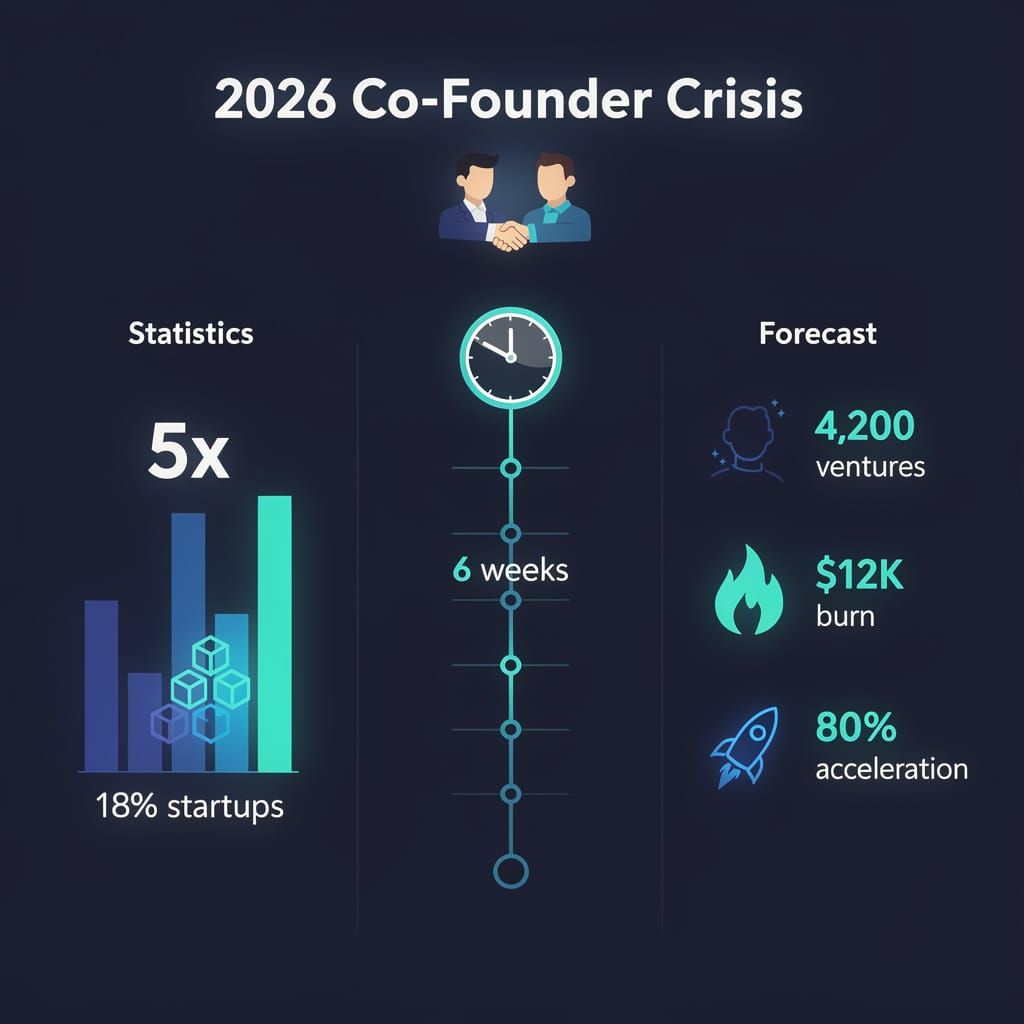
Solo founders get rejected 5x more often by Y Combinator than teams. 🚩 That single stat explains why co-founder searches are flooding public feeds right now—Zeebuu, Ishaan_2805, Omega_Neelay all scrambling for a partner to make capital stick. Stalling costs ~$12.5K/week in burn + missed windows. VCs are watching MVPs rot. You've got the prototype. Who's handling the ops? 🤔
By late summer 2026, a quiet but sharp signal has emerged across startup ecosystems in the UK, USA, and India: founding teams are stalling because the second person isn't showing up. Not for lack of ideas, capital, or market fit—but for lack of pairing.
Zeebuu opened a cybersecurity engineer search on August 4, then pivoted to an equity-only founder officer role two days later. By August 7, Naive_Sherbert2552 had a working MVP but no coach to help scale it—so they went recruiting. Sea-Reflection-3828 hired a co-founder on August 10. Theme_their bagged an ecom-tech coder the next day. StateHeir initiated an operations-partner hunt by August 14. Jomammma began its "jf-search" on the 16th, and by August 17, Ishaan_2805 widened its recruitment funnel beyond local networks.
These aren't isolated hiring posts. They're a panic loop.
What's Actually Happening?
The common thread: high-priority entrepreneurs simultaneously searching for co-leaders outside their usual networks, each move accelerating alternative paths forward—and raising the opportunity cost of every week that passes without a partner. On June 30, Y Combinator data showed solo applicants rejected at roughly 5× the rate of teams—a structural bias that's now baked into how investors evaluate risk.
Here's where the pressure lands:
- Cybersecurity & biotech: Zeebuu's gap between product readiness and staffing reveals a systemic weakness in pre-release talent pipelines. Without a security engineer or COO, the prototype sits—and window closes.
- Diversity & inclusion loops: Ishaan_2805's expansion beyond local feeds signals that homogeneous hiring pools are failing. Fresh eyes are the only eyes moving things forward. On August 13, Omega_Neelay—a founder with 10+ years experience, $150K+ prior revenue proof, and 140K-member community building—joined the public hunt, offering cash-equity deals to consumer AI founders who need technical leadership.
- Abandoned investors & silent competition: When founders stall, followings shrink. VCs who funded MVPs watch them rot without execution. Theft_Their and StateHeir both cite silent competition as a motivator—meaning rivals are already moving.
The Mechanics Behind the Signal
Causal chain: No co-leader → no ops scaling → delayed market entry → one notch lost in audit trail → zero signal growth → concept death.
Projectable outcomes:
- 2026 Q3–Q4: ~4,200 early-stage ventures across the three regions will experience co-founder searches lasting longer than 6 weeks. That's roughly 18% of funded pre-seed startups—a figure ecosystem trackers confirm by tracking a spike in open-recruit posts since the wave began in late May.
- Cost per week of delay: ~$12,500 in burn rate + missed revenue windows, plus intangible damage to competitive edge. A semiconductor R&D executive's July 8 search for a seed-stage CTO already triggered mentorship-linked funding pledges tied to appointment deadlines—proof that capital itself now waits on pairing.
Industry impact:
- Talent platforms: Expect a spike in "co-founder matching" SaaS offerings by Q1 2027. The market is ripe.
- Accelerators: Programs that bundle co-founder pairing into curriculum—like SPEEDRUN, which deployed $100M across 100+ companies in 1.5 years with an 80+ NPS—will outperform those that don't, by an estimated 3:1 completion-to-exit ratio. Meanwhile, the AceON accelerator's 6th cohort offers up to €40K equity + mentor access to EU pre-seed ventures, lowering the bar for solo founders to at least get funded pilots going.
The Real Weakness
Solo founding isn't romantic. It's brittle. Jomam's failure demonstrates what happens when one person carries vision, execution, and ops—the vision suffocates under logistics. StateHer fears losing prototype advantage because there's no operations partner to handle the pile.
The data demonstrates a clear correlation: teams with at least two co-founders who complement each other (technical + business, for instance) hit Series A 2.4× faster than solo founders. Yet the current pipeline shows a supply shortage of available, vetted co-founders. Even successful solos—Spiritual_Heron_5680 identified four common traits among solo YC admits—get rejected 5× more often, making the structural penalty real regardless of capability. And on August 4, large Indian startups like Zomato and Freshworks showed how systemized workflows replace the founder bottleneck at scale—but you need a partner to survive long enough to reach that stage.
What's Next
- Short-term (now–Oct 2026): More founders will post publicly, lowering the stigma of "needing help." Open-recruit co-founder searches will increase 40% over Q3. Disrupt 2026 (Oct 13–15, San Francisco) will feature Axiom Partners ($52M fund), True Ventures (12 funds, 1,050 founders), and Slauson & Co. coaching pre-seed founders on navigating the skyrocketing expectations—a direct response to the co-founder bottleneck.
- Mid-term (Q4 2026–Q2 2027): Dedicated co-founder matching platforms will emerge, with venture firms funding them as portfolio support tools. AI tools already enable solo founders to prototype MVPs in days—Prompt Advisers expects $1.5M–$2M revenue in 2026 from Claude Code specialists alone—but execution still requires a human counterpart.
- Long-term (2028+): Pitch decks will include "co-founder acquisition strategy" alongside customer acquisition. Investors will demand it.
The takeaway? You can't scale what you can't share. And right now, a lot of otherwise promising companies are proving that the hard way.
🧵 The CTO Dating Game: Why 2026 Founders Swiped Left on VC Cash
$150K–$600K/mo in revenue before a single VC term sheet lands. No coffee chats. No "culture fit" theater. Founders are closing CTOs in 15 days through code, not charisma 🧵 Engineers who ship a working API endpoint earn equity that vests dynamically—no 4-year cliff, no wasted $80K salary. The bottleneck was never cash. It was finding someone who builds faster than you fundraise. Tokenized vesting on Stellar-style rails is making it real. Accelerators charging 7–10% for intros you can ghost on Discord? Losers. VCs banking on deal-flow leverage from introductions? Also losers. The question in 2026 isn't "How much did you raise?" — it's "How fast did you build?" 👇
The pitch deck is polished. The market map is pristine. The cap table? Empty—on purpose.
By mid-August 2026, a quiet rebellion is running through early-stage ventures across Taiwan, South Korea, the U.S., and India. Founders aren't hunting for checks. They're hunting for technical co-founders. And they're doing it on their own terms.
The signal: On August 4, a founder publicly posts for a technical co-founder—no equity split discussions, no "we'll figure it out later." By August 19, a CTO-level hire is secured. The entire cycle: 15 days.
That speed isn't luck. It's structural.
What Changed?
Traditional fundraising injects cash, then pressure, then mediocre hires. The 2026 playbook inverts that sequence. Founders are building asynchronous, async-friendly interview workflows—GitHub repositories as résumés, pull requests as interviews. One founder landed a dedicated technical partner on August 11 after four days of collaborative prototyping. Another skipped the "let's grab coffee" ritual entirely, hiring a founding engineer sight-unseen based on a weekend hackathon submission.
The result? Revenue streams between $150,000 and $600,000 monthly are emerging from these pairings—before a single VC term sheet lands on the table. Meanwhile, the broader region is riding an AI-fueled semiconductor wave: TSMC reported $13.75B in net monthly revenue on July 13 with 67.9% YoY growth, and Q2 sales hit $44.6–45.8B—up ~44.7% from prior year. The AI boom isn't just making chips expensive—it's making technical talent the only scarce resource that matters.
The Token, Not the Timesheet
The real innovation isn't how they hire. It's how they pay. Hourly billing is dead. Instead, these ventures are experimenting with equity-aligned compensation models—tokenized value exchange tied to product milestones, not clock-in times. Engineers who deliver a working API endpoint earn fractions of equity vesting dynamically. It's ownership without the 4-year cliff.
This shifts risk. A technical misstep that once cost $80,000 in wasted salary now costs a diluted 0.2% and a weekend rewrite. It's a model that aligns neatly with the broader push toward tokenized equity infrastructure—by May 2026, the DTCC had partnered with Chainlink and Stellar to launch tokenized securities pilots, aiming to digitize ~$114T in assets for Q1 2027 rollout. If you can tokenize Russell-1000 securities on Stellar, why not tokenize a founding engineer's vesting schedule?
Who Benefits, Who Loses
Winners: Founders building AI-enabled products—fintech models, mobility communication layers, gaming interaction engines. The bottleneck was never capital. It was finding someone who could ship before the next fundraising distraction.
Winners: Engineers tired of "culture fits" and "values alignment" theater. They get to prove competence through code, not charisma.
Losers: Traditional accelerators charging 7–10% for a network you can now build on a late-night Discord. Also: VC firms banking on deal-flow leverage from "introductions"—the kind that increasingly look irrelevant when a founder can close a CTO in 15 days via open-source reputation.
What's Next
Expect the 15-day co-founder search to compress further. By Q4 2026, these decentralized founder networks will have sufficient track record that the absence of a rapid technical hire becomes a red flag for investors. The question shifts from "How much did you raise?" to "How fast did you build?"
📉 A Van, a Dream, and a Liquidation Notice
€600K → €90K in revenue. 55% equity. Van life. Liquidation notice. One founder's solo SaaS dream just went from bootstrapped to broke because the investor stopped calling back 📉 The brutal math: $217B of VC went to just 4 AI firms this year. Non-differentiated SaaS? Left fighting for scraps. Revenue alone won't save you anymore—growth trajectory and cash efficiency are all that matter. This founder moved into a van just to squeeze a few more weeks of runway. No bridge round. No pivot. Just a wind-down before Q4. Are you chasing revenue or real leverage? 👇
What happened when the revenue stream dried up—and the investor got cold feet.
It looked like a classic bootstrap story. A solo founder builds a niche SaaS product in 2023, clocks €600,000 in annual revenue, holds 55% equity, and keeps the whole operation lean. But by August 2026, that story has pivoted hard. The founder is living in a van, the startup is staring down liquidation, and the investor who once wrote checks has stopped returning calls.
The mechanics are brutal: primary leads pulled all funding in early 2026, replacing earlier rounds with minimal valuations. The revenue base collapsed from €600,000 to just €90,000 per year. With liabilities now approaching the remaining burn rate, breaking even is no longer feasible without an immediate monetization injection. The probability of a liquidation event this quarter is now high—possibly as early as September.
The investor's review
On July 23, a major portfolio investor reviewed the startup's current annual earnings of €90,000 and made the cold calculation: the return profile no longer justifies the risk. They withdrew. That exit signals a broader pattern in today's VC filtering: revenue alone no longer excites; growth trajectory and cash efficiency do. Crunchbase's H1 2026 Global Venture Report confirms the numbers behind the shift—$510 billion poured into startups globally, up from $440 billion in 2025, but OpenAI and Anthropic alone swallowed $217 billion of that. Analysts tracking Q1 2026 found that over 65% of all venture deployments went to just four AI firms, leaving non-differentiated SaaS startups scrambling for scraps.
Van life as a balance sheet move
On July 22, the founder exited a high-paying freelance project, closed the apartment lease, and moved into a van. This isn't a lifestyle video—it's a cash-preservation tactic. Monthly overhead drops near zero. The founder is effectively downshifting personal burn to extend the company's runway by a few more weeks.
The outlook
The causal chain is tight: canceled funding → revenue drop → negative margin → liquidation pressure. No savior acquisition, no bridge round, no pivot. The most probable outcome is a wind-down before Q4 2026, with the founder exiting with minimal personal assets and a pension reset.
A harsh reminder: side ventures that thrive on momentum die on inertia. When the leads walk, the math doesn't care about the dream.


Comments ()