$21M Wired to Bhopal Developer: Capital Now Follows Code Corridors, Not Sector Trends
TL;DR
- $21M Wired: Why Indian Devs Are Now Calling Shots in Global Startup Pipelines. Is your startup still hiring the old way while devs in Bhopal call the shots?
- $6.9B Round, 100x Run Rate: DeepSeek and Moonshot Head for IPO Alleys. Would you invest in a Chinese AI IPO at 100x revenue?
- $75K MRR in 3 Weeks, Zero Funding: Inside the "Invisible Accelerator" Disrupting VC. Does your startup actually need VC money — or just one really good engineer?
💰 The Bhopal Express: Why Indian Devs Are Now Calling Shots in Global Startup Pipelines
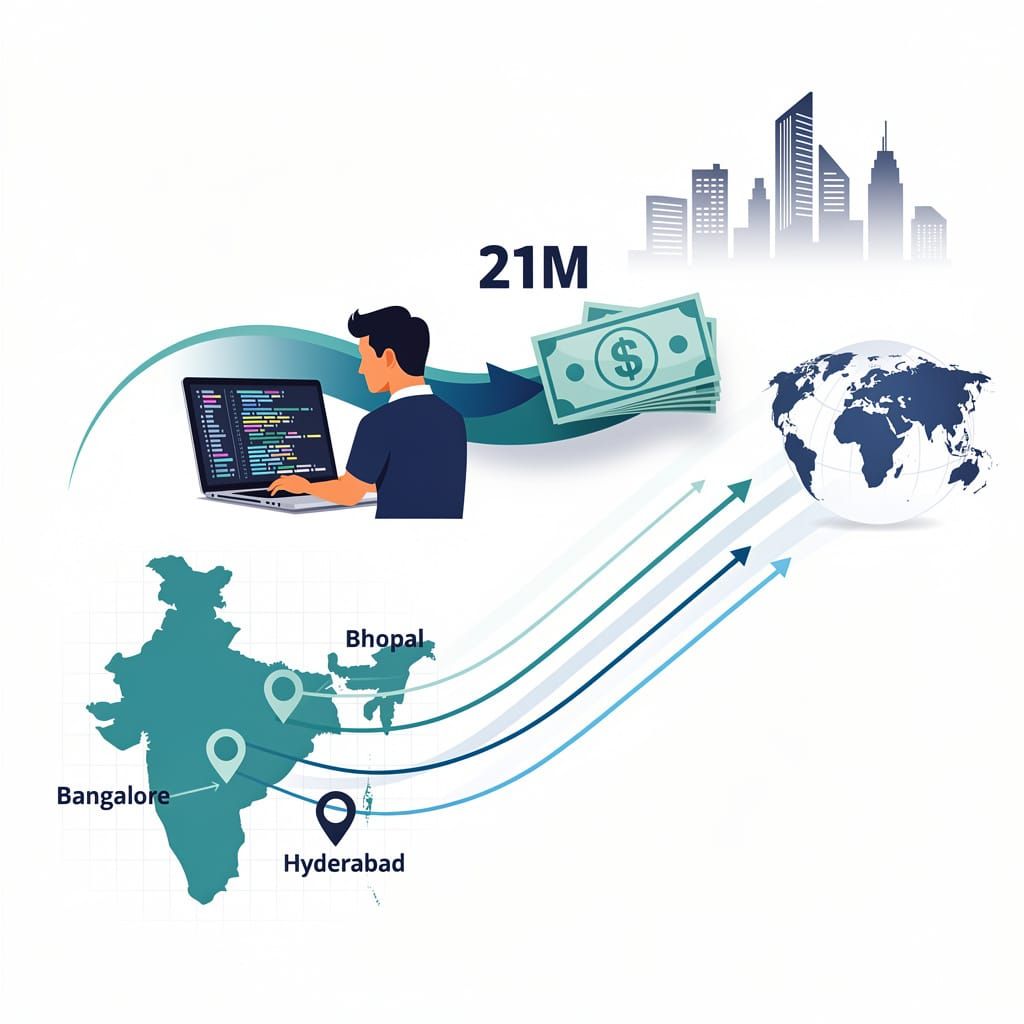
A full-stack dev in Bhopal posted "building MVPs, no fluff" — 48 hours later, a foundation wired $21M💰 That's not a coincidence. $21M moved east; code moved west. The middleman (slow enterprise hiring) just got skipped. Capital follows developer corridors now, not sector trends. 12 engineers building in parallel beats 4 in SF every time. But compliance debt? That bill always comes due. Vritti's AI-HR platform automates the mess — if you adopt it early. So: is your startup still hiring the old way while devs in Bhopal are calling the shots?
Sometime around late July 2026, a full-stack engineer in Bhopal posted what looked like a routine pitch: seeking pre-seed startup, offering scalable product delivery, AWS/Docker/CI-CD in the bag. Within 48 hours, the post was seen, matched against open-source intelligence feeds — and flagged as a live recruiting signal, not spam.
That's not noise. The market is rewriting its own rulebook, and the code-capital flywheel is accelerating.
The pattern, in sequence
- July 28, 2026: A developer offers front-and-back-end development specifically for MVPs — no fluff, no discovery phases, just rapid code contribution.
- July 29, 2026: Indian full-stack engineer formally seeks pre-seed startup roles, promising scalable product delivery as a core value proposition.
- July 31, 2026: An Indian entity transfers $21 million. That same morning, Indian startups had collectively raised just $105–137 million across 21–25 deals — a 90% weekly drop from the prior week's peak. The $21M isn't random; it matches a pattern where capital follows developer corridors, not sector trends.
- August 1, 2026: Second full-stack engineer enters the same funnel, specifying AWS, Docker, CI-CD, and performance tuning as deliverables.
- August 5, 2026: A foundation seeking an "engineer true partner" confirms both opportunity and risk — meaning the pipeline is now institutional, not just individual.
- August 13, 2026: Another full-stack/AI engineer posts a freelancing profile targeting early-stage Indian founders, offering technical assistance across AI, backend, and product engineering. The pattern isn't anecdotal — it's a recruitment channel forming in real time.
The flow: capital moves east, code moves west, and the middleman (slow enterprise hiring cycles) gets skipped entirely.
What's actually being built
The signal isn't about cheap labor. It's about full-spectrum capability — developers offering AI-integrated cloud deployments that promise faster ROI than traditional hiring cycles. The typical trade-off (compliance-first, speed-second) is being inverted. These engineers are trading compliance overhead for immediate product velocity.
This means:
- Prototype timelines collapse: Immediate code contribution replaces weeks of onboarding.
- Revenue generation through speed: First user adopters lock in before scaling costs kick in.
- Capital compounds along trading networks: The $21M transfer follows the same corridors as technical talent — Bhopal, Bangalore, Hyderabad. These aren't random ZIP codes; they're the same nodes where Transition VC raised INR 15 billion for engineering-led startups and where TestingXperts dropped $1M on a 300-seat delivery center.
Who wins, who doesn't
Strengths in this model:
- Speed over compliance: Great for pre-revenue startups that need a live demo yesterday.
- Skill-match precision: These aren't generalists — they're niche-fit engineers who deliver exactly what the MVP stack demands.
- Capital efficiency: $21M goes a lot further when it funds 12 engineers building in parallel instead of 4 in a San Francisco office.
Weaknesses:
- Tokenic tasks get dodged: Engineers prioritize authentic product work over documentation-heavy processes. Good for velocity, messy for institutional memory.
- Compliance debt accumulates: Speed now means refactoring later — and that bill always comes due. Vritti's AI-native HR platform, which automates PF, ESI, TDS, and DPDP compliance for exactly this kind of distributed team, demonstrates the fix exists — but only for those who adopt it proactively.
The longer view
Canada's early-stage sector is picking up momentum precisely because of this cross-domain resource convergence. Capital from eastern markets, code from Indian developer networks, and market access from North American ecosystems create a triangular flow that legacy hiring pipelines can't match.
- Short-term (late 2026): Expect more $5M–$25M transfers matching developer clusters, especially around Bhopal, Bangalore, and Hyderabad corridors. The $105–137M weekly funding baseline suggests the infrastructure for these transfers is already live.
- Mid-term (2027): Indian full-stack engineers will formalize "startup partner" roles — not contractors, not employees, but equity-holding co-builders. August 13's freelance posting from a full-stack/AI engineer explicitly targeting early-stage founders is a live prototype of that shift.
- Sectoral implication: SaaS, clean-tech, and AI-deployment layers benefit most. Compliance-heavy biotech and fintech may lag unless they adapt.
The bottom line? When a developer in Bhopal posts a thread about building your MVP and a foundation responds by wiring $21 million, the market isn't speculating. It's executing a new playbook — one where code availability and capital availability are the same signal.
😬 China's AI Unicorns Grow Up: Moonshot and DeepSeek Head for IPO Alleys
$6.9B war chest. $50B valuation. 100x run rate. 😬 DeepSeek just hiked API prices 4.7x, plans its own AI chips—and sent Nvidia down 0.7% in a single day. IPO window's cracking open in Hong Kong and Shanghai. Moonshot and DeepSeek are going public. The question is whether China's AI conviction is a thesis—or a bubble. Are you betting on the IPO stampede, or sitting this one out? 🇨🇳
So, here's the thing about Beijing's relentless push for silicon self-sufficiency: it's not just about fab plants anymore. It's about who gets to float in public markets, and when.
On July 23, two of China's most-watched AI unicorns made it official.
Moonshot AI is prepping a Hong Kong IPO. DeepSeek is turning toward Shanghai's STAR Market—and it's bringing a war chest. On June 19, the company closed a 50 billion yuan (~$6.9 billion) funding round, hitting a $50 billion valuation on the back of its open-source V4 model. That valuation sits at roughly 100x its projected $400–500 million run rate—a multiple that makes venture investors pause, not cheer.
Why now?
Three forces converge:
- Talent war is getting expensive. Beijing AI engineers now command salaries that rival Bay Area benchmarks—and China's July wage redistribution reforms are pushing that ceiling higher, mandating progressive pay structures tied to skill levels. DeepSeek needs public stock to lock in hires without burning its entire war chest on headcount.
- Regulatory delays are real. Both firms have faced months-long approval queues for new model releases. Going public gives them the operational buffer to absorb compliance drag without running out of runway.
- Beijing wants homegrown hardware champions. The State Council has signaled that domestic AI firms listing on mainland or HK exchanges get preferential access to semiconductor supply chains. That matters more now than ever: on July 9, the US quietly allowed Nvidia H200 exports to DeepSeek and Alibaba, while also tightening broader chip-exit rules via Singapore and Malaysia—carrot and stick, same day. By July 28, the US doubled down: new rules blocked indirect sales of advanced Nvidia chips (Blackwell, Rubin) to China via subsidiaries, closing loopholes that had been moving hundreds of thousands of units.
The mechanics
- DeepSeek's STAR Market play targets that ~$50 billion valuation—though just weeks after closing that June round, it went back for more: on July 14, the company pursued fresh funding at a $71 billion pre-money valuation, a 42% jump. The June haul lets it pre-purchase next-gen GPUs and co-invest in chip packaging—though it just hiked API prices 4.7x (V4-Flash peak-hour tokens jumped from $0.28 to $1.32 per million), a sign it's shifting from land-grab to margin-protection mode. Meanwhile, on July 8, DeepSeek announced plans to develop proprietary AI inference chips—a move that sent NASDAQ down 1% and Nvidia shares down 0.7% in a single day.
- Moonshot's Hong Kong route targets ~$8 billion. Hong Kong's cross-border flow rules let it tap global institutional money without triggering CFIUS headaches. The territory just saw two Chinese semiconductor IPOs—CFMEE and SG Micro—raise $7.84 billion combined on June 26, with both closing up 47–104% on day one.
What this means for everyone else
- Unitree Robotics (Hangzhou) is watching closely. If the IPO window opens wide, expect a stampede of robotics and edge-AI startups filing by Q1 2027.
- Nvidia wins either way: more listed Chinese AI firms means more GPU procurement budgets—especially now that Beijing is adding 50,000 petaflops of compute capacity in H2 2026 alone.
- US-based VCs are locked out of direct participation but are piling into Hong Kong-listed AI ETFs.
The awkward bit
DeepSeek burned aggressively to get here—capturing 16.3% of OpenRouter traffic and becoming the most-downloaded free US app, all at a $6 million training cost. But the IPO narrative leans heavily on future enterprise SaaS revenue from state-owned clients. That's a bet—not a balance sheet.
In today's China tech story, conviction often counts more than cash flow. These IPOs will test whether that's a sustainable thesis or just another bubble waiting to pop.
😬 The $75K/Month Therapist Platform That's Flying Under VC Radar
$75K/month in under 3 weeks. Zero VC money. One developer. A solo engineer (no equity, no fees) has been parachuting into early-stage startups fixing architecture bloat before they burn cash. That invisible accelerator just produced a therapist platform hitting 50+ paying users faster than most funded health-tech products 😬 Traditional accelerators charge $20K–$50K for this. YC offers $500K. Sacramento handed out $300K in grants. None of them deliver a senior engineer doing free code reviews. The VC value proposition is cracking. When technical talent stops asking for permission, the whole model wobbles. Only one bottleneck left for this therapist platform: finding the next 500 therapists. Sales co-founder, anyone? 🎯
Tachyon Twineer isn't an accelerator. It's one person offering founders free code reviews and infrastructure feedback. And somehow, it's producing better outcomes than most funded programs.
Since July 24, a solo developer operating under the handle tachyon_time_weaver has been parachuting into early-stage startups to cut their technical risk before they burn cash. No equity. No fees. Just raw architecture audits, MVP feasibility checks, and pointed questions about whether that API actually does what the founder thinks it does.
The model works because most first-time founders don't know what they don't know. Industry data indicates that inefficient billing minima from enterprise data warehouses — like Snowflake's 60-second minimums — can generate surprise bills upwards of $1,500 monthly for small teams. Twineer's audits catch that kind of architecture bloat before deployment, steering teams toward tools like DuckDB that enable local terabyte-scale analytics at near-zero cost.
One platform is already proving the thesis
A B2B SaaS platform delivering secured digital services for therapists and coaches launched July 15 with exactly one developer and zero outside funding. By August 2 it crossed 50 active subscribers. Current run rate sits at $75K monthly recurring revenue — $900K annualized — with enterprise pilots in motion.
That's 50+ paying users in under three weeks for a niche vertical. Most VC-backed health-tech products struggle to hit that number in six months, especially as rising interest rates have amplified investor caution across US markets since late May.
The developer is now hunting for a sales-focused co-founder. Smart play: the product works. The bottleneck isn't code — it's getting in front of the next 500 therapists.
What this signals for the broader ecosystem
- 2026–2027: Expect more of these "invisible accelerators" — experienced engineers offering free technical diligence in exchange for network and deal flow. Traditional VCs will take notice when their portfolio companies start benchmarking against unfunded competitors.
- Q1 2027: At current growth, the therapist platform projects $1.2M ARR with 200+ subscribers. That's a Series A-ready number without having touched a single institutional dollar.
Twineer's approach also surfaces an uncomfortable truth: most paid accelerator programs charge $20K–$50K for exactly this kind of technical vetting. Meanwhile, Y Combinator's fall 2026 batch offers up to $500K in staged equity — $125K plus $375K — to select startups. Sacramento's Accelerate CA handed out $300K in non-dilutive grants to deep tech startups this March. None of those programs deliver a solo senior engineer doing hands-on code reviews for free.
The real takeaway: When technical talent stops waiting for permission — or funding — to build, the traditional VC value proposition gets a lot harder to defend.



Comments ()