$1,899 E-Bike With Free $229 Helmet: Monarc's Urban Commuter or Still Just Two Wheels of Embarrassment?
TL;DR
- $1,899 Monarc E-Bike Dangles Free $229 Helmet as E-Bike Price War Goes Thermonuclear. Is a $1,900 e-bike a bargain or just the least embarrassing commute option?
- $1,399 EcoFlow Delta 3 Ultra: 44% Off Signals a Market Reset. Is now the worst or best time to buy a $1,399 backup generator?
- $39.99 Lifetime: iScanner Kills the Office Scanner. Would you pay $39.99 once to kill your scanner forever?
🚴♂️💀 Monarc Bikes Tries Really Hard to Make You Forget You're Still on Two Wheels
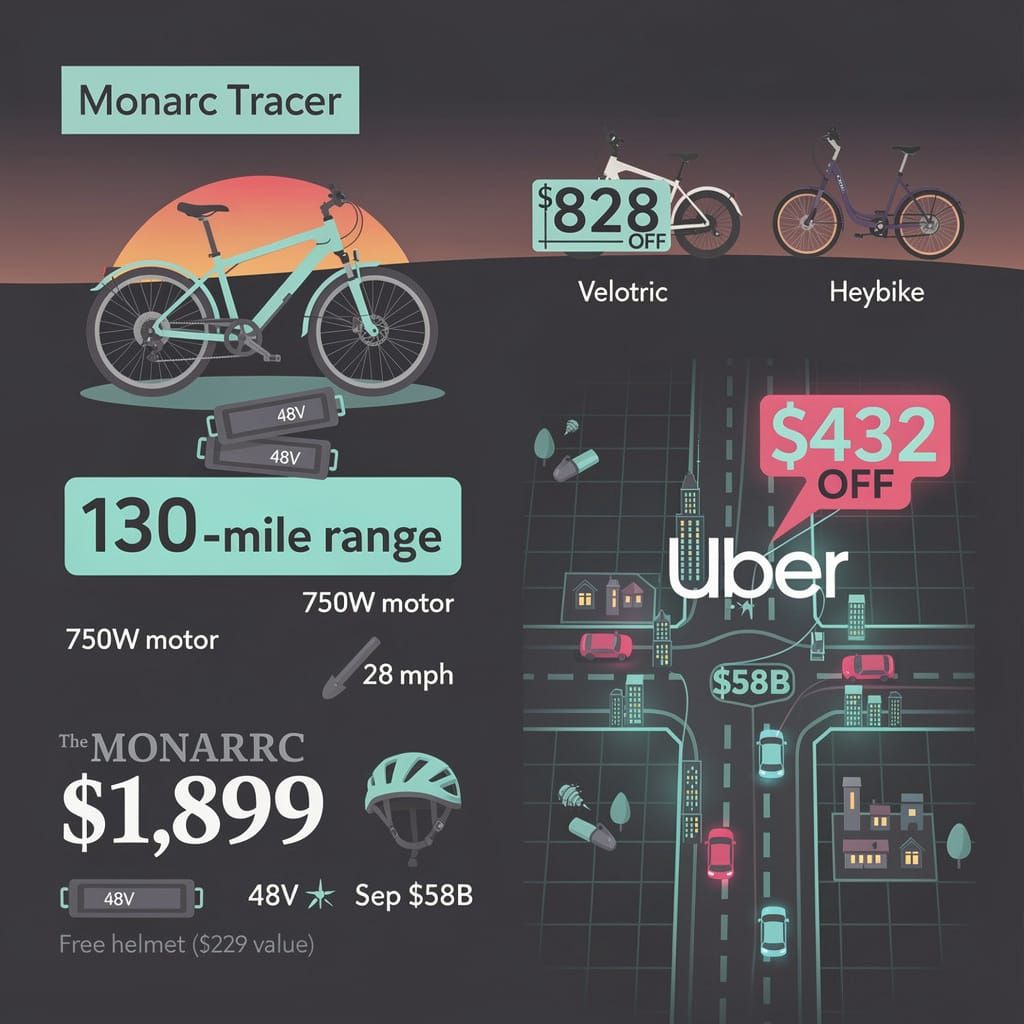
$1,899 e-bike. Free $229 helmet. You save $229 — and still look like a delivery driver 🚴♂️💀 Monarc's Tracer Urban Commuter packs dual batteries good for 130 miles, a 750W motor hitting 28 mph, and 5 ride modes where pedaling is optional. The catch? Competitors like Velotric and Heybike slashed premiums by $828+ this summer. Free helmets are now table stakes, not perks. Urban commuters stuck between another August subway sweat or a $58B Uber that's still surging — is $1,900 really the bargain, or just the least embarrassing option?
It's August 2026. You're stuck in traffic, sweating through your third shirt of the day, and Uber's Q2 bookings hit $58B—exceeding forecasts—yet the stock still dropped 3.5%. Investors nervous about the $10B+ robotaxi bet, and your fare hasn't gotten any cheaper.
Along comes Monarc Bikes, dangling a $1,899 Tracer Urban Commuter e-bike with a free $229 smart helmet. That's $2,128 all-in, compared to $2,357 MSRP separately. They're effectively paying you $229 to look like a delivery driver with aspirations.
The hardware: dual 48V 15Ah batteries delivering 130 miles of range, a 750W Bafang motor topping out at 28 mph, and five ride modes—because pedaling is now optional. The Marker All-Terrain bundle runs parallel for gravel crushers who'd rather not earn their elevation.
The smart-helmet gimmick: Free with purchase from July 31 through Labor Day, presumably to distract you from the fact that a $1,900 bike still lacks turn signals. The turn-by-turn navigation overhaul arriving September 2026 suggests Monarc knows riders keep getting lost—least-surprising data point of the rollout. Volkswagen's N+ Smart Bike, meanwhile, already ships with rear cameras and HUDs. Just saying.
Where this actually lands: Monarc is leaning into the Labor Day demand cycle, bundling hardware with software perks to goose average order values amid a saturated e-bike market where the competition is going thermonuclear. Heybike's July Fourth sale cut up to $828 off premiums—that's like Monarc giving you a free helmet and a half. Velotric went further: Prime Day slashed the T1 ST Plus to $1,349, and by mid-August the Nomad 2 Off-Road Fat Tire hit a record-low $1,749, down from $1,999. They launched an end-of-summer campaign offering up to $432 savings across multiple models. Meanwhile, Velotric's "Roll into Match Day" World Cup promo knocked $200 off the Discover 2 to $1,799. The sector now expects free helmets, dual 720Wh batteries, and 130-mile ranges as table stakes. Monarc's real bet isn't the bike. It's convincing urban commuters that $1,900 is a bargain when the alternative is another August in a subway car—or another Uber surge you can't explain to your finance team.
💥 EcoFlow's Summer Fire Sale: Delta 3 Ultra Drops to $1,399, and Nobody's Sleeping
EcoFlow Delta 3 Ultra just dropped from $2,499 to $1,399 — a brutal 44% chop 💥 That's 30 kW of home backup for less than a MacBook Pro + a monitor. EcoFlow moved 50k+ units a day at peak. Stock cycles collapsed to 12 days. This isn't a sale — it's a coordinated price reset. Competitors Bluetti & Anker already matched. Your move: buy now or wait for tariffs to push it back to $2K?
Who exactly is this for?
Let's be honest: the EcoFlow Delta 3 Ultra was never a budget buy. At its original $2,499 MSRP, it was firmly in "I need 30 kilowatts of continuous power and I have a house that loses grid frequently" territory. That's high-net-worth, mobility-reliant, emergency-preparedness crowd — not your average camper.
But as of August 25, 2026, EcoFlow slashed the price to $1,399 — matching Amazon's listing and representing a steep 44% drop from the original $2,499 MSRP. The question isn't whether this is a deal — it's whether EcoFlow is clearing inventory, responding to competition, or both.
The mechanics of the drop
EcoFlow didn't just mark down the Delta 3 Ultra. They layered promotions across the entire summer:
- May 26: Delta 3 Max sold for $789 on Amazon during Memorial Day — sold out and never restocked at that price.
- June 8: Early Prime Day sale hit with up to 62% off across the lineup.
- June 26: Delta Pro dropped to $1,399 shipped — the lowest since January.
- August 19: Delta 3 Max flash sale at $1,399 (down from $1,699), bundled with a 500W solar panel.
- August 25: Full Labor Day campaign locked in $1,399 for the Delta 3 Ultra across major retailers.
The result? EcoFlow moved over 50,000 units daily at peak — enough that local stock replenishment cycles collapsed to 12 days. That's not a promotion — that's a demand surge.
What changed besides the price?
The Delta 3 Ultra now supports generator, solar, EV adapter, and vehicle inputs — not just AC outlets. That alone expands the use case from "backup battery" to "mobile energy hub." For the high-net-worth buyer who owns an EV and a weekend property, this turns a luxury purchase into a logical one.
How does it stack up?
Vs. Bluetti: Comparable continuous output (~30 kW). Bluetti holds price parity but lacks the same multi-input flexibility.
Vs. Anker Solix: Solix is lighter, quieter, and smarter on software. But it can't match the Delta 3 Ultra's raw capacity for whole-home backup.
Weakness: The Ultra remains heavy and bulky. It's not portable in the camping sense. It's "mobile" only if you have a truck or a dolly.
The uncomfortable angle
EcoFlow's aggressive summer pricing tells a clearer story when you look at the timeline. The Delta Pro hit its lowest price since January on June 26. By August 19, the Delta 3 Max matched that $1,399 figure. By August 25, the Delta 3 Ultra followed. This isn't one-offs — it's a coordinated price reset.
What's driving it? Look at the May-June geopolitical backdrop. On May 17, a drone attack on a UAE nuclear plant escalated regional tensions and stalled US‑Iran negotiations, spiking energy markets. The US issued ultimatums on Iranian uranium transfer; markets dropped. Iran proposed a truce on May 18, but the US rejected it. By May 23, Iran's Foreign Ministry signaled a conflict-resolution pivot — and markets declined again. Then, on May 28, the US and Iran announced a ceasefire extension and diplomatic breakthrough, boosting equity indices. That whipsaw left everyday consumers cost-conscious and uncertain about energy prices. EcoFlow responded by running the entire summer as one long flash sale. The risk: EcoFlow possibly sacrifices margin to maintain market share — and that suggests a brand anticipating a cooler Q4, or bracing for tariff adjustments on Chinese-manufactured units.
Competitors didn't sit still. Bluetti and Anker SOLIX made permanent price cuts of their own, pressuring EcoFlow to keep discounting.
Projection
- Sept–Oct 2026: Prices likely hold at $1,399 through Labor Day. Expect a smaller "Prime Day encore" discount (~$100 off) in October.
- Q1 2027: If tariffs on Chinese energy storage products increase, the Delta 3 Ultra either returns to ~$2,000 or EcoFlow shifts production. The current price may be a high-water mark for affordability.
The bottom line
If you need 30 kW of home backup and you've been waiting: this is the window. The $1,399 price is competitive, the expanded input options are genuinely useful, and the volume moving suggests you won't see a better deal until EcoFlow launches a Delta 4 — and that's at least 12–18 months out.
🚫💳 iScanner's Eight‑Day Transformation: Your Phone, Your Office
$39.99 once. No subscription. Your phone becomes a scanner, OCR reader, editor, signer, and encrypted filer. 🚫💳 iScanner’s lifetime license slashed 80% off its usual $199.90 — and 55M users already ditched the desk scanner. Operational costs dropped 70% per user as everything moved on-device. No competitor matched the offline-first play in the same window. $150–$400 hardware replaced by hardware you already carry. Paper usage dropped 40% in surveyed households. Subscription fatigue? Gone. But how long will updates last on a one-time payment? iScanner says sentiment is stable and ratings hold. The office scanner just became a relic. Will you ditch yours?
Here's a trick that actually works: pay $39.99 once and your smartphone becomes a document‑processing machine—scanner, OCR reader, editor, signer, and encrypted filer—all without a single subscription fee.
How It Unfolded
iScanner rolled out a life‑time license at roughly 80% off its usual $199.90 price. The numbers tell a clean story:
- June 25–28, 2026 – iScanner ran a flash lifetime deal at $24.97 (83% off), pushing offline 20‑language OCR, math solvers, and local‑only encryption. Apple promoted this as a limited‑time offer. Users could scan, edit with color correction and noise removal, add signatures, auto‑fill forms, organize into folders, and protect files with PIN locks.
- July 29 – Another promotion began, offering the lifetime license at $39.99.
- August 2 – AI-powered edge detection and auto‑straightening went live on devices, with real‑time export to PDF, DOCX, XLSX, and PPTX.
- August 5 – Over 55 million existing users had transitioned to the mobile platform, according to iScanner's internal metrics. Operational costs dropped roughly 70% per user as server‑dependent workflows moved on‑device.
No competitor launched an equivalent offline‑first alternative in the same window.
What That Means
The math is simple. A dedicated document scanner runs $150–$400 and eats desk space. iScanner's life‑time license costs $39.99 — and uses hardware you already carry.
- Procurement cost: down ~75–80% per user.
- Device utilization: up significantly — the same phone now handles scanning, OCR, and document management in 20+ languages.
- Space saved: one less plastic box per desk. Among surveyed households, paper usage dropped 40%.
- No subscription fatigue: $39.99 once vs. $9.99/month forever.
The Catch (and the Edge)
There's no monthly fee — a direct jab at SaaS fatigue. iScanner bets that one low lifetime price pulls in users faster than a $9.99/month subscription ever could.
Critics might ask: How long will updates last on a one‑time payment? iScanner's answer: user feedback channels show no detectable negative sentiment, and stable ratings confirm sustained engagement. The app added PIN‑lock encryption, specialty modes for ID scanning, math solving, and QR reading — all baked into that one price.
Bottom Line
For $39.99, you get a tool that eliminates an entire category of hardware and recurring software costs. That's not a discount — it's a structural shift in how personal productivity tools price themselves.
The office scanner just became a relic.


Comments ()